
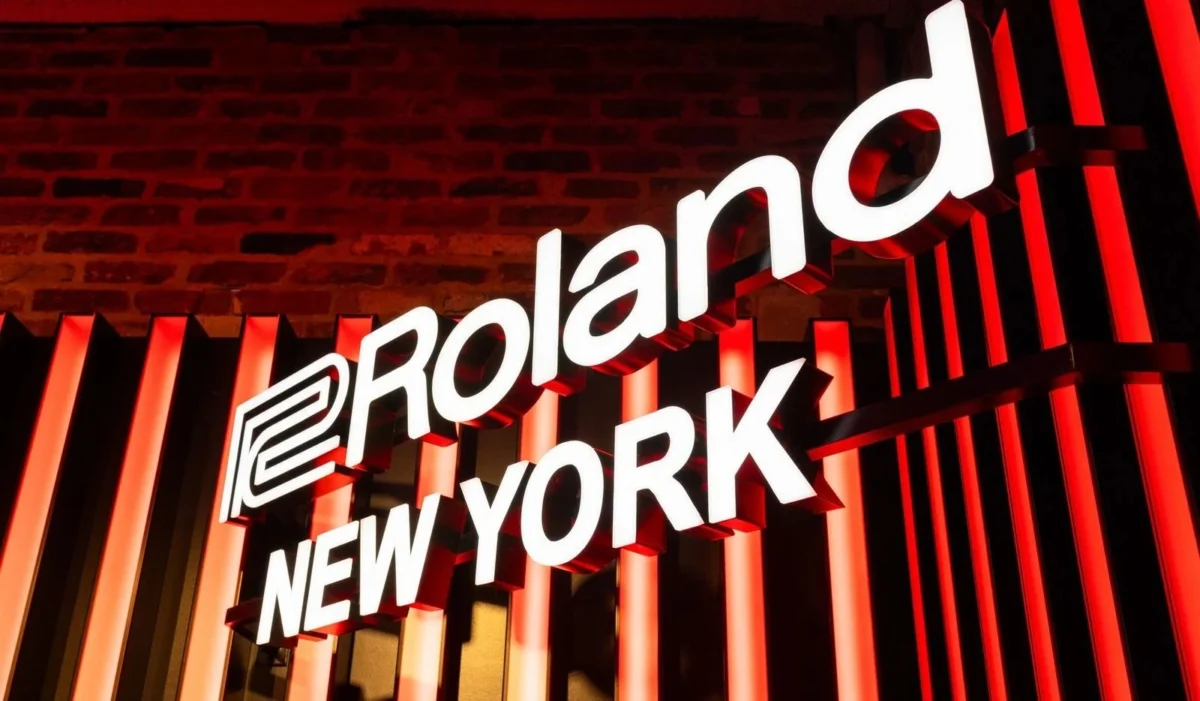
In a strategic expansion of its global retail footprint, Roland Corporation has officially unveiled its first standalone flagship store in the United States. Located at 414 West 14th Street in the historic Meatpacking District of Manhattan, the 9,000-square-foot facility serves as a physical manifestation of the company’s evolution over the last half-century. The opening, scheduled for early October 2026, consolidates the Roland, BOSS, and Drum Workshop (DW) brands into a single, high-tech creative environment, marking a significant pivot for the manufacturer as it transitions from a traditional wholesale model to a direct-to-consumer experiential retail strategy.
This retail debut is not merely a store opening; it represents the latest milestone in Roland’s "Then. Now. Next." campaign. The initiative serves as a ten-year retrospective and forward-looking celebration of the company’s landmark 2016 "The Future. Redefined." livestream, which fundamentally altered how musical instrument manufacturers engaged with global audiences. By establishing a permanent home in one of the world’s most influential cultural and musical hubs, Roland is positioning itself at the epicenter of the North American creative economy.
A Legacy of Innovation: From 1972 to 2026
To understand the gravity of the New York City opening, one must look at the historical trajectory of the Roland Corporation. Founded in 1972, the company spent the following five decades establishing itself as a pillar of modern music production. From the TR-808 Rhythm Composer—which arguably defined the sound of hip-hop, techno, and electro—to the V-Drums series and the AIRA range, Roland’s technology has remained a constant in professional recording studios and live venues globally.
The chronology of this expansion includes several key phases:

- 1972-1980s: Roland establishes its reputation through analog synthesis and early rhythm machines.
- 2016: The "The Future. Redefined." campaign marks a digital shift, showcasing 30 instruments in a 24-hour global broadcast.
- 2022-2024: Strategic acquisitions, most notably the integration of Drum Workshop (DW), expand the company’s reach into premium acoustic and electronic percussion.
- 2026: The opening of the New York City flagship store, signaling a commitment to high-touch, immersive physical retail environments.
Architecture of Creativity: The 9,000-Square-Foot Experience
The choice of the Meatpacking District is deliberate. Surrounded by Chelsea Market and a dense network of recording studios, media companies, and performance venues, the 414 West 14th Street location is optimized for accessibility. The facility is split into dedicated zones that cater to specific segments of the music-making community.
The showroom floor features distinct areas for pianos, guitars, synthesizers, and electronic percussion. Notably, the store hosts the only dedicated DW showroom in the United States, providing a focused environment for percussionists to explore high-end acoustic drums and hardware. For guitarists, the "BOSS Cavern" provides a sound-isolated, hands-on environment to test the brand’s extensive range of pedals and amplifiers.
Technological integration is a cornerstone of the store’s design. The environment is managed by "Roland Soundscapes," an AI-driven ambient music system that utilizes real-time data inputs—including foot traffic, time of day, and meteorological conditions—to generate a perpetually shifting sound environment. This ensures that the acoustic signature of the retail space is never static, mirroring the improvisational nature of the music created on the products sold within.
Strategic Objectives and Industry Implications
The retail shift is part of a broader industry trend where legacy manufacturers are bypassing traditional middle-market retailers to control the brand narrative. By operating its own storefronts in London, Tokyo, and now New York, Roland creates a feedback loop with end-users. This direct access allows the company to collect qualitative data on user behavior, preferences, and pain points, which can then be fed back into the Research and Development cycle in Japan.
Masahiro Minowa, CEO and Representative Director of Roland Corporation, emphasized that the store is designed to be a bridge between the company’s storied past and its technological future. "New York has long been a place where new sounds, ideas, and creative movements take shape," Minowa stated. "This store gives us a new way to share that spirit with musicians and creators, while bringing our global retail experience to one of the world’s most important cultural centers."

Manuele Barbini, CEO of Roland Americas, echoed this sentiment, highlighting the pedagogical aspect of the new location. "We are excited to give musicians, producers, and creators in New York a space where they can explore the latest Roland, BOSS, and DW innovations, connect with our team, and be part of a new creative hub for the city."
Data-Driven Engagement and Consumer Education
A primary challenge in the musical instrument industry is the "barrier to entry" for beginners. To combat this, the New York flagship places a heavy emphasis on education. Every visitor has access to "Roland Concierges"—specialists tasked with guiding newcomers through the initial stages of musical creation.
The store offers a tiered educational structure:
- Guided Onboarding: 30-minute sessions for beginners to get hands-on with synthesizers or drum pads.
- Product Deep-Dives: One-to-one appointments for advanced users to explore professional workflows, such as integrating Roland Cloud software with hardware controllers.
- After-Sales Support: Complimentary training for new owners to ensure the longevity and effective use of their purchase.
This service-oriented model is intended to foster brand loyalty among a generation of "bedroom producers" who may be comfortable with software but intimidated by hardware integration. The introduction of the FP-40 Digital Piano—the company’s first piano with native Wi-Fi connectivity—exemplifies this trend, as the store uses the product to demonstrate the ease of modern digital music workflows.
The Future of Music Retail
The grand opening on October 10, 2026, serves as the final, public-facing component of the current campaign. By inviting industry leaders, artists, and media, Roland is framing this opening as a major cultural event. As the music industry continues to balance the rapid rise of AI-generated content with a resurgence of interest in tactile, hardware-based music making, Roland’s decision to invest in a massive physical space in Manhattan suggests a strong belief in the enduring value of the "hands-on" experience.

For the professional musician, the flagship offers a curated environment to test gear that is often unavailable in mass-market retail chains. For the casual enthusiast, it provides a low-pressure environment to engage with technology that has shaped the last 50 years of pop culture.
As urban retail landscapes continue to shift toward "experiential" destinations, Roland’s New York City store serves as a case study in how heritage brands can remain relevant. By blending the history of the TR-808 with the future of AI-powered soundscapes, the company is attempting to secure its place in the next generation of music production. Whether this physical retail strategy will lead to sustained growth remains to be seen, but the scale and ambition of the New York location underscore a commitment to maintaining a dominant position in the global musical instrument market. The store is open seven days a week from 11 A.M. to 7 P.M., inviting a new generation of creators to participate in the ongoing evolution of the Roland legacy.