
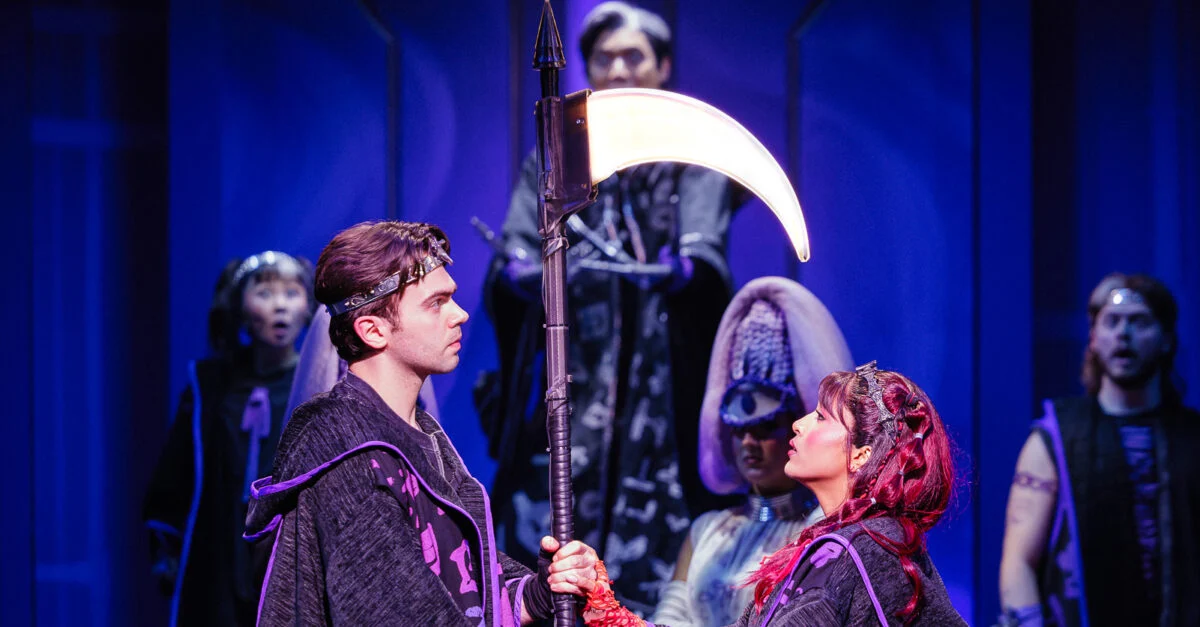
The landscape of contemporary musical theatre is undergoing a significant transformation as La Jolla Playhouse presents the world premiere of Grim, a bold new production that imagines the afterlife with a pop-infused sensibility. This ambitious project, currently captivating audiences in California, centers on a retirement-bound Grim Reaper and the complications that arise when his heir apparent develops a human connection. With a pedigree of talent that bridges the gap between Broadway excellence and the global pop charts, the production has quickly become a focal point of regional theatre, necessitating two extensions to accommodate overwhelming demand. As the show prepares for a potential future on the Great White Way, it represents a synthesis of modern musical storytelling, leveraging the expertise of industry veterans to explore themes of mortality and legacy through a contemporary lens.
A Narrative of Celestial Succession
At its core, Grim serves as a high-stakes family drama draped in supernatural aesthetics. The protagonist, a Grim Reaper who has spent the last 300,000 years dutifully managing the transition of souls, is finally preparing for a well-earned retirement. The weight of this transition falls upon his daughter, Diana, who must successfully complete a standardized test of aptitude to inherit her father’s formidable mantle. The narrative tension escalates when Diana encounters a human named Josh, a complication that threatens to disrupt the rigid, millennia-old structure of the afterlife.
The play functions as a subversion of classical tropes. By grounding the existential concept of death in the familiar dynamics of a family business and the unpredictability of romantic entanglement, the creative team has crafted a story that is both relatable and fantastical. This thematic duality has allowed the show to resonate with a broad demographic, moving beyond the niche appeal of supernatural fiction to address universal questions regarding duty, personal agency, and the inevitability of change.
The Creative Engine Behind the Production
The success of any new musical is tethered to the cohesion of its creative team, and Grim boasts a lineup of professionals who have significantly shaped the current theatrical and musical landscape. The production is spearheaded by director Sammi Cannold, whose previous work on How to Dance in Ohio demonstrated a profound ability to handle complex emotional narratives with nuance and sensitivity. Her direction of Grim maintains this standard, ensuring that the spectacle of the afterlife does not overshadow the human-centric arcs of the characters.
The auditory identity of the show is defined by an eclectic team of composers and lyricists. The music—a crucial component for a show eyeing a future on Broadway—features contributions from songwriters Petro AP, known for collaborations with Reneé Rapp and One Direction, and Scott Hoying, a founding member of the vocal phenomenon Pentatonix. This partnership suggests a score that is not only melodic but also rhythmically sophisticated, designed to appeal to audiences accustomed to high-production-value pop music. Complementing the score is the work of choreographer Andy Blankenbuehler. A three-time Tony Award winner whose work on Hamilton revolutionized the integration of movement into narrative, Blankenbuehler’s involvement indicates a high degree of precision in the show’s physical storytelling.
Chronology and Operational Success
The trajectory of Grim since its initial announcement has been marked by steady momentum. The La Jolla Playhouse, a venue renowned for fostering productions that eventually transfer to Broadway, provided the ideal incubator for the show. Since the start of its run, the production has faced intense public interest, a reality reflected in the scheduling of its extensions. Originally slated for a limited engagement, the show has been extended twice, with current performances scheduled to continue through December 13.
This extended run serves as a crucial data point for the producers, providing them with a wealth of information regarding audience demographics, pacing, and the effectiveness of specific musical numbers. In the ecosystem of theatrical development, such regional success is often the primary metric used to gauge viability for a larger, multi-city tour or a sustained Broadway run.
The Cast and Technical Infrastructure
The production features a robust ensemble cast, tasked with bringing a diverse range of characters to life. Paolo Montalban anchors the cast as the titular Grim, while Akshara Gunda and Mateo Lizcano handle the central romantic conflict as Diana and Josh. The inclusion of specialized roles such as Jennifer Fouché’s "Death of Love" underscores the allegorical nature of the script, where abstract human emotions and states of being are personified.
Behind the scenes, the technical requirements of a show featuring an ethereal afterlife are immense. Music supervisor and director Ted Arthur, orchestrator John Clancy, and arranger Cian McCarthy have constructed a soundscape that balances the weight of death with the levity of musical comedy. The visual department, led by scenic designer Jason Sherwood and costume designer Paloma Young, has created a world that feels both ancient and contemporary. Lighting designer Amanda Zieve and sound designer Connor Wang provide the atmospheric depth necessary to distinguish the "mortal" world from the "reaper" realm. The technical complexity is further supported by a professional team of stage managers and a casting department led by Benton Whitley and Peter Dunn, ensuring that every facet of the production maintains a professional, Broadway-adjacent standard.
Broader Implications and Industry Impact
The emergence of Grim reflects a broader shift in the theatrical industry. There is a growing appetite for original stories that do not rely on existing intellectual property—such as films or jukebox catalogues—to attract audiences. While the musical incorporates contemporary pop sensibilities, its narrative is an original creation. If Grim successfully makes the leap to Broadway, it would signal a victory for original musical development in an era where major houses are often risk-averse.
Furthermore, the involvement of artists from the pop-music world like Scott Hoying represents a trend of "crossover" creativity. As the lines between streaming music and live theatrical performance blur, the use of pop-chart-topping songwriters is becoming a strategic move to capture younger audiences. This approach is not merely about commercial viability; it is an evolution of the musical theatre language, incorporating modern production techniques that have become standard in the recording industry.
Fact-Based Analysis of the "Grim" Model
An analysis of the production reveals a highly calculated effort to balance artistic ambition with commercial viability. The "test of succession" plot device allows the show to introduce world-building elements gradually, avoiding the "info-dumping" that often plagues high-concept musicals. By utilizing a "simple test" as the primary conflict, the script maintains a clear, linear objective for the audience to follow, which is vital for pacing in a two-act structure.
Additionally, the casting of a wide ensemble, including multiple swings and understudies, indicates a production designed for longevity. The high volume of personnel involved suggests that the creative team is preparing for a rigorous schedule, potentially anticipating a long-term residency or a national tour. The logistical infrastructure—from the casting of the swings to the wig, hair, and makeup design—demonstrates a level of foresight typically reserved for established productions.
Conclusion: The Future of the Afterlife
As the run at La Jolla Playhouse continues toward its December 13 conclusion, the industry will be watching closely. The success of Grim is not merely a testament to its creative talent, but to the health of the regional theatre system in the United States. By providing a laboratory for new works to be tested, refined, and eventually polished for the commercial stage, the Playhouse continues to be a cornerstone of the theatrical economy.
Whether Grim achieves its goal of reaching a Broadway stage remains to be seen, but the elements for such a transition are clearly present. The production combines a compelling, high-concept narrative with a creative team that understands both the emotional requirements of theatre and the sonic demands of modern pop. As the Grim Reaper contemplates his retirement on stage, the theatre world is similarly looking toward the next generation of musical creators, and in the case of this production, the future appears to be both ambitious and rhythmically inclined. The production’s ability to sustain its run through multiple extensions serves as the strongest indicator that, in the theatre, death can indeed be a vibrant, singing, and highly entertaining affair.