
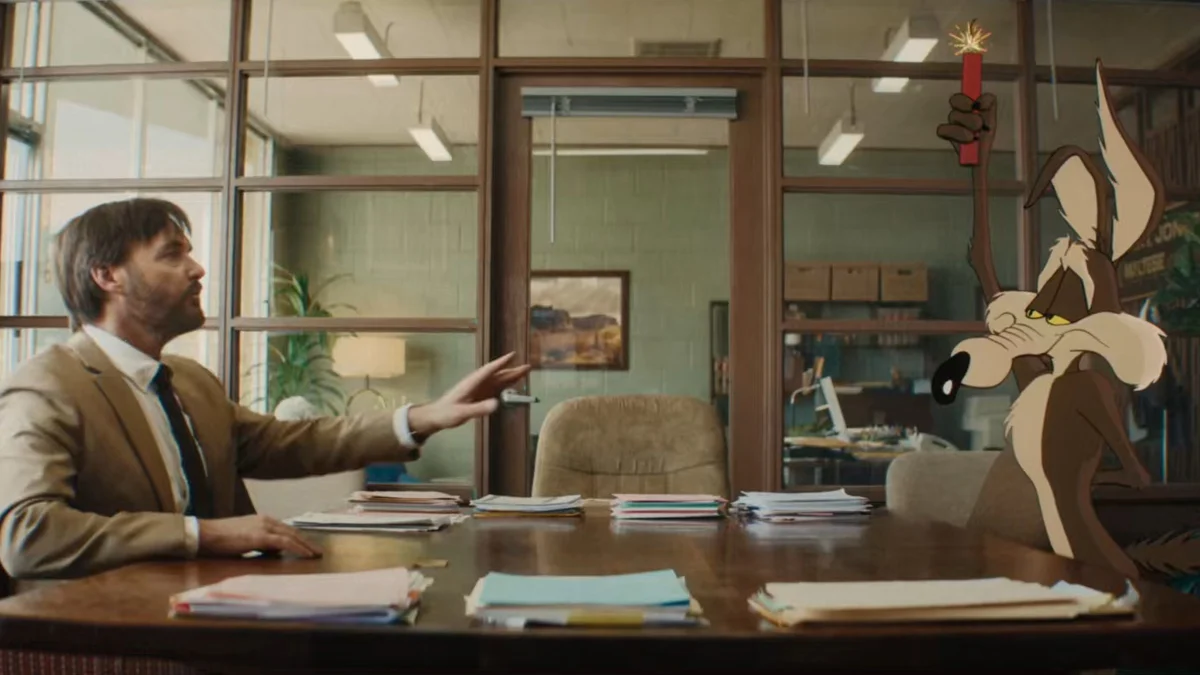
The journey of the hybrid live-action and animated feature film Coyote vs. Acme has taken one of the most remarkable turns in modern Hollywood history. Following a tumultuous development cycle, a controversial shelving decision by its original studio, a subsequent rescue effort, and a successful theatrical release managed by Ketchup Entertainment, the film has officially crossed a major industry milestone. Industry reports have confirmed that Coyote vs. Acme has been officially ruled eligible to submit for consideration in the Best Animated Feature category at the upcoming 20th Academy Awards.
This ruling marks a stunning vindication for the filmmakers, cast, and crew behind the project, as well as the legions of animation fans, industry professionals, and advocates who campaigned fiercely against the corporate write-down culture that nearly consigned the movie to permanent oblivion. Starring Will Forte, John Cena, and a slate of classic Looney Tunes characters led by Wile E. Coyote, the film now transitions from a cautionary tale of corporate restructuring to a legitimate contender on Hollywood’s biggest awards stage.
A Timeline of Turbulence: From Shelving to Salvation
To understand the magnitude of the Academy’s eligibility ruling, one must examine the unprecedented trajectory of Coyote vs. Acme. Directed by Dave Green and produced by a team including James Gunn, Eric Goldman, and Jeremy Slater, the film wrapped principal photography and completed its animation phase under the Warner Bros. Pictures Animation banner.
In November 2023, however, Warner Bros. Discovery made the shocking announcement that it was shelving the completed film entirely. The studio opted not to release the movie theatrically or via its streaming platforms, choosing instead to take a multi-million-dollar tax write-down, mirroring a controversial tactic it had previously deployed against other completed or near-completed projects like Batgirl and Scoob! Holiday Haunt.
The decision sparked immediate and unprecedented backlash from the creative community. Directors, writers, actors, and fans voiced outrage over the practice of burying completed works for financial maneuvering. Under intense pressure, Warner Bros. Discovery reversed its hardline stance just weeks later, granting the filmmakers permission to shop the completed project to other studios and distributors.
For months, the film’s fate hung in the balance as negotiations stalled and alternative buyers weighed the financial risks of acquiring a project that its original parent company had deemed commercially unviable. Finally, Ketchup Entertainment stepped forward in 2025, securing distribution rights and mapping out a rescue rollout that culminated in a theatrical run in mid-2026. The film’s subsequent critical reception and box office performance proved that the audience demand for Wile E. Coyote’s courtroom battle against the Acme Corporation was not just internet hyperbole, paving the way for its current status as an Academy Awards contender.
Navigating the Hybrid Landscape and Category Rules
The eligibility of Coyote vs. Acme in the Best Animated Feature category opens up familiar conversations regarding the classification of hybrid films. Because the movie blends live-action performances—anchored by Will Forte as Wile E. Coyote’s beleaguered human lawyer and John Cena as his former corporate boss—with traditional and computer-generated animation, critics and analysts initially questioned whether it would meet the strict criteria established by the Academy of Motion Picture Arts and Sciences.
However, precedent strongly favors the film’s inclusion. The Academy’s rules stipulate that a significant portion of the movie must be animated—typically requiring that a substantial majority of the major characters be animated figures and that animation constitutes a predominant method of storytelling.
This path was famously paved by 2022’s acclaimed stop-motion and live-action hybrid Marcel the Shell With Shoes On, which successfully competed for and secured a Best Animated Feature nomination. Other notable historical hybrids, such as Who Framed Roger Rabbit and Space Jam, navigated different eras of Academy voting, but the modern rules have become more accommodating to innovative cross-medium storytelling.
By meeting the technical thresholds set by the Academy’s shortlisting committees, Coyote vs. Acme joins a competitive and diverse field of contenders for the 2027 Oscars. Other anticipated entries in the Best Animated Feature race include Laika’s stop-motion fantasy epic Wildwood, Disney and Pixar’s Toy Story 5 and Hoppers, and Brad Bird’s ambitious independent project Ray Gunn.
Cast, Creative Vision, and Critical Reception
At its core, Coyote vs. Acme reimagines the classic cat-and-mouse (or rather, coyote-and-roadrunner) dynamic through the lens of a courtroom drama. The plot follows Wile E. Coyote as he decides to sue the Acme Corporation for years of defective products that invariably backfired, resulting in physical comedy, explosions, and endless frustration. He hires a down-on-his-luck human attorney, played by Will Forte, to represent him against the formidable legal team of the Acme corporation, headed by John Cena’s slick corporate executive character.
The creative team leaned heavily into the nostalgic yet subversive tone of the original Looney Tunes theatrical shorts, blending slapstick comedy with meta-narrative commentary. The integration of hand-drawn aesthetic principles with modern CGI ensured that the classic characters retained their timeless appeal while operating within a complex live-action environment.
When the film finally reached audiences through Ketchup Entertainment following its rescue, it was met with favorable reviews. Critics praised the film’s heart, sharp writing, and the comedic chemistry between Forte and Cena, as well as its faithful yet modern treatment of the beloved animated icons. The film’s commercial and critical survival transformed it into a symbol of resilience for artists operating within an increasingly corporate and risk-averse studio system.
Industry Implications and Future Precedents
The Academy’s confirmation that Coyote vs. Acme is eligible for the Best Animated Feature Oscar carries profound implications for the broader entertainment industry. The decision serves as a subtle validation of independent film acquisition models, proving that projects abandoned or cast aside by major media conglomerates can still find a path to high-level artistic recognition.
Furthermore, the ruling may influence how studios approach write-down practices moving forward. When Warner Bros. Discovery initially shelved the movie, industry experts warned that a dangerous precedent was being set where hundreds of millions of dollars in creative labor could be legally and permanently suppressed for tax purposes. The successful rescue, distribution, and subsequent awards consideration of Coyote vs. Acme demonstrate that completed artistic works retain their cultural and industrial value, even when corporate leadership attempts to discard them.
As the voting season approaches, industry analysts will be watching closely to see if Academy members embrace the film not only as a statement against corporate shelving practices, but on its own merits as a work of cinematic art. Regardless of whether Coyote vs. Acme secures an official nomination or goes on to win the category, its mere presence on the eligibility ballot represents a historic victory for creative perseverance.
For fans eager to revisit the courtroom battle or experience the rescued film for the first time, Coyote vs. Acme has been made available for pre-order on 4K Ultra HD via major retailers ahead of its home media release. Meanwhile, the creative team behind the picture continues to celebrate a milestone that few believed possible when the project was languishing in a studio vault just a few short years ago.