America just got better by one person as legendary singer-songwriter Joni Mitchell officially attained United States citizenship, closing a remarkable personal and artistic migration that spanned more than half a century.
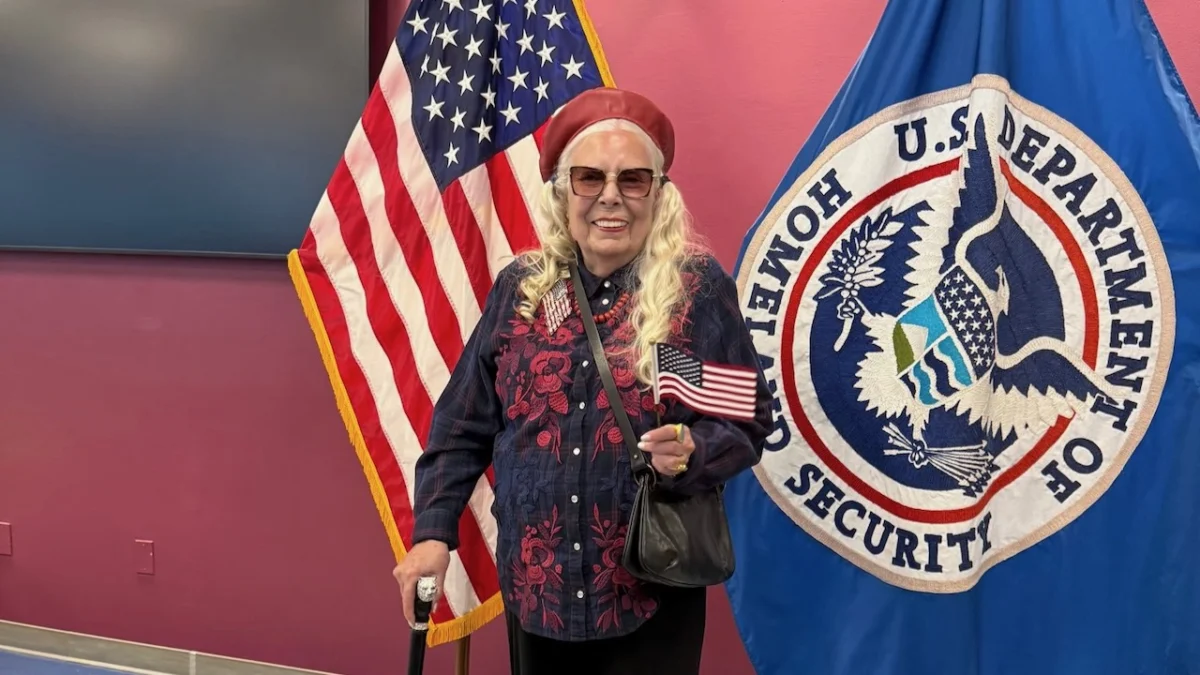
The iconic musician shared the milestone through a social media update, describing the bureaucratic finalization of her citizenship as the culmination of “a journey that began 62 years ago.” Accompanying the announcement was a short, celebratory video capturing the moment her name was called at a Department of Homeland Security office. Surrounded by roughly two dozen other individuals undergoing the same naturalization process, Mitchell was greeted with enthusiastic cheers and warm applause. The post also featured a photograph of the newly minted U.S. citizen smiling proudly in front of an American flag while holding a small ceremonial banner.
This long-awaited legal transition represents a profound personal milestone for the Alberta-born artist, though her embrace of American civic life comes with characteristic complexity. Mitchell’s decision to formally integrate into the American electorate arrives during a politically charged era and notably follows public critiques of the nation’s political leadership. Despite making the U.S. her primary residence for over six decades, her recent path to the ballot box highlights a renewed desire for direct political participation.
Chronology of a Transnational Life and Career
Born Roberta Joan Anderson in Fort Macleod, Alberta, Canada, in November 1943, Mitchell developed an early passion for the arts and music while battling polio during her childhood. Her migration southward began in the mid-1960s, a pivotal era defined by the burgeoning North American folk revival. Accompanied by her then-husband, Chuck Mitchell, she crossed the border into the United States, initially settling in Detroit, Michigan. In the motor city, the young couple immersed themselves in the local coffeehouse and folk music circuit, honing the distinct lyrical and acoustic sensibilities that would soon captivate the cultural mainstream.
By the late 1960s, Mitchell’s trajectory led her to Los Angeles, California—specifically the bohemian enclave of Laurel Canyon. This geographic shift coincided with her ascent as a generational voice, releasing seminal records like Song to a Seagull, Clouds, and Ladies of the Canyon. Los Angeles provided both a creative haven and a permanent home base. For more than sixty years, despite international tours and properties elsewhere, Southern California remained the anchor of her personal and professional life.
Despite decades of cultural integration, economic contribution, and deep-rooted residency in the United States, Mitchell retained her Canadian citizenship, a status that historically precluded her from participating in American federal elections. That geographical and civic limitation became a prominent talking point during her rare live performances in late 2024.
Political Activism and the Catalyst for Citizenship
Mitchell’s journey to naturalization gained renewed public relevance following her unscripted remarks at a high-profile concert in October 2024. During the rare performance, the singer addressed the audience and offered a blunt assessment of the political landscape, shouting “Fuck Donald Trump” from the stage. Expanding on her political frustrations, she urged the gathered crowd to exercise their civic duty.
“Everybody get out and vote. This is an important one,” Mitchell told the audience, according to reports from The Guardian. “I wish I could vote. I’m Canadian. I’m one of those lousy immigrants.”
The poignant on-stage confession underscored a paradox that had defined her American experience: while she was culturally woven into the fabric of American society—hailed as a national treasure by critics, fans, and peers alike—she lacked the legal mechanism to influence the nation’s governance. Observers note that her decision to finally cross the threshold into official U.S. citizenship in 2026 directly rectifies that disenfranchisement, granting her the legal franchise she publicly yearned for just two years prior.
Cultural Legacy and Ongoing Biopic Developments
Mitchell’s acquisition of U.S. citizenship occurs concurrently with a resurgence of mainstream appreciation for her expansive artistic catalog. Widely recognized as one of the most influential singer-songwriters of the 20th century, her accolades span multiple Grammy Awards, induction into the Rock and Roll Hall of Fame, and top placements on canonical music lists, including Consequence’s prestigious ranking among the 100 Best Vocalists of All Time.
Her enduring impact on contemporary culture is further underscored by high-profile cinematic projects currently in development. A biographical film chronicling Mitchell’s life is actively being produced by acclaimed filmmaker Cameron Crowe. The prestige project has secured legendary actress Meryl Streep to portray Mitchell in her later years. Furthermore, industry reports have circulated suggesting that actress Anya Taylor-Joy is slated to portray a younger iteration of the songwriter, though formal confirmation of that specific casting choice remains pending from production studios.
Broader Impact and Implications of Naturalization
The naturalization of an immigrant as culturally prominent as Joni Mitchell offers a unique lens through which to examine themes of belonging, artistic migration, and civic responsibility. While thousands of individuals quietly complete the naturalization process daily within the Department of Homeland Security offices across the nation, high-profile cases frequently illuminate the complex emotional and bureaucratic hurdles associated with dual identity.
For Mitchell, who spent the vast majority of her adult life creating art that defined the American counterculture and introspection of the 1960s and 1970s, citizenship does not signify a severance from her Canadian roots. Instead, it serves as the official legal punctuation mark on a life already deeply anchored in the cultural landscape of the United States.
As she steps into her new role as a voting U.S. citizen, the implications stretch beyond mere bureaucratic status. By securing the right to cast a ballot, Mitchell bridges the gap between her long-standing cultural citizenship and formal political enfranchisement. In doing so, the artist who once lamented being “one of those lousy immigrants” has completed a generational transition, ensuring her voice will resonate not only through her timeless catalog of recorded music, but at the ballot box as well.