
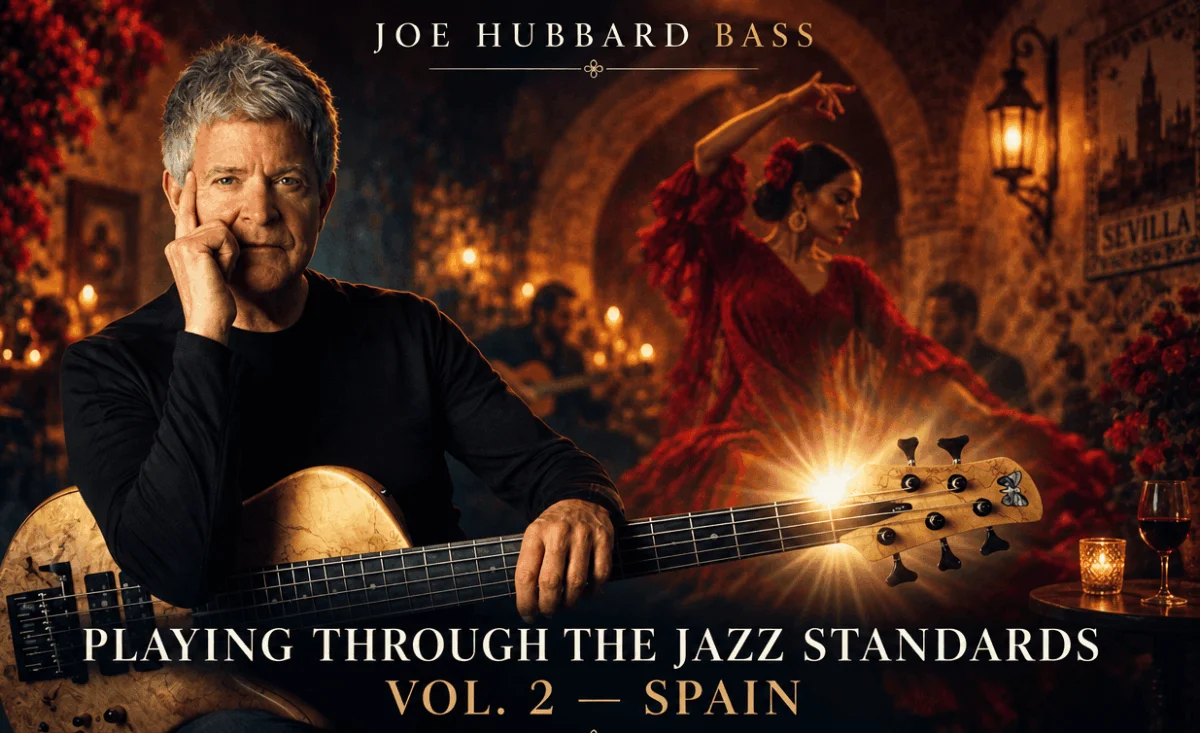
The jazz standard Spain, composed by Chick Corea and popularized by his seminal fusion group Return to Forever, stands as a monolith in the contemporary repertoire. Its intricate blend of Joaquin Rodrigo’s Concierto de Aranjuez, complex syncopation, and driving Brazilian samba rhythms has challenged musicians for decades. Now, veteran bassist and educator Joe Hubbard has released the second volume of his Playing Through the Jazz Standards series, an ambitious pedagogical project designed to dismantle the barriers to entry for this demanding composition. By applying a rigorous, neuroscientifically backed methodology to the piece, Hubbard aims to transform how bassists approach one of the most frequently called, yet often misunderstood, tunes in jazz history.
The Anatomy of a Jazz Standard
To understand the significance of this release, one must first appreciate the technical demands of Spain. Unlike traditional swing-based standards that rely on predictable harmonic cadences, Spain is a hybrid composition. It requires the bassist to possess a high degree of technical facility, particularly regarding the execution of fast, sixteenth-note syncopated rhythms that define the samba feel. Furthermore, the modal harmony and the structural transition from the classical-inspired introduction to the high-energy fusion main theme demand a level of versatility that many intermediate players lack.
Joe Hubbard, an educator with over four decades of experience—including extensive one-on-one tutelage under the late jazz improvisation master Charlie Banacos—argues that the primary failure of most students is the reliance on "improvisation as intuition." Hubbard’s philosophy posits that improvisation is, in fact, the real-time deployment of deeply internalized vocabulary. His new course, which serves as the direct successor to his successful volume on Charlie Parker’s Donna Lee, attempts to systematize the acquisition of this vocabulary.
A Chronology of the Project
The development of this course follows a deliberate timeline of pedagogical refinement. Following the release of the first volume of the Playing Through the Jazz Standards series, which garnered a student base of over 300 professionals and advanced students, Hubbard identified a specific gap in the market. While there are countless "play-along" videos available on platforms like YouTube, there was a noticeable absence of high-fidelity, academically structured courses that paired world-class rhythm sections with granular, bar-by-bar analysis.
The production of the Spain volume began in early 2024, focusing on the recruitment of a rhythm section that could provide more than just a backing track. By securing the talents of drummer Tom Bretchlein, who served in Chick Corea’s ensemble for nearly a decade, and pianist Santiago Bosch, a distinguished alumnus of the Berklee Global Jazz Institute, Hubbard ensured that the foundation of the course was built on authentic performance history rather than synthesized approximations. The collaboration involved a remote recording process where the trio synchronized their performance, creating a definitive, high-resolution audio environment for students.
Comparative Analysis: MIDI vs. Live Performance
A critical differentiator in Hubbard’s course is the rejection of MIDI-based backing tracks. In the broader landscape of digital music education, the use of MIDI (Musical Instrument Digital Interface) has become standard due to its cost-effectiveness and ease of production. However, MIDI lacks the "micro-timing" and dynamic nuance inherent in human performance.
By utilizing tracks recorded by Bretchlein and Bosch, Hubbard provides students with an immersive experience. When a student practices over these tracks, they are forced to contend with the natural fluctuations in energy and rhythmic "pocket" that define a professional jazz ensemble. This aligns with modern findings in music psychology, which suggest that students learn better when exposed to high-quality, authentic stimuli that reflect the conditions of a live performance environment.

Pedagogical Framework: Beyond the Information Dump
Hubbard’s methodology is structured around the principles of Bloom’s Taxonomy, a hierarchical model used to classify educational learning objectives. In the context of jazz education, the model is applied as follows:
- Remembering: Recalling the melody and basic chord changes of Spain.
- Understanding: Analyzing the harmonic structure and the rhythmic nuances of the samba groove.
- Applying: Using the rhythm section tracks to practice the bass line and soloing concepts.
- Analyzing: Deconstructing the solo into individual motifs and harmonic fragments.
- Evaluating: Comparing one’s performance against the provided master transcriptions.
- Creating: Generating original lines and improvisations by repurposing the vocabulary learned in the course.
The inclusion of Lesson 11, which explicitly demonstrates how to extract melodic fragments from the Spain solo and transpose them into the context of Autumn Leaves, serves as a proof of concept for this taxonomy. By demonstrating that jazz vocabulary is transferable rather than static, Hubbard provides a roadmap for students to build a comprehensive "musical language" rather than simply memorizing a single song.
Supporting Materials and Technical Scope
The course content is expansive, totaling approximately three hours of video instruction across 12 modules. Beyond the video components, the curriculum includes:
- 20 Downloadable PDFs: These assets contain comprehensive transcriptions, chord charts, and fretboard diagrams, providing a visual reference for the auditory instruction.
- The Focused Bassist: A 10-page supplemental booklet that addresses the cognitive aspects of practice. This document incorporates elements of neuroscience to explain how neuroplasticity can be leveraged through intentional, structured practice.
- Professional Backing Tracks: High-fidelity audio files that allow for isolated practice, mimicking the environment of a professional rehearsal.
Broader Implications for Music Education
The release of this course highlights a growing trend toward "vertical" integration in music education—the move away from general, broad-strokes tutorials toward deep-dive, composition-specific masterclasses. As the digital education market becomes increasingly saturated, providers are finding that value is no longer determined by the volume of content, but by the quality of the pedagogical framework.
Industry analysts suggest that the shift toward professional-grade, niche education is driven by a global audience of dedicated amateur and semi-professional musicians who are no longer satisfied with superficial learning. For these players, the "information dump" model—characterized by uncurated, scattered tutorials—is being replaced by systems that promise measurable progression in skill acquisition.
Strategic Launch and Availability
The launch of Playing Through the Jazz Standards Vol. 2: Spain is positioned as a premium offering in the jazz education space. By setting a launch price of £267 ($349 USD) with a limited-time window ending October 12, 2024, the producers are targeting a demographic of serious students committed to long-term skill development. The transition from the £297 ($388 USD) standard price point suggests a high-value valuation for the intellectual property contained within the course.
The success of the first volume, combined with the rigorous production standards applied to the second, positions Joe Hubbard as a significant figure in the evolution of online jazz pedagogy. Whether this systematic approach to jazz standards will become the new industry standard remains to be seen, but the initial reception suggests a strong appetite for deep, research-informed instruction. Interested students can access the full curriculum and enrollment details via the official Joe Hubbard Bass portal. As the educational landscape continues to adapt to the digital age, the focus on "vocabulary acquisition" may well become the defining metric for success in jazz performance at the professional level.