
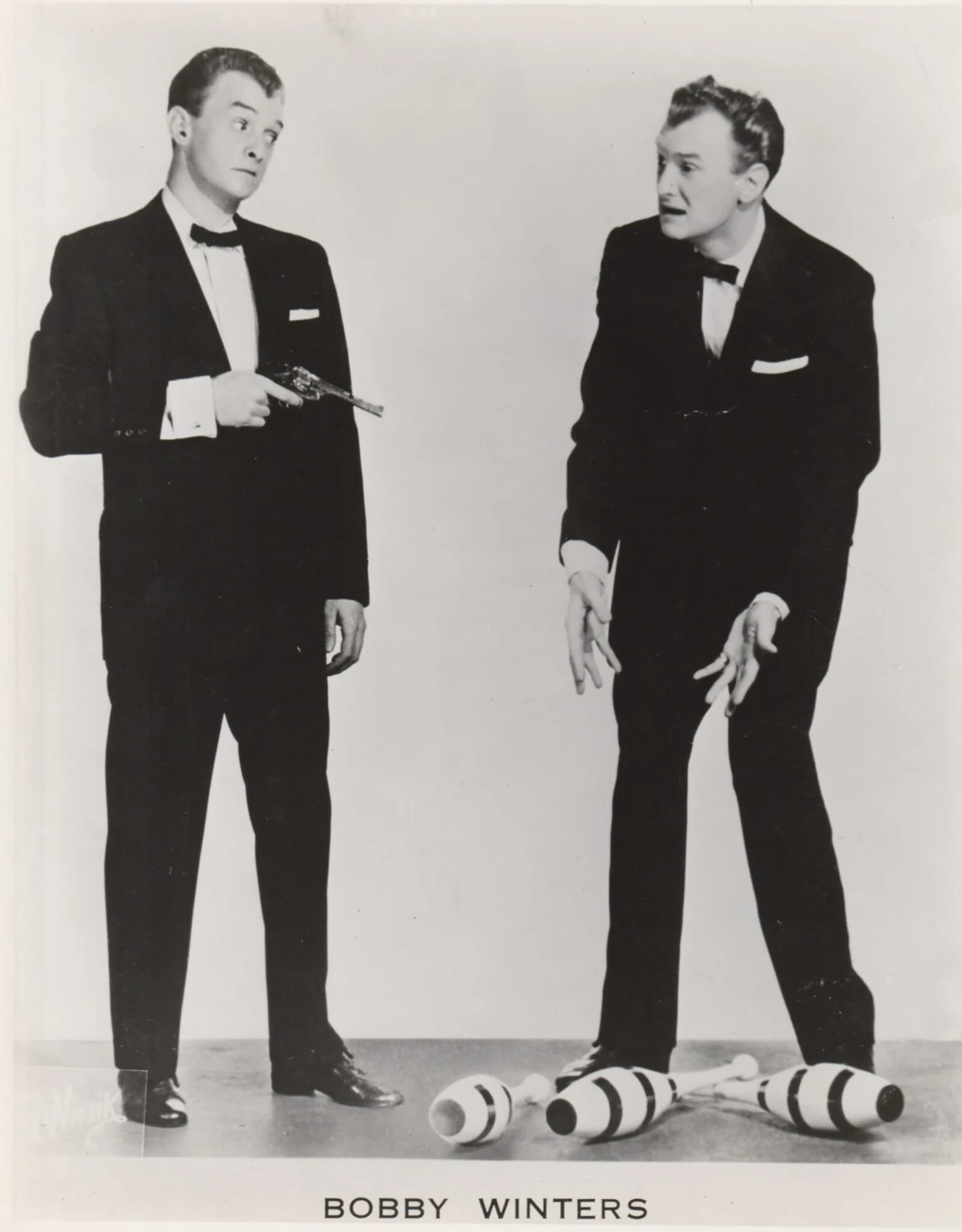
In the annals of performance history, certain names drift into obscurity despite their foundational roles in shaping modern variety entertainment. Among these are Raymond Pike and his son, Raymond Pike Jr.—the latter known professionally as Bobby Winters. While their contributions were once mainstays of the American vaudeville circuit and the burgeoning era of television variety shows, their stories had largely faded from the public consciousness until the recent efforts of archival researchers like Tom Kellett. By piecing together rare film clips and historical documentation, a clearer picture has emerged of a father-son duo whose technical prowess and comedic timing defined a generation of mid-20th-century performance.

The Era of the Multi-Hyphenate Performer
Born in 1893, Raymond Pike emerged during a golden age of variety performance. The landscape of the 1920s and 1930s demanded versatility; audiences were rarely satisfied with a single skill. To be a successful entertainer, one had to be a "triple threat" or more. Pike fit this mold perfectly, mastering the disciplines of acrobatics, dance, and juggling.
Pike’s career spanned an impressive 42 years, beginning with a 16-year tenure as an acrobat before transitioning into the specialized field of professional juggling. His act was a masterclass in the pacing of the era, typically running approximately 15 minutes. Historical records provided by variety enthusiast Larry Weeks offer a granular look at the structure of a Pike performance: he would open with a rhythmic tennis racket and ball routine, transition into four-hoop manipulation, and move through a clean three-stick sequence.

However, it was his "Drunken Juggler" persona that garnered the most acclaim. This routine was not merely about the technical difficulty of the props; it was a character study. By utilizing "cute pieces of business" and intricate sight gags, Pike demonstrated the transition from the rigid, skill-focused variety acts of the late 19th century to the more personality-driven comedy of the mid-20th century. His ability to maintain a high level of technical proficiency while appearing to be in a state of controlled disarray remains a hallmark of high-level comedy juggling.
Wartime Service and Industry Leadership
Beyond the stage, Raymond Pike was a figure of professional significance. Prior to the onset of World War II, he served as the president of the Boston branch of the American Guild of Variety Artists (AGVA). This leadership role speaks to his standing within the community of performers, suggesting he was not merely a practitioner but an advocate for the labor and professional standards of his peers.

As the geopolitical climate shifted in the 1940s, Pike felt a personal call to service. He spent much of his later career working intermittently for the United Service Organizations (USO), performing for troops overseas. This transition from civilian stages to military venues represented a broader trend in the entertainment industry, where performers were tasked with providing morale-boosting, low-tech entertainment in challenging, often austere, environments. Pike’s death in 1948 at the age of 55 marked the end of a career that had bridged the gap between the silent era of acrobatics and the post-war shift toward modern variety television.
The Rise of Bobby Winters: A Generational Transition
The torch was passed to Raymond Pike Jr., who adopted the stage name "Bobby Winters" to distinguish his career from that of his father. Operating from the 1940s through 1970, Winters navigated the evolution of the industry as it migrated from live vaudeville houses to the living rooms of America via television.

Winters maintained the family tradition of comedy-focused manipulation but leaned further into the "clumsy" aesthetic. While his technical skills—particularly his work with three clubs and three balls—were objectively high, his presentation was famously described as "purposely clumsy, but brilliant." This paradox is a staple of successful comedic performance, where the audience’s laughter is predicated on the illusion of imminent failure.
One of his signature routines involved the use of tambourines. Unlike standard prop juggling, Winters integrated the percussion instruments into his movement, hitting them against his body in time with the rhythm of his act. This added a sensory layer to the performance, moving it beyond visual spectacle into the realm of musical performance.

Signature Gags and Comedic Pacing
Winters was a master of the "gag" structure, utilizing recurring motifs to build audience rapport. His "drum roll" sequence, where he would command an off-stage drum to roll toward him, relied on the timing of stagehands and the performer’s ability to react with mock surprise. Similarly, his "medals gag"—wherein he would pull a small medal from his pocket, only to eventually reveal a full uniform array of honors—served as a satirical commentary on the self-importance of performers.
These bits were not just filler; they were essential components of the "variety" structure, allowing for moments of breath between the more taxing physical feats of juggling. By controlling the tension and release of the performance, Winters ensured that his audience remained engaged through both the high-skill segments and the lower-energy comedy interludes.

Technological Archiving and Historical Preservation
The resurgence of interest in Bobby Winters is largely due to the digitization of film reels. Contemporary juggling historians, such as David Cain, have utilized these fragments to analyze the mechanics of the "kidney swing" and the "ball on parasol" gag—techniques that are rarely taught in modern circus schools.
The video evidence provided by researchers reveals a performer who possessed an intimate understanding of physics and timing. In clips featuring the "ball on a string" (the kidney swing), one can observe the precise tension required to keep the prop in motion—a feat that looks effortless but requires significant muscle memory and spatial awareness. The preservation of these clips is vital, as they serve as the primary source material for understanding the transition from vaudeville to the early television variety hour.

Broader Implications and Legacy
The careers of the Pikes represent a broader narrative in American history: the professionalization of the variety arts. As the medium transitioned from the stage to the screen, the requirements for success shifted. The Pikes adapted by honing their characters and simplifying their props for better visibility on camera.
The decline of Bobby Winters’ career, marked by health struggles including multiple strokes and eventual blindness, serves as a poignant reminder of the physical toll of the performance industry. Despite these hardships, the legacy of the Pikes remains a subject of intense study for those interested in the evolution of physical comedy.

In the contemporary context, the preservation of these acts serves as a reminder that "new" comedy techniques are often iterations of foundational principles established decades ago. By analyzing the "clumsy but brilliant" work of Bobby Winters, modern performers can gain a deeper understanding of how to bridge the gap between technical mastery and audience connection. The work done by archivists to recover these performances ensures that the lineage of the Pikes will continue to inform the next generation of variety artists, grounding the fluid, digital world of today in the solid, physical foundations of yesterday’s stages. The story of Raymond Pike and Bobby Winters is, ultimately, a testament to the endurance of the performing spirit and the necessity of preserving the history of those who paved the way for modern entertainment.