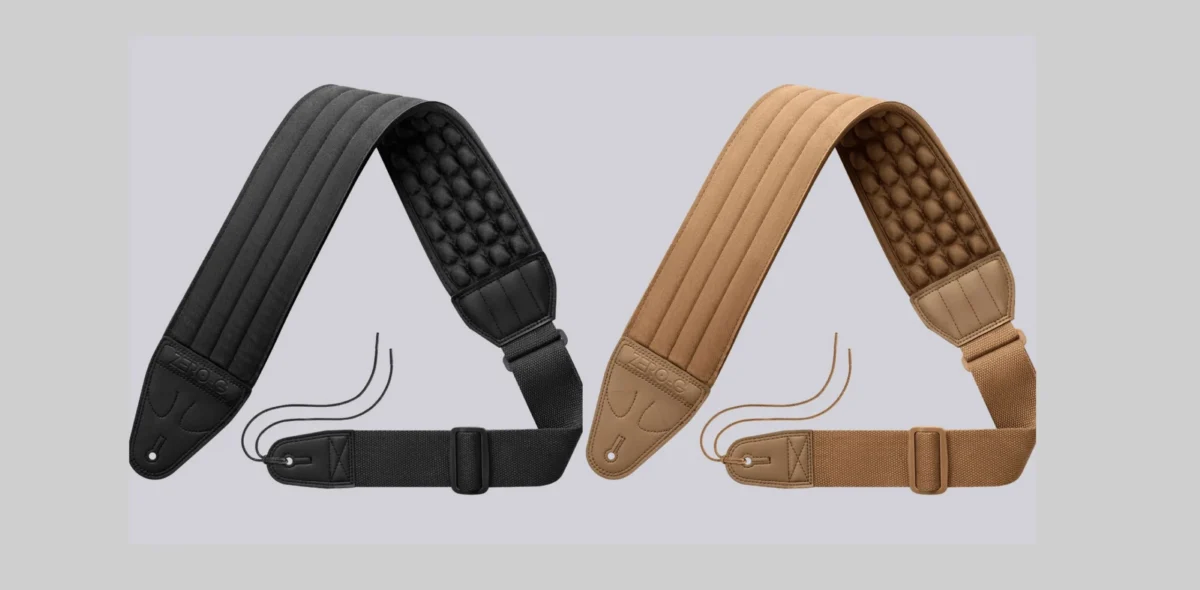
The challenge of managing weight in professional musical instrumentation has long plagued bass players, particularly those who favor vintage instruments or high-end multi-string models. A 1978 Fender Jazz Bass, for instance, often tips the scales at 13 pounds—a significant burden for any musician standing for extended periods. Historically, the industry has addressed this through wide leather straps, which often lack the necessary shock absorption for multi-hour performances. Cable Free Guitar (CFG) recently entered this niche market with its ZERO-G Pro padded bass strap, a product designed to mitigate the physical strain associated with heavy-duty stage gear.
Evolution of Ergonomic Support in Musical Gear
The history of guitar and bass support systems has seen a steady progression from basic nylon webbing to high-tech, multi-layered synthetic materials. In the mid-20th century, standard leather straps were the industry norm, valued for their durability rather than their ergonomic profile. As bass guitars grew in complexity—adding preamps, extra strings, and heavier woods—the need for specialized weight distribution became apparent.
By the early 2000s, neoprene-based "comfort" straps gained traction, most notably with the introduction of products like the Comfort Strapp. These materials provided a "bouncy" sensation that helped dampen the impact of a heavy instrument during movement. However, the market has recently shifted toward air-cell technology, which prioritizes pressure distribution and moisture management over the elastic bounce of traditional neoprene. The CFG ZERO-G Pro represents the latest iteration in this timeline, combining a cotton canvas outer shell with 3D air-cell cushioning to provide a more stable, less "spongy" user experience.

Technical Specifications and Construction
The ZERO-G Pro is engineered with a 3.5-inch width, a dimension chosen to maximize the surface area of contact between the strap and the musician’s shoulder. By widening the strap, the pressure—measured in pounds per square inch—is effectively lowered, reducing the risk of nerve impingement or localized muscle fatigue.
Key technical specifications include:
- Tensile Strength: The product has been stress-tested to 110 pounds, significantly exceeding the weight of even the most massive custom-built 6-string basses.
- Material Composition: The outer layer consists of 8-ounce cotton canvas, chosen for its wear resistance and structural integrity. The inner padding utilizes an air-cell architecture that promotes airflow, a critical factor for musicians performing under stage lighting.
- Adjustment Mechanism: Unlike many competing straps that require the padded section to slide through a buckle—often creating bulk and uneven weight distribution—the ZERO-G Pro utilizes a dedicated rear strap section for adjustment. This maintains the integrity of the shoulder pad’s positioning.
Comparative Market Analysis
The market for ergonomic straps is currently segmented into three distinct categories: entry-level mass-produced nylon options, mid-range comfort straps, and high-end boutique solutions.
At a price point of $64.99, the ZERO-G Pro occupies the upper-middle tier of this market. It competes directly with products from established manufacturers such as Neotech, Mono, and Gruv Gear. A technical comparison reveals that while the Mono Betty ($99.99) offers a premium, minimalist aesthetic, the ZERO-G Pro focuses on functional modularity and high-tensile durability.

Industry analysts note that the trend toward "tactical" or "medical-grade" aesthetic designs—a critique sometimes leveled at high-tech straps—is gradually giving way to more diverse color palettes. CFG’s decision to introduce multi-colored variants indicates a response to consumer feedback regarding the visual integration of these straps into a musician’s stage persona.
Clinical and Practical Implications for Musicians
The physical toll of performing with a 9-pound-plus instrument is well-documented within the music community. Prolonged exposure to heavy, poorly distributed weight can lead to chronic trapezius strain, shoulder bursitis, and in extreme cases, cervical radiculopathy.
In controlled testing environments, the ZERO-G Pro was evaluated against a variety of instrument weights, including a 13-pound vintage Jazz Bass and modern boutique instruments from Elrick and Wal. The results suggest that while no strap can physically negate the mass of an instrument, the distribution provided by the 3D air-cells allows for better blood flow and reduced localized pressure.
Professional musicians often cite "bounciness" as a primary concern with traditional neoprene straps. The ZERO-G Pro’s construction, which limits the longitudinal stretch while maintaining cushion, provides a "locked-in" feel. This is essential for players who perform complex technical maneuvers, as it minimizes the micro-movements of the instrument during high-velocity playing.

Broader Impact on the Industry
The introduction of the ZERO-G Pro serves as a microcosm for the broader "pro-sumer" shift in music technology. Musicians are increasingly demanding gear that solves specific ergonomic issues without sacrificing the aesthetic preferences of their chosen genre.
The reliance on high-grade cotton canvas and reinforced stitching reflects a move toward sustainability and longevity in musical accessories. By offering a lifetime warranty—a significant step up from the two-year guarantees provided on the company’s previous Gen-1 and Slim models—CFG is signaling a commitment to a "buy-it-for-life" philosophy. This strategy is particularly effective in a market saturated with cheap, imported straps that often fail after minimal use.
Conclusion and Future Outlook
The CFG ZERO-G Pro is positioned as a corrective tool for the modern bassist. Its design prioritizes the long-term health of the player by acknowledging that the physical demands of playing a 13-pound instrument are unsustainable without proper hardware. While the strap is not a replacement for proper posture or physical conditioning, it acts as a critical component in the musician’s ergonomic toolkit.
Looking ahead, the industry is likely to see further integration of "smart" materials—such as memory foams or phase-change fabrics that adapt to temperature—into guitar straps. For now, the ZERO-G Pro stands as a benchmark for how specialized manufacturing and thoughtful engineering can address the specific, recurring pain points of professional performers. Whether for a three-hour rehearsal or a high-intensity touring schedule, the integration of high-tensile hardware and optimized pressure distribution marks a meaningful advancement for those who carry the heaviest instruments in the industry.