
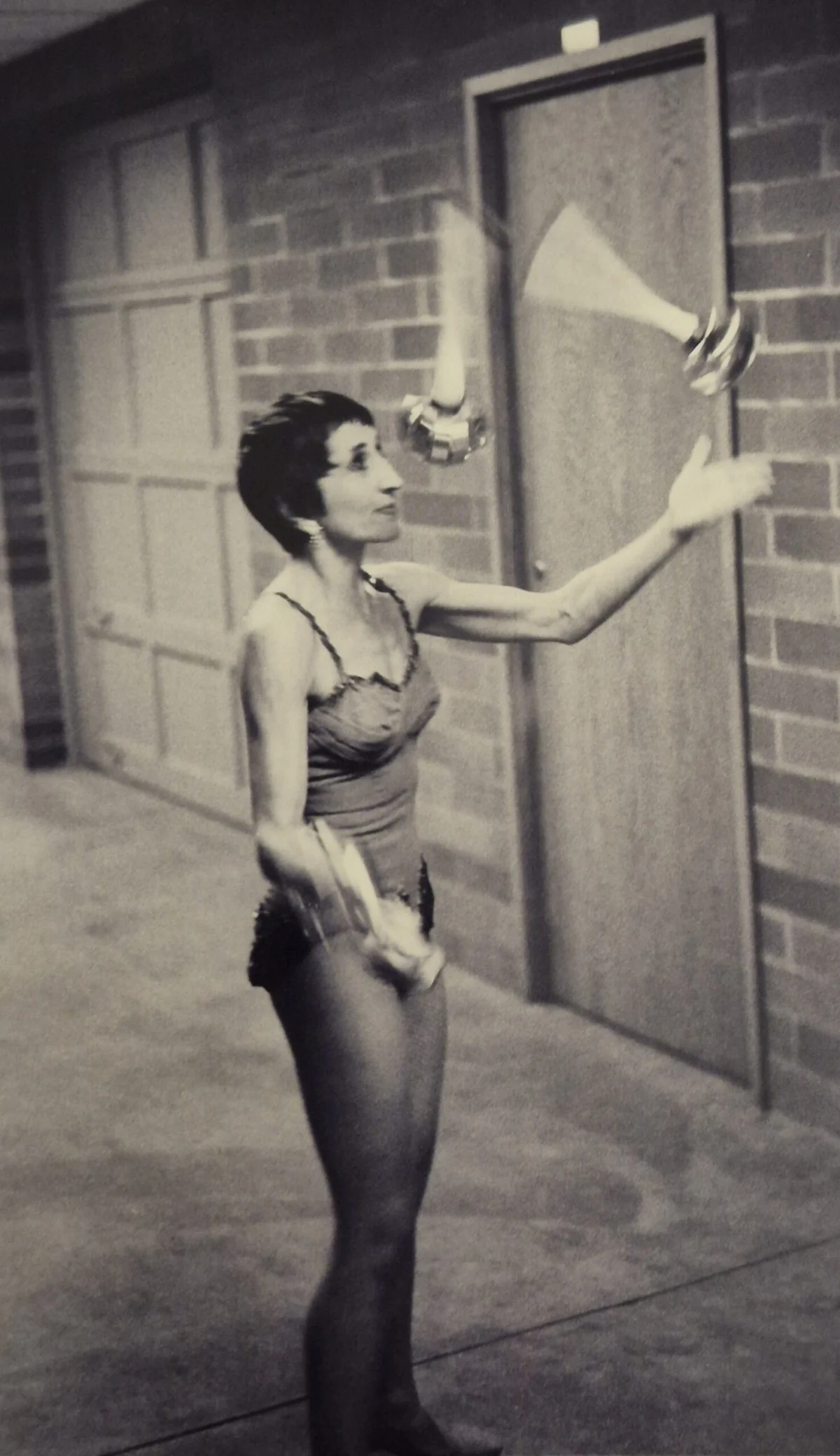
The history of variety arts and circus performance is punctuated by figures who did more than entertain; they redefined the boundaries of human dexterity and stage presence. Among these luminaries, Lottie Brunn (1925–2008) stands as a singular force, widely recognized by historians and peers as the fastest female juggler to ever grace the stage. Her career, spanning nearly half a century, serves as a testament to the transition of juggling from a niche circus skill to a high-energy centerpiece of global variety entertainment. Born in Germany and eventually becoming a fixture of American show business, Brunn’s trajectory was marked by technical milestones that remain impressive by modern standards and a solo career that shattered gender barriers in the world’s most prestigious venues.

Early Life and the Brunn Dynasty
Lottie Brunn was born in 1925 into a Germany that was a central hub for the circus and variety arts. Alongside her brother, Francis Brunn—who would himself become one of the most celebrated jugglers in history—Lottie was immersed in a culture of rigorous physical discipline and artistic innovation. The Brunn siblings represented a new breed of performer: those who combined the traditional athleticism of the circus with the refined elegance required for the European variety stage.

By the age of 14, Lottie had already achieved a level of technical proficiency that many professional jugglers never reach. She was capable of performing with eight rings, a feat of coordination and speed that placed her in the upper echelons of the craft. This early mastery was not merely about the number of objects; it was about the velocity and precision of her execution. While many jugglers focused on slow, deliberate patterns, the Brunns were characterized by a "flash" style—high-speed movements that dazzled audiences and required near-perfect reflexes.

In 1948, following the end of World War II, the Brunn siblings emigrated to the United States. They arrived during a transformative era for American entertainment, as the public sought the kind of high-caliber, international talent that the European circuit had perfected. Their arrival marked the beginning of a legendary tenure in the American spotlight, though Lottie would soon seek to establish an identity independent of the family act.

The Solo Transition and Breaking the Glass Ceiling
For the first few years of her American career, Lottie performed alongside Francis, contributing to an act that was considered the gold standard of the industry. However, in 1951, she made the pivotal decision to launch a solo career. This move was both a personal and professional risk. At the time, the world of high-level juggling was overwhelmingly dominated by men, and female performers were often relegated to supporting roles or "assistant" positions within family troupes.

Lottie Brunn defied these conventions with immediate success. Her technical prowess was undeniable, and her stage presence was electric. She achieved a historic milestone when she became the only solo female juggler to perform in the center ring of the Ringling Brothers and Barnum & Bailey Circus. In the hierarchy of the circus world, the center ring was reserved for the "greatest" acts—those capable of commanding the attention of thousands in a massive arena. Brunn’s inclusion was an official acknowledgment of her status as a premier global talent.

Her solo act was a masterclass in variety. While she remained famous for her speed, her repertoire was diverse, featuring ball spinning, complex combination tricks, and toss juggling with balls, rings, and spring head clubs. The spring head club, a specific type of juggling prop common in the mid-20th century, required a unique touch, and Brunn’s ability to manipulate them at high speeds became one of her signature calling cards.

Global Stages and the Golden Age of Variety
The 1950s and 1960s represented the "Golden Age" of variety entertainment, and Lottie Brunn was one of its most sought-after stars. Her career took her to the world’s most iconic stages, venues that served as the ultimate proving grounds for entertainers. She performed at Radio City Music Hall in New York, a venue synonymous with American grandeur, and crossed the Atlantic to headline at The Savoy and the London Palladium.

Her versatility allowed her to bridge the gap between traditional circus and modern sports-entertainment. She spent a year touring with the Harlem Globetrotters, providing a high-energy variety act during their world-famous basketball exhibitions. This partnership was a natural fit; both the Globetrotters and Brunn specialized in the intersection of extreme physical skill and comedic showmanship. Additionally, she toured for a year with the Spike Jones show, a musical comedy troupe known for its frantic and satirical performances, further proving her ability to adapt to different entertainment formats.

A Cultural Fixture: Television and Celebrity Collaborations
As television became the dominant medium for household entertainment, Lottie Brunn transitioned seamlessly into the new format. She appeared on numerous programs, most notably the Ed Sullivan Show, which was the premier platform for variety acts in the United States. Despite her frequent appearances, Brunn was often vocal about her distaste for the pressures of live television. Unlike a stage performance, where a performer can "work" a room and recover from minor slips, the unforgiving nature of early live broadcasts—with their tight framing and lack of retakes—created a high-stress environment for a juggler whose act relied on millisecond precision.

Throughout her career, Brunn’s name was frequently billed alongside the biggest icons of the 20th century. Her professional circle included a "who’s who" of the entertainment industry:

- Comedy Legends: The Three Stooges, Milton Berle, Buddy Hackett, and Joey Bishop.
- Musical Icons: Tony Bennett, Sammy Davis, Jr., Dean Martin, Tommy Dorsey, Rosemary Clooney, and Diana Ross and the Supremes.
- Stage and Screen Stars: Gregory Hines, whose own rhythmic precision in tap dancing shared a spiritual kinship with Brunn’s juggling.
These collaborations were not merely coincidental; they were a reflection of the high-caliber variety circuits of the era. Brunn was a "performer’s performer," respected by her peers for a level of technical skill that was as rigorous as any world-class musician’s or dancer’s.

Innovation and the Final Act
In 1960, Lottie Brunn pioneered a new frontier for variety performers: the cruise ship industry. Her first contract was on the French ship Flandre, marking her as one of the first professional jugglers to recognize the potential of maritime entertainment. This move helped establish a path that thousands of variety artists would follow in the decades to come.

During the 1950s and 60s, she was also a regular fixture in the burgeoning entertainment hubs of Las Vegas and Reno. In these desert cities, variety acts were essential components of the lavish floor shows that defined the era’s nightlife. Brunn’s high-speed act was perfectly suited for the flashy, high-stakes atmosphere of the Nevada casinos.

Lottie continued to perform until her retirement in 1985, concluding a professional career that spanned 46 years. Her retirement did not mark the end of her influence, however. She passed her skills and professional secrets to her son, Michael Chirrick, ensuring that the Brunn-Chirrick technical lineage continued into the next generation.

Recognition and Legacy
The juggling community formally recognized Brunn’s contributions in 1992, when the International Jugglers’ Association (IJA) presented her with the Historical Achievement Award. This honor is reserved for those who have made significant, lasting impacts on the art form, and Brunn’s role as a female pioneer and a paragon of speed made her an undisputed candidate.

Lottie Brunn passed away in 2008, leaving behind a legacy that continues to be studied by historians of the variety arts. Today, her impact is preserved through the work of David Cain, a professional juggler and historian who maintains the Museum of Juggling History. Cain’s extensive collection of Brunn’s personal photos, scrapbooks, and props offers a rare glimpse into the life of a performer who was often too busy working to document her own greatness.

The preservation of her props is particularly significant. To see the rings and spring head clubs used by Brunn is to understand the physical reality of her speed. Unlike modern plastic props, the equipment of Brunn’s era was often heavier and more difficult to manipulate, making her high-speed records even more remarkable.

Broader Impact and Implications
The career of Lottie Brunn offers more than a list of dates and venues; it provides an analytical look at the evolution of performance gender roles. Brunn’s success as a solo artist in the mid-20th century paved the way for modern female jugglers, proving that speed and technical difficulty were not gender-restricted domains. Her ability to command the center ring at Ringling Bros. was a symbolic victory that expanded the possibilities for women in the circus.

Furthermore, Brunn’s career reflects the shifting landscape of global entertainment. From the variety stages of pre-war Europe to the television sets of suburban America and the stages of luxury cruise liners, she navigated the transitions of the industry with agility. Her "fastest" title remains a benchmark, a reminder of an era where variety acts were the pulse of popular culture. As the International Jugglers’ Association continues to celebrate figures like Brunn at festivals in cities like Fort Wayne, Indiana, her story remains a vital chapter in the history of human achievement through practice, precision, and performance.