
The definition of juggling has historically been a fluid concept, encompassing a wide array of disciplines that modern audiences might now categorize separately as circus arts, athletics, or niche object manipulation. For David Cain, a professional juggler, historian, and curator of the Museum of Juggling History, the boundaries of the craft are far-reaching. His interpretation includes not only traditional toss juggling but also ball spinning, trick roping, plate spinning, object balancing, and the use of cigar boxes, devil sticks, poi, diabolos, and boomerangs. This expansive view was once the industry standard during the golden age of Vaudeville, where any performance involving the rhythmic and skillful manipulation of objects could fall under the umbrella of juggling. Among these forgotten disciplines, perhaps none is more surprising to the modern observer than "bag punching"—the rhythmic, choreographed hitting of boxing speed bags.

The Vaudeville Context and the Art of Object Manipulation
To understand why bag punching was once classified alongside juggling, one must look at the structure of variety entertainment in the late 19th and early 20th centuries. Vaudeville was the primary form of mass entertainment in the United States from the 1880s through the 1930s. It relied on a "bill" of unrelated acts, ranging from musicians and comedians to "dumb acts"—performances that did not rely on speech, such as acrobats, magicians, and jugglers.

In this era, the distinction between a sport and a performance was often blurred. Athletes frequently took to the stage to demonstrate their prowess in ways that emphasized rhythm, timing, and visual spectacle rather than combat. Bag punching transitioned from the boxing gym to the theater stage because it required extraordinary hand-eye coordination, a sense of tempo, and the ability to keep an object (the bag) in constant, controlled motion. For the Vaudeville audience, the sight of a performer keeping multiple bags in a state of rapid-fire vibration was functionally identical to a juggler keeping several balls in the air.

Technical Foundations: Gus Keller and the Early Pioneers
One of the earliest and most influential figures in the transition of bag punching from athletic training to stage performance was Gus Keller. In 1903, Keller was captured on film demonstrating a level of speed and precision that remains impressive by modern standards. Unlike a boxer who uses a speed bag to build endurance and timing for a fight, Keller treated the bag as a musical instrument and a prop.

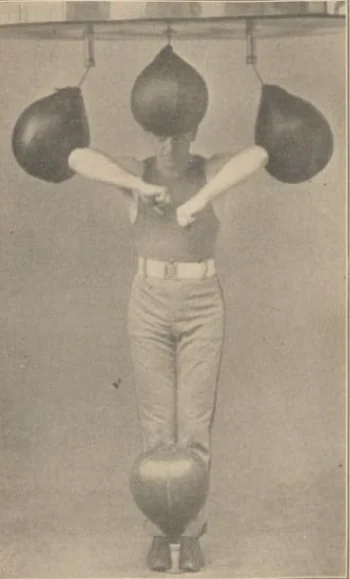
Keller’s performances often featured a specialized apparatus—a large wooden frame that held multiple punching bags in various arrangements. This allowed him to move seamlessly between bags, creating complex percussive patterns. His contribution to the art form was codified in his instructional manual, How to Punch a Bag. In this work, Keller outlined the "scientific" approach to the discipline, emphasizing that the "rebound" was the most critical element. By mastering the number of times a bag hit the rebound board between strikes, a performer could synchronize their movements to music, a hallmark of the Vaudeville "juggling" style.

The Codification of "Scientific Bag Punching"
As the popularity of the act grew, so did the complexity of the routines. In 1913, Harry Seeback published Scientific Bag Punching, a comprehensive guide that further bridged the gap between athletics and the performing arts. Seeback was a prominent performer who argued that the discipline was as much about mental acuity as physical strength.

Seeback’s routines involved intricate footwork and the use of various parts of the hand—knuckles, palms, and elbows—to strike the bag from different angles. The "scientific" moniker referred to the mathematical precision required to maintain a consistent rhythm. In the context of juggling history, this era represents a time when "object manipulation" was being documented with the same rigor as toss juggling patterns. Seeback’s book provided diagrams and step-by-step instructions for tricks that involved hitting two bags simultaneously or performing "blind" strikes while facing away from the apparatus, further aligning the skill with the spectacle of professional juggling.

Belle Gordon: The Queen of the Punching Bag
While many bag punchers came from the world of prize-fighting, the most famous performer of the Vaudeville era was Belle Gordon. Beginning her career around 1900, Gordon became a sensation by combining high-level athletic skill with the grace and showmanship expected of a Vaudeville headliner.

Gordon’s act was a testament to the broad appeal of bag punching. She was often marketed as "The World’s Champion Lady Bag Puncher," and her performances were noted for their musicality. She would often perform to popular marches or ragtime tunes, her strikes acting as the percussion for the orchestra. Gordon’s success highlighted a key aspect of why bag punching was considered juggling: it was a feat of dexterity. At a time when women were carving out more space in the variety arts, Gordon’s ability to master a traditionally masculine tool and turn it into a refined stage act made her one of the most photographed and celebrated performers of the early 1900s.

A Diverse Roster of Performers
The Vaudeville circuit hosted a wide variety of bag punching acts, each bringing a unique flair to the discipline. George Herz and Joe Marnell were known for their speed and the complexity of their multi-bag frames. These frames were often ornate, designed to catch the stage lights and enhance the visual impact of the vibrating bags.

Other notable performers included Jessie Franks, the duo of Francis and W. A. Waldoras, and the team of Lenny and Margie Ross. These acts often incorporated elements of "juggling" in the most literal sense—sometimes transitioning from punching a stationary bag to tossing and catching small medicine balls or juggling clubs between sequences. This crossover reinforced the public perception that bag punching was merely one branch of the larger juggling family tree.

Chronology of the Bag Punching Era
- Late 1880s – 1890s: Bag punching emerges in athletic clubs and boxing gyms as a training tool; early adopters begin performing "exhibition" bouts in music halls.
- 1900: Belle Gordon begins her professional career, elevating the discipline to a headline Vaudeville act.
- 1903: Gus Keller’s performance is filmed, providing one of the earliest visual records of the "juggling style" of bag punching.
- 1904 – 1910: The peak of bag punching as a "dumb act" in Vaudeville; performers begin using music and choreographed routines.
- 1913: Harry Seeback publishes Scientific Bag Punching, providing a technical manual for the art form.
- 1920s: The "Jazz Age" sees bag punching acts incorporating faster tempos and more elaborate stagecraft.
- 1930s: The decline of Vaudeville due to the rise of cinema and the Great Depression leads to the disappearance of bag punching from the professional stage.
- Post-1940: Bag punching returns almost exclusively to the boxing gym, losing its status as a form of "juggling" or "variety art."
Analysis: Why the Definition Shifted
The question of why bag punching is no longer considered juggling is a matter of cultural and professional specialization. In the early 20th century, a "juggler" was any "manipulator of objects." However, as the 20th century progressed, the International Jugglers’ Association (founded in 1947) and other organizations began to standardize the definition of juggling, focusing heavily on "toss juggling" (the throwing and catching of objects).

Furthermore, the divergence of sports and entertainment played a significant role. Bag punching became more closely associated with the burgeoning professional boxing industry, while juggling moved toward the circus and the modern "flow arts." The rhythmic, percussive nature of bag punching was eventually replaced in the variety world by tap dancing and drum solos, which offered similar auditory satisfaction without the need for the bulky punching bag apparatus.

Broader Impact and Implications for Juggling History
The study of bag punching as a form of juggling offers a valuable perspective on the evolution of human skill. It serves as a reminder that many modern "sports" have their roots in performance, and many "arts" have their roots in physical training. For historians like David Cain, reclaiming bag punching as a form of juggling is not just about expanding a list of tricks; it is about recognizing the shared heritage of hand-eye coordination and the universal human drive to turn a functional movement into a rhythmic spectacle.

As Cain notes, if he were to remake his "61 Types of Juggling" video today, the list would likely exceed 100. This expansion reflects a return to the Vaudeville-era mindset—a recognition that the manipulation of the physical world, whether through tossing a ball or striking a bag, is a singular pursuit of mastery. Part 2 of this exploration will delve deeper into the specific historical documents and testimonies that explicitly linked these two worlds in the eyes of the 20th-century public.