
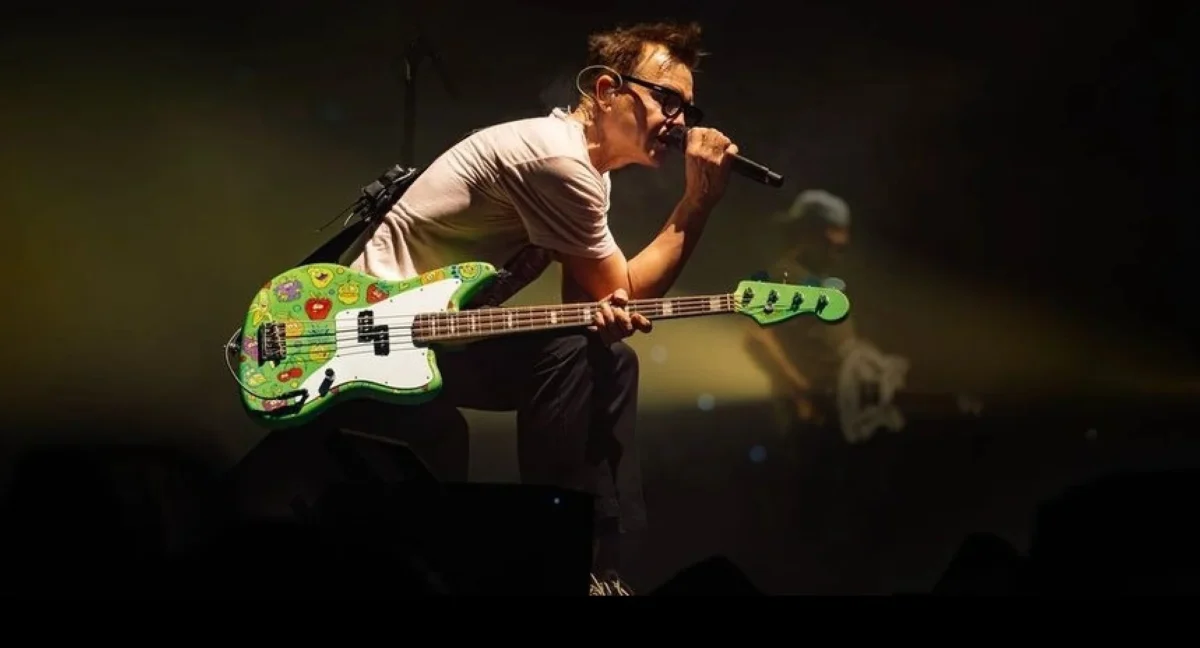
For over two decades, the intersection of pop-punk iconography and professional-grade instrumentation has been defined by the partnership between Blink-182 bassist Mark Hoppus and Fender. This quarter-century milestone is now being celebrated with the release of the Stoned Fruit Signature Jaguar Bass, a custom-designed instrument that encapsulates the aesthetic and tonal evolution of one of modern rock’s most recognizable low-end players. The launch arrives as both a testament to a long-standing manufacturing relationship and a forward-looking nod to the next chapter of the band’s creative output.

The Stoned Fruit model, developed in collaboration with graphic artist Burrito Breath, is more than a commemorative piece; it is a synthesis of the specific technical requirements Hoppus has refined since his early days in the Southern California punk scene. Built on a Jaguar body platform, the instrument features a rosewood fretboard on a C-style neck and incorporates his preferred reverse Precision pickup configuration. By marrying 1990s-era skate culture influences with modern engineering, the bass serves as a physical representation of the DIY ethos that catapulted Blink-182 to global prominence.
A Quarter Century of Evolution: The Chronology of a Signature Sound

The history of the Hoppus-Fender relationship is one of incremental, problem-solving innovation. In the late 1990s, during the recording sessions for the seminal album Enema of the State, Hoppus began his transition toward a streamlined, high-output instrument. Working alongside producer Jerry Finn, Hoppus identified a need for a bass that could occupy the specific frequency space required for a three-piece band where the bass guitar must frequently function as both a rhythmic foundation and a lead melodic instrument.
Initially, this involved stripping away secondary controls. Hoppus removed the tone knob entirely, opting for a direct, wide-open signal path that maximized the raw output of the pickups. This minimalist approach was not merely stylistic; it was a functional choice designed to cut through dense, high-gain guitar arrangements. Following the success of the standard Precision Bass setup, Hoppus experimented with Jazz Bass bodies, seeking to balance the mid-range punch of the P-Bass with the low-end resonance of the Jazz model.

The most significant technical development in this timeline was the introduction of the reverse pickup configuration. By flipping the split-coil P-Bass pickups—placing the E and A strings closer to the bridge and the D and G strings closer to the neck—Hoppus and his technical team effectively balanced the output across all four strings. This configuration solved the “doinky” or inconsistent tone often associated with standard setups, allowing for a more uniform performance, particularly when utilizing the chordal playing style that defines tracks like Carousel and Josie. The transition to the Jaguar body style roughly ten years ago further refined the ergonomics and aesthetics of his signature series, providing a sharper, more aggressive visual profile that aligned with the band’s stage presence.
Technical Specifications and Performance Mechanics

The Stoned Fruit Signature Jaguar Bass is engineered to support a high-intensity playing style. At the heart of the instrument is the Seymour Duncan SPB-3 Quarter Pound split-coil P-Bass pickup. Chosen for its focused attack and high output, this pickup is the cornerstone of the “Hoppus tone,” which is characterized by a tight, aggressive mid-range and a controlled high end.
Supporting this electronic foundation are several hardware choices designed for road-readiness and durability. The inclusion of a HiMass Vintage bridge ensures consistent sustain and tuning stability, while the lightweight vintage-style tuners prevent neck dive, a common issue with larger body shapes. A notable aesthetic and personal touch is the custom neck plate, engraved with the “Hi, My Name is Mark” octopus logo, a branding element that has become synonymous with the bassist’s personal projects.

The decision to offer the bass in a striking Guava Green finish with a matching headstock represents a shift toward more vibrant, visually arresting designs. Furthermore, the inclusion of a sticker pack featuring custom artwork by Burrito Breath allows users to personalize the instrument, reflecting the punk-rock tradition of decorating gear as a means of individual expression. The finish is applied with a clear coat that protects the body while maintaining a professional appearance, ensuring that the instrument remains resilient under the rigors of professional touring.
Strategic Collaboration and Design Philosophy

The design process, spearheaded by Fender Head of Signature Artists Michael Schulz, focuses on the intersection of utility and accessibility. A primary goal for Hoppus was to ensure that the production model mirrors the instrument he uses on stage. This philosophy stems from the practical reality of touring: if an instrument sustains damage or malfunctions in a remote location, the artist must be able to acquire a reliable replacement from a standard retail environment.
This commitment to accessibility is a hallmark of the Fender Signature series. By keeping the core specifications identical to the professional-grade instruments used in studio and arena settings, the company allows fans and professional peers alike to utilize the same tools that define the artist’s sound. The partnership with Burrito Breath, an artist whose work Hoppus discovered via social media, highlights a broader trend in the music industry: the integration of visual art and graphic design into the functional architecture of musical instruments. This approach pays homage to bands like Sonic Youth, who historically collaborated with fine artists to create cohesive, visually distinct brand identities.

Implications for the Music Industry and Future Creative Directions
The release of the Stoned Fruit Signature Jaguar coincides with a pivotal moment for Blink-182. As the band prepares for a return to the studio in early 2027, the instrument serves as both a tool for creation and a symbol of the band’s continued momentum. For the industry, the ongoing success of the Hoppus signature line underscores the sustained demand for high-performance, single-purpose instruments. In an era where digital modeling and complex signal chains are increasingly common, the enduring popularity of a passive, one-knob bass reinforces the value of simplicity and high-quality analog components.

Analysis of the current market suggests that signature models like the Stoned Fruit Jaguar continue to serve as significant revenue drivers for manufacturers. By leveraging the history and brand loyalty of artists who have been with a company for decades, brands like Fender are able to bridge the gap between legacy audiences and new generations of players. For Hoppus, the collaboration is a professional milestone that validates his journey from a fan of the instrument to an influential designer of its modern iterations.
As the band transitions into the next phase of their career, the gear remains a focal point of their process. Hoppus has noted that the creative spark within the band remains high, with new material already in development. The ability to return to the studio with an instrument that has been specifically tuned to his tonal preferences—tight low end, punching mids, and a consistent, high-output attack—provides a stable foundation for the songwriting process.

Ultimately, the Stoned Fruit Signature Jaguar Bass is a reflection of a career built on technical refinement and a refusal to compromise on the essential elements of the instrument. It is a synthesis of the past and the future: the legacy of the Fender Precision Bass, the evolution of the Jaguar body, and the personal, artistic vision of one of punk rock’s most consistent performers. As the music industry continues to evolve, the partnership between Hoppus and Fender remains a benchmark for how long-term artist-manufacturer relationships can foster innovation, maintain brand relevance, and provide tools that meet the rigorous demands of contemporary live performance.