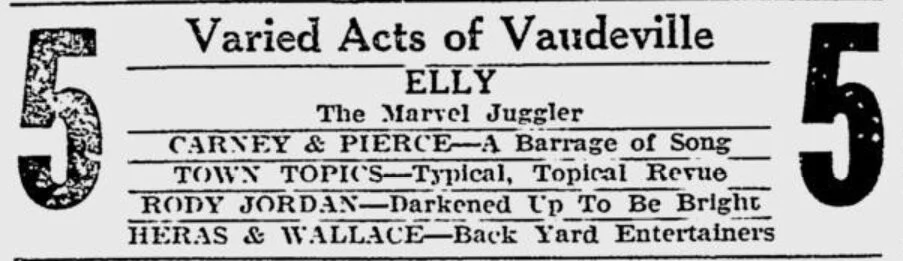
In the annals of early 20th-century entertainment, few performers captured the imagination of transatlantic audiences quite like a diminutive, blond-haired vaudeville act known simply to history as Elly. Billed by theatrical managers across the United States, Canada, and Great Britain as “the youngest female juggler in the world,” Elly commanded the stages of premier circuits during the turbulent decade of the 1920s. Yet, despite commanding headlines in major metropolitan newspapers from Montreal to Los Angeles, her life outside the theater walls remains shrouded in complete obscurity. No birth records, familial lineage, post-career trajectories, or personal diaries have surfaced to illuminate the person behind the applause. Historians and researchers are left to piece together her dazzling career solely through the yellowed clippings of archival theater reviews, route sheets, and promotional advertisements spanning a brief, highly active six-year window from 1920 to 1926.
Main Facts of the Act and Performance Profile

At a time when female participation in the grueling physical discipline of heavy manipulation and balance arts was exceptionally rare, Elly shattered conventions. Contemporary accounts describe her as a petite adolescent—frequently characterized in her mid-teens—performing acts of physical strength and dexterity that routinely baffled seasoned critics. Rather than relying solely on the traditional juggling of balls or clubs typical of the era, Elly’s signature routine integrated household furnishings into high-risk balancing feats.
Eyewitness reviews from prominent journalists detail an act that combined rapid-fire utensil manipulation with architectural balancing. Elly would casually handle kitchen implements—such as butcher knives, forks, spoons, and dishpans—while simultaneously executing precise balancing acts on her forehead or chin. The technical pinnacle of her performance involved hoisting a full-sized, upholstered parlor sofa or divan onto her head or chin, maintaining absolute equilibrium while ascending and descending a twenty-foot, two-sided stepladder. Reviewers frequently marveled at the contrast between her delicate, almost childlike appearance and the Herculean physical demands of her routine, which combined cat-like grace with the structural load-bearing capacity of a seasoned acrobat.
Chronology of a Transatlantic Career (1920–1926)

The documented timeline of Elly’s public performances reveals an aggressive touring schedule that crisscrossed the North American continent and extended into British music halls.
The earliest identified press notices emerge in the summer of 1920. On June 15, 1920, Canada’s The Montreal Gazette documented her closing out a theatrical programme with a tumbling and juggling turn described as remarkable even for an adult practitioner. By September of that year, her tour had expanded across North America. The Vancouver Sun reported on September 2, 1920, that her performance at the Orpheum Theatre formed an indispensable highlight of a bill featuring acrobatic troupes. Weeks later, the act transitioned to the United States, prompting the San Francisco Call on September 20, 1920, to highlight her trademark bobbed blonde hair, short frock, and nonchalant handling of furniture items. Further American notices in the Sacramento Daily Union and the Fresno Bee through October 1920 cemented her branding as an international youthful prodigy.
The act’s appeal quickly crossed the Atlantic. By July 17, 1921, the British newspaper The Sunday Chronicle reviewed her engagement in Paterson, praising her inventive selection of objects and the sophisticated precision of her technique. Returning to North American venues, The Day published a colorful profile on February 25, 1922, noting that the young performer could balance virtually any household object—from clocks and spinning disks to oranges and full sofas—upon her nose while navigating stage ladders.

As the decade progressed, Elly’s routing maintained its rigorous pace. On October 19, 1924, New York’s The Troy Sunday Budget emphasized the refined, drawing-room elegance of her performance, contrasting her disciplined execution with the more rugged aesthetics typically associated with gymnasium athletics. By mid-1926, extensive coverage in California publications marked the apparent zenith of her recorded career. The Los Angeles Herald on July 5, 1926, and the Evening Express on July 6, 1926, published glowing notices of her debut at the Pantages Theater, drawing explicit comparisons between her physical prowess and classical mythological strength, all while performing against a whimsical nursery-themed backdrop. Advertisements traced her movements through publications like the Easton Free Press and The Border Cities Star as late as 1927, after which contemporary paper trails abruptly vanish.
Supporting Data and Comparative Analysis in Vaudeville
To contextualize Elly’s prominence, one must examine the broader landscape of novelty and equilibrium acts within the 1920s entertainment industry. Vaudeville circuits relied heavily on "prodigy" acts—young performers whose exceptional skills subverted audience expectations regarding age and physical capacity. Billed superlatives such as "the youngest in the world" served as standard promotional hyperbole, yet theatrical critics consistently noted that Elly’s technical execution justified the promotional claims.

Furthermore, Elly was not entirely alone in her specialization. During the mid-1920s, the renowned German juggler and balancer Kathi Gultini was executing international tours featuring a strikingly similar centerpiece: balancing a full sofa while manipulating multiple cushions simultaneously. This stylistic parallel suggests that heavy furniture balancing represented a distinct, highly specialized sub-genre of European and American manipulation arts during the interwar period—a discipline demanding rigorous core strength, precise spatial awareness, and absolute poise under theatrical spotlight conditions.
Broader Impact and Historical Implications
The archival footprint left by Elly offers critical insight into the socio-cultural dynamics of gender and labor in the early 20th-century performing arts. At a time when female entertainers were frequently relegated to ornamental roles, dance troupes, or vocal turns, Elly operated squarely within the physical, highly technical domain of heavy balancing and prop manipulation—a sphere dominated by male strongmen and acrobats. Reviewers repeatedly underscored this anomaly, framing her physical competence not as unfeminine, but as a marvel of refined dexterity that bridged the gap between raw athleticism and parlor-room refinement.

Ultimately, the absence of biographical closure adds a poignant layer to Elly’s historical footprint. Whether she retired from the stage to pursue a quiet domestic life, transitioned into other theatrical pursuits under an alias, or simply aged out of the "child prodigy" demographic that fueled her marketing appeal remains unknown. Nevertheless, the surviving newspaper dispatches preserve the image of a pioneering young woman who routinely hoisted domestic comfort into the air, transforming ordinary furniture into instruments of extraordinary wonder for audiences across the globe.