Five years after launching a critical examination of modern industrial systems, Milan-based street artists Biancoshock and Francesco Garbelli have unveiled the third and final installment of their public art project, the Apocalypse Trilogy. Titled Omnia Global Defense, the installation serves as a scathing critique of the modern multinational corporation’s ability to monetize both the destruction and the preservation of the natural world. This concluding piece arrives as the culmination of a half-decade-long dialogue on environmental exploitation, corporate social responsibility, and the systemic normalization of ecological damage.

A Chronology of the Apocalypse Trilogy
The project began in 2021, a period marked by heightened public discourse regarding the ethics of global food supply chains and industrial agriculture. In the first installment, Super Size Flowers, the artists addressed the aggressive expansion of fast-food culture into public green spaces. By presenting oversized, "overfed" floral specimens, the artists highlighted the grotesque distortion of nature under the guise of corporate benevolence.
The second chapter, Engulf & Devour, followed shortly thereafter, shifting the focus to the visual language of intensive factory farming. By placing hundreds of flowers in confined, cage-like structures, Biancoshock and Garbelli drew a direct parallel between the commodification of agricultural life and the rigid, often inhumane, structures of industrial livestock production. In both instances, the artists utilized fictional corporate sponsors to underscore the irony of organizations that "solve" the problems they simultaneously propagate.

The third installment, Omnia Global Defense, shifts the focus from food to the broader, more complex intersection of the armaments industry and the pharmaceutical sector. By placing these two seemingly disparate fields under the banner of a single holding company—the fictional "Omnia"—the artists interrogate the moral agility of modern conglomerates that claim to protect "life" while manufacturing the tools of its destruction.
The Anatomy of the Installation: Omnia Global Defense
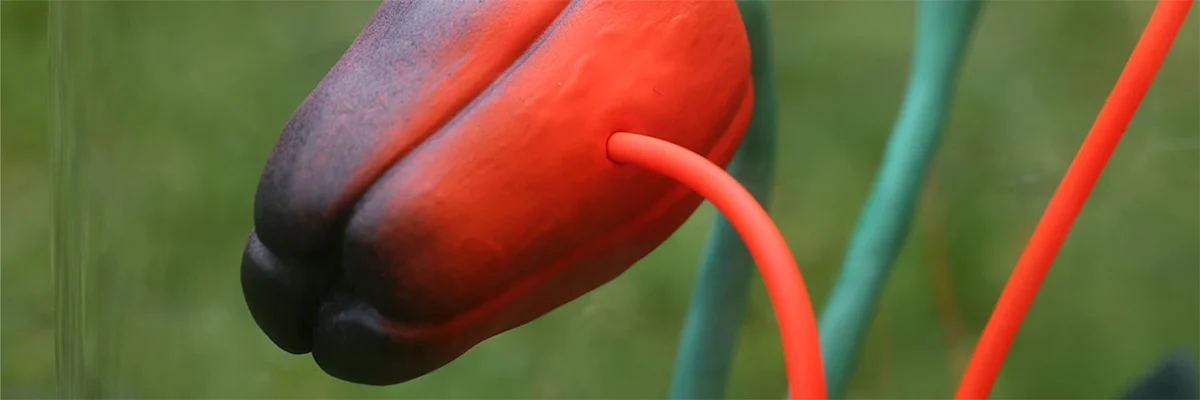
The 2026 installation in Milan features delicate, laboratory-raised flowers housed under transparent, climate-controlled domes. While the enclosure suggests a form of protection or preservation, the visual effect is one of quarantine. These flowers are isolated from the ecosystem, rendered inaccessible to the public, and reduced to specimens of a managed, artificial reality.

The accompanying signage, consistent with the tone of the previous two chapters, presents the "Omnia" brand as a sterile, professional entity. The slogan "One Force, One Future" acts as the centerpiece of the corporate branding, a phrase designed to sound unifying and forward-thinking while masking the contradictory nature of the company’s dual operations. The juxtaposition of the vulnerable, captive flowers against the aggressive, cold language of the corporate signage creates a tension that is central to the artists’ intent: the critique of "greenwashing" and the systematic sanitization of environmental decline.
Data and Contextual Trends
The themes explored by Biancoshock and Garbelli are not merely artistic metaphors; they reflect growing trends in global industrial consolidation. According to recent reports from the Stockholm International Peace Research Institute (SIPRI), the world’s top 100 arms-producing and military services companies have consistently seen revenue growth despite fluctuating global economic conditions. Simultaneously, the pharmaceutical industry has seen a massive surge in market consolidation, with major firms frequently pivoting toward "biosecurity" and "life-science" portfolios that mirror the rhetoric used by the artists in the exhibition.

The "frictionless" nature of these corporate structures—where a firm can simultaneously profit from global conflict and global health initiatives—is a documented phenomenon in corporate law and governance. Economists refer to this as "strategic diversification," a mechanism that allows large entities to mitigate risks by holding assets in opposing market sectors. In the context of the Apocalypse Trilogy, this strategy is presented not as efficient business management, but as an ethical bankruptcy that the public has been conditioned to accept as normal.
Theoretical Implications of Corporate Stewardship
The final chapter of the trilogy raises significant questions regarding the role of private corporations in environmental stewardship. In the 2026 installation, the "defense" of the flower becomes a form of ownership. By controlling the environment of the plant, the corporation effectively removes it from the commons. This mirrors real-world debates regarding "sustainability" initiatives, where critics argue that private entities often frame themselves as the saviors of the environment while engaging in extractive practices elsewhere.

Urban planning experts and sociologists have noted that the "packaging" of nature—restoring small, fenced-off plots of land while losing thousands of acres to industrial development—is a hallmark of modern urban environmental policy. The Apocalypse Trilogy captures this shift by showing that the "apocalypse" is not necessarily a sudden, cinematic collapse, but rather a slow, managed transition where the natural world is increasingly placed under glass, controlled by those who have the capital to manage its decline.
Public Reception and Artistic Legacy
The work of Biancoshock and Garbelli has long been characterized by its accessibility and its use of the urban environment as a canvas for social commentary. By placing these installations in public spaces in Milan, the artists force passersby to engage with the contradiction of their surroundings. The finality of the trilogy suggests a definitive statement on the state of the world in 2026, marking a turning point in the artists’ careers.

While the artists themselves have remained relatively quiet regarding the specific "solutions" to the problems they pose, the reaction from the public and the art community has been one of recognition. The trilogy has become a point of reference for discussions regarding the visual language of corporate power. By effectively "skewering" the language of corporate social responsibility, the artists have provided a vocabulary for the public to question the authenticity of the institutions that define their daily lives.
Future Outlook
As the Apocalypse Trilogy concludes, it leaves behind a legacy of critical inquiry. The transition from the "overcrowded" reality of 2021 to the "chemically assisted, glass-enclosed" reality of 2026 illustrates a perceived trajectory of progress that is inherently hollow. For observers, the question remains: if the future is being managed by entities like "Omnia," what becomes of the untamed, unmanaged, and truly wild parts of the world?

The final installment of the trilogy serves as a mirror. By presenting the corporate narrative in such a stark, minimalist fashion, Biancoshock and Garbelli have removed the distractions that usually accompany such discussions. They invite the viewer to look at the flower beneath the dome and decide whether the protection it receives is worth the cost of its freedom. As the project concludes, the silence of the installations in Milan speaks volumes about the trajectory of an era defined by the branding of survival and the commodification of the future.