
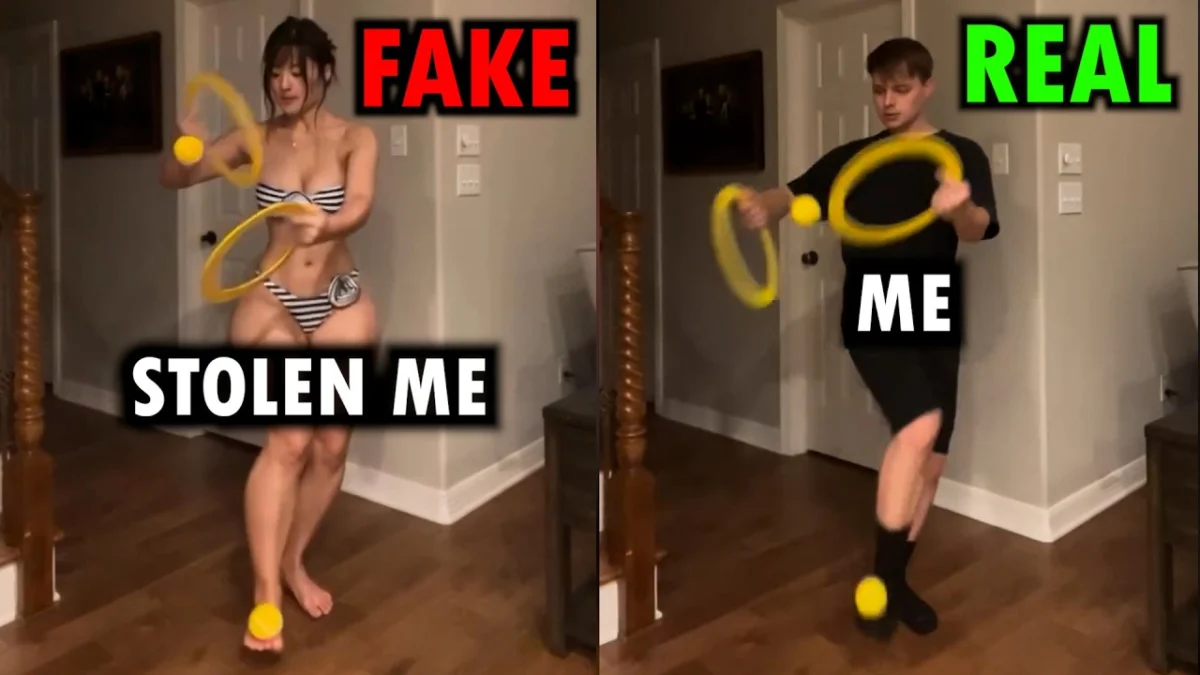
The modern digital landscape is facing an unprecedented crisis of authenticity, and members of the niche creative community are increasingly on the front lines. Champion juggler and performance artist Zak McAllister has added his voice to a growing chorus of creators condemning the proliferation of artificial intelligence-generated media, specifically targeting the unauthorized scraping, replication, and fabrication of human talent. In a newly released multimedia feature and commentary, McAllister explores how synthetic media, deepfakes, and automated generation tools are degrading the integrity of the internet, actively undermining independent creators, and threatening the fundamental concept of genuine human achievement.

The commentary, hosted via major juggling and performance networks, underscores an anxiety that has been quietly festering across the digital arts ecosystem for years. As generative artificial intelligence models become more sophisticated, the line between authentic human physical mastery and algorithmic approximation continues to blur. For performers like McAllister, whose craft relies on decades of rigorous physical training, muscle memory, and genuine risk, the rise of frictionless synthetic video creation poses an existential threat.

The Mechanics of Digital Exploitation
At the core of McAllister’s critique is the dual threat posed by AI-generated content: the unauthorized ingestion of existing creator portfolios to train machine learning models, and the mass production of synthetic lookalike videos that flood social media feeds. In his analysis, McAllister points out that algorithms trained on human performers often replicate intricate physical motions without attribution, compensation, or consent.

This technological paradigm shift relies on massive datasets scraped from public video platforms. When a professional juggler uploads footage of a complex, record-breaking pattern, that content frequently serves as raw training data for machine learning models. Once ingested, these models can synthesize similar visuals in seconds, effectively decoupling the art from the artist. The result is a saturated digital ecosystem where audiences are increasingly unable—or unconcerned—to distinguish between a human spending twenty years mastering a prop and an algorithm rendering pixels in real-time.

Furthermore, this dynamic creates a severe economic disadvantage. Independent artists depend on visibility, algorithmic reach, and platform monetization to sustain their careers. When automated content farms generate endless streams of derivative, AI-driven spectacle, they capture user attention spans that would otherwise support authentic creators. The economic model of the internet, which rewards engagement above all else, inadvertently incentivizes the mass production of synthetic noise over genuine human culture.

A Chronology of Growing Concern within the Performing Arts
The friction between performing artists and automated media tools did not emerge in a vacuum. The timeline of this digital transformation reveals a steady escalation of tension:

- Late 2022 to Early 2023: The widespread public release of advanced text-to-image and generative video models sparks initial alarm among visual artists and illustrators, though physical performers largely view the technology as a novelty with little bearing on physical arts.
- Mid-2023: Generative video platforms begin demonstrating improved physics engines, capable of simulating motion, gravity, and object trajectory with startling fidelity, prompting early warnings from niche sports and circus arts communities.
- 2024: Instances of deepfaked physical stunts and manipulated athletic feats begin going viral on mainstream social media platforms, frequently misleading millions of viewers and eclipsing real athletes in terms of algorithmic reach.
- 2025: Intellectual property theft becomes a mainstream legal battleground, with numerous class-action lawsuits filed by writers, actors, and visual artists against major AI developers. Performance artists begin organizing localized advocacy groups to address the lack of legal frameworks protecting bodily likeness and physical motion choreography.
- October 2026: Prominent figures like Zak McAllister elevate the discourse from specialized legal forums to the public eye, releasing direct multimedia critiques that frame AI content theft not merely as a copyright issue, but as a cultural emergency ruining the utility and trust of the internet.
Data and Disruption: The Quantitative Toll on Creators
While exact economic losses in niche fields like professional juggling and physical theater are difficult to quantify, broader digital creator surveys indicate a systemic downturn in audience monetization and reach. According to recent digital rights reports, over 70% of independent online creators express anxiety regarding the unauthorized use of their likeness and stylistic output by AI developers.

In the performing arts, the metrics of success are deeply tied to proof of human capability. The thrill of watching a juggler manage seven clubs or execute a blindfolded cascade relies entirely on the premise that failure is possible and that human discipline achieved the result. When AI tools synthesize perfect, physics-defying routines without consequence, the psychological value of the performance evaporates.

Industry analysts note that platform algorithms frequently favor high-frequency posting schedules. Human creators, constrained by the physical limits of endurance, injury recovery, and practice time, cannot compete with automated generation pipelines capable of producing dozens of hyper-optimized videos daily. This volume-based supremacy crowds out authentic human expression, forcing creators to either adapt by becoming commentators on their own art or abandon digital platforms altogether.

Industry and Institutional Responses
The response from technology companies developing generative tools has traditionally centered on fair use arguments and the transformative nature of AI training. Developers assert that machine learning models analyze data in a manner analogous to human inspiration—learning from existing works to create something new.

However, artists, legal scholars, and labor organizations strongly contest this framing. Organizations representing performers argue that physical motion, stylistic execution, and personal likeness are fundamentally distinct from abstract data points. Unlike a human artist who studies a master and interprets those lessons through personal experience, an AI model compresses and reproduces specific human labor at scale without reciprocity.

Legislative bodies worldwide are slowly attempting to catch up with the rapid pace of technological innovation. Initiatives such as the European Union’s Artificial Intelligence Act represent early efforts to mandate transparency regarding training data and copyright compliance. In the United States, proposed legislation focusing on the protection of likeness and voice rights—such as federal deepfake prevention acts—seeks to provide legal recourse for individuals whose digital identities are exploited. Yet, enforcement remains complex, slow, and frequently prohibitively expensive for independent creators.

Broader Implications for the Digital Commons
Zak McAllister’s warning touches on a philosophical question that extends far beyond the juggling community: What happens to the internet when human-generated content is drowned out by synthetic recursion?

As AI models increasingly train on data generated by other AI models—a phenomenon researchers refer to as "model collapse"—the quality of digital information risks severe degradation. If authentic human artistry, captured through physical sweat, error, and triumph, is no longer economically viable to produce, the foundational training material for future technologies will dry up. A digital ecosystem that feeds exclusively on its own synthetic output faces stagnation and homogeneity.

Furthermore, the erosion of trust in recorded media presents severe societal challenges. When video documentation can no longer serve as reliable proof of physical reality, public skepticism extends to all forms of media. For physical performers, whose entire professional identity rests on verifiable real-world skill, this skepticism strikes at the heart of their vocation.

A Call for Sustained Advocacy
McAllister’s intervention serves as a reminder that the preservation of digital authenticity requires active participation from both creators and consumers. Industry observers suggest several steps to mitigate the ongoing displacement of human artists:

- Strict Attribution and Consent Frameworks: Requiring AI developers to obtain explicit permission and provide financial compensation when utilizing creator archives for training purposes.
- Platform Transparency: Implementing mandatory labeling and watermarking for all synthetic and AI-generated media to ensure audiences can readily identify manipulated content.
- Community Support for Independent Creators: Encouraging digital audiences to directly support human artists through subscription models, direct patronage, and engagement with verifiable, live performances.
As the digital landscape continues to navigate the turbulent intersection of technology and art, the advocacy of figures like Zak McAllister highlights the resilience of human creativity. Whether policy makers and technology platforms will respond with adequate protections before independent artistry is permanently marginalized remains one of the defining questions of the digital age.