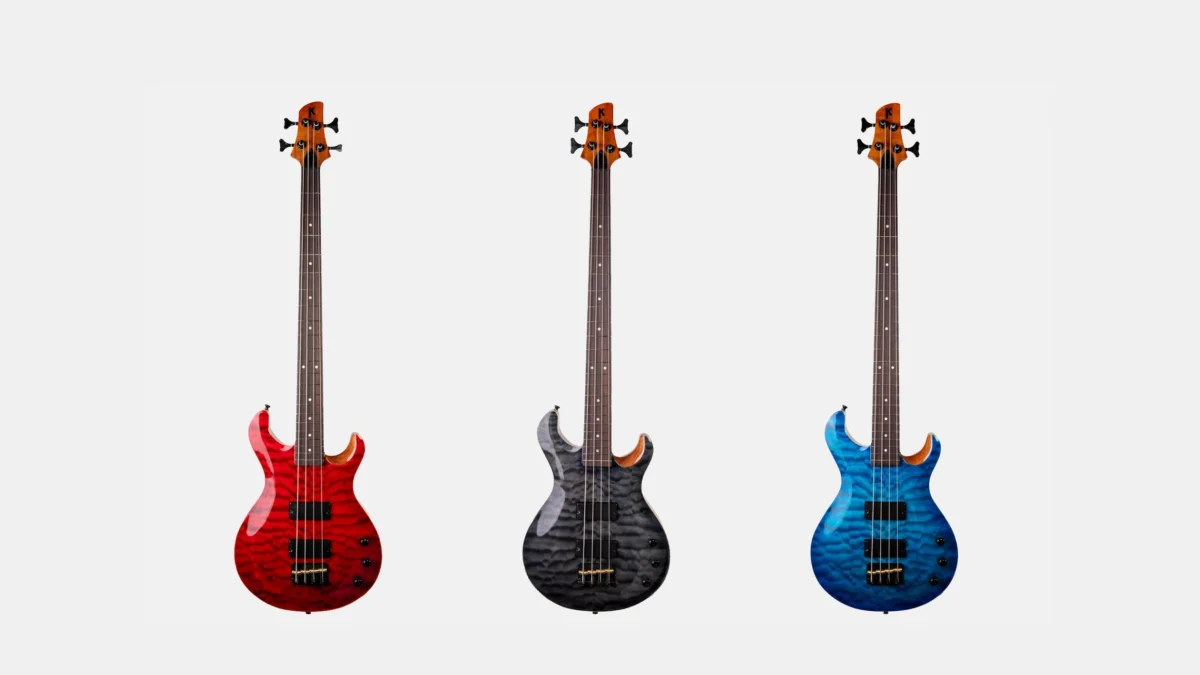
Kardinal Guitars has officially entered the competitive mid-market instrument sector with the announcement of the Kardinal Bass, a four-string electric bass engineered to bridge the gap between entry-level affordability and professional-grade performance. By positioning the instrument at a $549 pre-order price point, the manufacturer is challenging established industry norms that typically reserve high-end features—such as neck-through construction and stainless steel fretwork—for instruments priced significantly higher. The pre-order window for this inaugural model is currently open and is scheduled to conclude on November 20, 2026.
Engineering and Design Philosophy
The foundational design of the Kardinal Bass prioritizes structural integrity and acoustic resonance. Central to its architecture is a neck-through mahogany body design. In the context of bass guitar manufacturing, a neck-through configuration—where the neck wood extends the entire length of the instrument’s body—is widely regarded as superior to traditional bolt-on alternatives. This design choice inherently provides enhanced sustain and more stable vibration transfer from the strings to the body.
To complement the mahogany’s natural tonal warmth, the instrument features a quilted maple top. While this addition offers a sophisticated aesthetic appeal, it also serves to balance the inherent low-mid frequency dominance of the mahogany, potentially offering a more nuanced, articulate frequency response. The fingerboard is crafted from rosewood, chosen for its density and smooth tactile properties, and is finished with stainless steel frets. The decision to utilize stainless steel is notable; compared to the standard nickel-silver frets found on most basses in the $500 to $700 range, stainless steel offers significantly higher resistance to corrosion and wear, reducing the long-term maintenance requirements for the end-user.

Technical Specifications and Electronic Components
The electronics package of the Kardinal Bass reflects a move toward vintage-inspired, yet high-output performance. The instrument is equipped with a pair of custom-wound dual-coil soapbar pickups utilizing Alnico V magnets. The technical advantage of Alnico V magnets over the ceramic alternatives commonly found in mass-produced budget instruments lies in their magnetic field properties; Alnico V magnets offer a lower pull on the strings, which minimizes damping and allows for longer, cleaner sustain.
From a sound design perspective, these pickups have been voiced to offer a broad dynamic range. In field tests, passive instruments with this specific configuration are noted for their sensitivity to touch—allowing players to manipulate the instrument’s output intensity through picking technique rather than relying solely on onboard preamps. The internal circuitry features full-size potentiometers and a straightforward Volume/Tone/Blend control layout. By eschewing complex active circuitry in favor of a high-quality passive design, Kardinal Guitars is targeting a demographic of professional session musicians who prefer a signal path that is less susceptible to battery failure and digital artifacts.
The Launch Timeline and Availability
The release strategy for the Kardinal Bass follows a direct-to-consumer model, designed to minimize overhead costs and pass those savings directly to the consumer. The following timeline outlines the key milestones of the product launch:
- October 2026: Initial announcement and public unveiling of the three launch colorways: Cardinal Red, Sapphire Blue, and Midnight Black.
- October 2026 – November 20, 2026: The exclusive pre-order window. During this phase, customers can secure the instrument at the introductory price of $549.
- Post-November 20, 2026: Conclusion of the pre-order period, with subsequent production scheduling and fulfillment timelines to be announced for the general release.
By limiting the purchase channel exclusively to the official Kardinal Guitars website, the company is effectively bypassing traditional retail markups, a tactic that has become increasingly prevalent among boutique and mid-sized instrument manufacturers looking to disrupt the market share held by legacy brands.

Market Context and Industry Implications
The entry of the Kardinal Bass into the marketplace occurs at a time when consumer demand for "pro-sumer" grade gear is at an all-time high. Economic factors have shifted consumer sentiment toward instruments that offer high-value-to-cost ratios. According to recent market analysis in the musical instrument industry, there is a growing segment of musicians—specifically gigging professionals and home studio recording artists—who seek instruments that do not require aftermarket modifications to be "gig-ready."
The inclusion of features like stainless steel frets and neck-through construction at a $549 price point forces a re-evaluation of current market standards. Historically, these features were the hallmark of instruments retailing for $1,200 or more. If Kardinal Guitars maintains quality control consistency during the mass production phase, the Kardinal Bass may serve as a benchmark that forces larger, legacy manufacturers to adjust their entry-level and mid-range tiers to remain competitive.
Expert Analysis and Expected Performance
Professional bassists and instrument technicians often analyze new gear based on the "cost of ownership" over a five-year period. A primary driver of depreciation in lower-priced instruments is the necessity of "fret leveling" or replacement due to soft fret wire, and the degradation of electronic components such as scratchy potentiometers or weak solder joints. By utilizing full-size pots and stainless steel fret wire, the Kardinal Bass is engineered to mitigate these common failure points.
Furthermore, the choice of a 12-inch fingerboard radius suggests a versatile, modern approach to playability. A 12-inch radius provides a relatively flat playing surface, which is conducive to both chordal work and fast, technical playing, while still offering enough curve to maintain comfort for traditional fingerstyle technique. The overall design language suggests an instrument that is intended to sit comfortably in a dense mix, a critical requirement for modern production environments where frequency masking is a common concern for bass players.

Official Response and Consumer Reception
While the company has not issued a formal press statement regarding its growth strategy, the design of the Kardinal Bass signals a pivot toward "democratized performance." Industry insiders suggest that the company’s decision to focus on a single, high-spec four-string model rather than an expansive range of entry-level options is a strategic move to establish brand credibility.
The initial social media and forum reception has focused heavily on the aesthetic variety, with the Cardinal Red and Sapphire Blue finishes drawing significant attention for their visual depth. However, the technical specifications—specifically the neck-through mahogany construction—remain the primary talking point for the more analytical segment of the bass-playing community. The success of this launch will likely be measured not only by units sold during the pre-order period but by the secondary market reviews that will inevitably follow the first wave of deliveries in late 2026.
Conclusion
The Kardinal Bass represents a calculated effort by Kardinal Guitars to provide professional-grade utility to a broader segment of the musician population. By prioritizing structural construction, high-quality hardware, and a focused, passive electronic system, the company has created an instrument that serves as a functional tool rather than a budget compromise. As the November 20, 2026, pre-order deadline approaches, the music industry will be watching to see if this model successfully captures the market share it is clearly targeting. For players seeking a reliable, high-sustain, and aesthetically striking instrument without the premium price tag of boutique luthier-made basses, the Kardinal Bass offers a compelling case for consideration. Prospective buyers are encouraged to visit the official website for further documentation and technical specifications before the conclusion of the initial order phase.