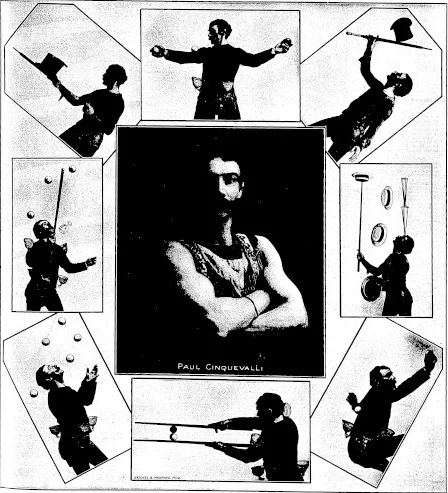
Paul Cinquevalli, born Emile Otto Lehmann-Braun on June 30, 1859, remains a towering figure in the annals of performing arts, often cited alongside legends such as Enrico Rastelli, Salerno, and Kara. His career, which spanned the late 19th and early 20th centuries, redefined the physical and creative boundaries of juggling. By moving away from the simplistic displays of his predecessors, Cinquevalli introduced a level of experimental complexity and showmanship that modern historians still struggle to fully replicate. His journey from a young gymnast in Posen, Poland, to the stages of royal command performances in London, represents a pivotal era in the evolution of variety entertainment.
The Formative Years: From Acrobatics to Manipulation
Emile Otto Lehmann-Braun’s transition into the world of performance began at age 14 when he fled his home to join the traveling troupe of Giuseppe Chiese-Cinquevalli. In the rigorous world of 19th-century circus life, he initially honed his skills as an acrobat and trapeze artist. However, a significant occupational hazard—a severe fall from the trapeze—forced him to reassess his professional trajectory.

Rather than abandoning the stage, Lehmann-Braun pivoted toward the precision-based discipline of juggling. Adopting the stage name Paul Cinquevalli, he began to develop a unique vocabulary of movement. Unlike the standard juggling acts of the Victorian era, which relied heavily on repetitive patterns, Cinquevalli’s methodology was rooted in the seamless integration of everyday objects into gravity-defying sequences. This shift required a fundamental change in his physical training, emphasizing hand-eye coordination and spatial awareness over the raw aerial strength required for trapeze work.
The Human Billiard Table: Innovation and Technique
Cinquevalli’s reputation was largely cemented by his ability to manipulate objects that were neither designed nor balanced for such tasks. The Juggling Hall of Fame notes that his repertoire included billiard cues, heavy steel balls, umbrellas, chairs, and household items. His most iconic routine—the "Human Billiard Table"—involved a complex display where he rolled billiard balls across the folds of his specially designed green felt jacket, catching them in strategically placed pockets.
This performance was not merely a feat of balance; it was an exercise in physics and sartorial engineering. By utilizing the friction and weight of the billiard balls against his clothing, he created a visual narrative that captivated audiences across Europe. Critics of the period described his work as a modernization of the craft, noting that he treated the stage not just as a platform, but as an interactive environment where the laws of motion could be manipulated to elicit wonder.

Chronology of a Remarkable Career
The rise of Paul Cinquevalli corresponds with the "Golden Age" of Vaudeville and Music Hall theater, a period marked by rapid international travel and the emergence of global stars.
- 1859: Born in Posen (then Prussia, now Poland) as Emile Otto Lehmann-Braun.
- 1873: Joins the Italian acrobatic company of Giuseppe Chiese-Cinquevalli at age 14.
- Late 1870s: Sustains a career-ending trapeze injury and transitions to professional juggling.
- 1880s–1890s: Reaches the peak of his fame, touring Europe and performing for royalty, including the King and Queen of England and the Prince of Wales.
- 1909: Publishes reflections on the rigorous nature of his craft in the North Otago Times and the Royal Magazine.
- 1914–1918: Faces professional and social marginalization due to his German heritage following the outbreak of World War I.
- 1918: Passes away in Brixton, London, on July 14, amidst the final months of the Great War.
The Physiological Demands of Elite Juggling
Cinquevalli’s own writings provide a rare glimpse into the physiological and psychological costs of maintaining an elite juggling career. In a 1909 editorial, he argued that "a juggler can never take a holiday," noting that even a week of inactivity could lead to a catastrophic loss of the muscle memory required for his complex routines. He famously described the experience of attempting to perform after a week of rest as a source of "horror," realizing that his mastery of the simplest feats had temporarily deserted him.
This necessity for constant, obsessive practice highlights the difference between amateur juggling and the high-stakes performance art of the 19th century. For Cinquevalli, the stage was a place where failure was immediately visible; he viewed his life not as a series of performances, but as an uninterrupted cycle of preparation. His commitment to "three billiard balls in one hand" while walking in the countryside suggests a level of devotion that borders on the ascetic, reinforcing the notion that his skill was the result of lifelong, unrelenting conditioning.

Social and Political Implications
The decline of Cinquevalli’s career during the final years of his life serves as a stark reminder of the intersection between personal success and geopolitical volatility. As a performer of German origin working in England, he found himself a victim of the intense nationalism that defined the First World War era. Despite decades of artistic contribution and cultural integration, his identity was reduced to his national background by a public that had previously hailed him as a master.
This social shunning resulted in a tragic end for a man who had entertained the highest echelons of European society. The transition from being a guest of the British Crown to a social outcast illustrates the precarious nature of public fame. It also serves as a historical case study for how immigrant artists are often susceptible to the whims of political conflict, regardless of their artistic legacy.
Analysis of His Lasting Influence
Modern juggling historians, such as Erik Aberg, have worked to preserve the memory of Cinquevalli’s technical contributions. Through works like Cleverer Than God, researchers have analyzed his journals and performance logs to understand how he achieved such high levels of consistency.
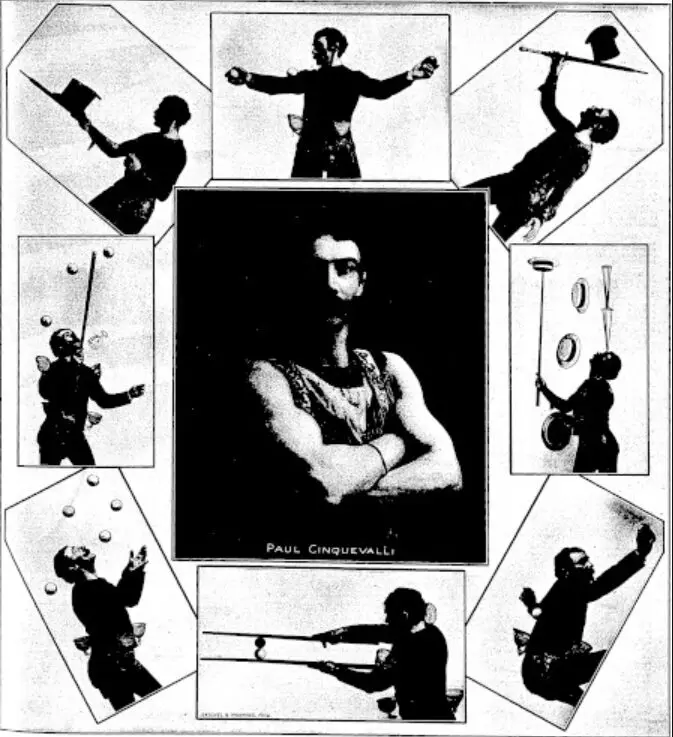
From an analytical standpoint, Cinquevalli’s influence on the craft is threefold:
- Object Manipulation: He expanded the definition of a "juggling prop," demonstrating that any object with mass and center of gravity could be part of a routine.
- Narrative Integration: He moved away from the "performer as athlete" model toward the "performer as storyteller," using costumes and physical props to create thematic sequences.
- Professional Standards: His insistence on constant practice and the rejection of seasonal breaks set a new benchmark for professional expectations within the variety arts.
While many of his specific routines have vanished from modern repertoires—partly because of their extreme difficulty and partly because they were tailored to the specific clothing and objects of his era—the core principles he established remain the foundation of contemporary manipulation arts.
Conclusion
Paul Cinquevalli’s life was defined by a singular focus that allowed him to rise above the common standards of his time. He was a pioneer who understood that the true art of juggling lay not in the speed of the toss, but in the precision of the catch and the ingenuity of the design. Though he died in relative isolation during the twilight of the Great War, his contributions to the history of performance remain secure.

For those interested in the technical minutiae of his craft, his personal confessions and instructional articles offer a roadmap of a bygone era. By examining the life of the "Human Billiard Table," we gain not only a better understanding of the history of juggling but also a profound respect for the dedication required to achieve greatness in an ephemeral art form. His legacy is a testament to the idea that, as he famously stated, "once a juggler, always a juggler." Even today, his life continues to inform, challenge, and inspire the next generation of practitioners who seek to push the boundaries of what is possible with nothing more than their hands and their environment.