
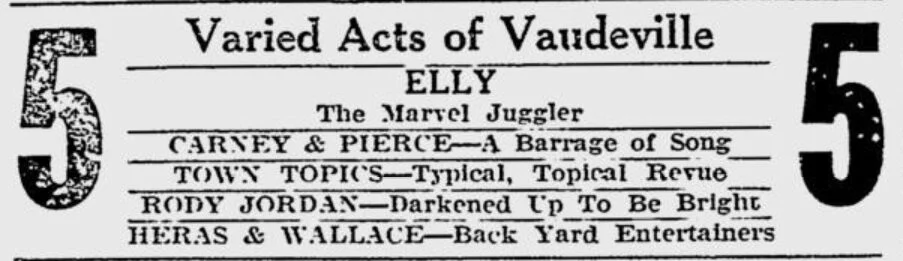
Decades after her star briefly illuminated the stages of North America and Europe, the identity and full story of Elly, billed as "the youngest female juggler in the world," remain shrouded in mystery. Despite captivating audiences and earning rave reviews in prominent newspapers across the United States, Canada, and the United Kingdom during the early 1920s, details of her personal life and career trajectory beyond a handful of performance critiques are virtually nonexistent. This article delves into the fragments of information available, piecing together a vivid picture of her remarkable act and exploring the broader context of vaudeville entertainment that allowed such prodigious talent to emerge and, sometimes, to vanish without a trace.
Vaudeville’s Golden Age and the Rise of Novelty Acts
The early 20th century marked the zenith of vaudeville, a popular theatrical genre characterized by a series of unrelated acts grouped together on a common bill. From comedians and musicians to magicians and acrobats, vaudeville offered diverse entertainment that appealed to broad audiences. Juggling, in particular, held a distinguished place within this landscape, evolving from simple street performances to intricate, stage-ready acts. Performers like Enrico Rastelli and Paul Cinquevalli pushed the boundaries of the art form, elevating it to an impressive display of skill and showmanship. Within this vibrant milieu, novelty acts, especially those featuring child prodigies or performers with unique specialties, were highly sought after. These acts often generated significant buzz, with promoters eager to highlight any extraordinary claim to draw crowds. It was against this backdrop that Elly, a young female juggler of seemingly astonishing talent, carved out her fleeting but memorable niche.
Female jugglers, while perhaps less numerous than their male counterparts, were an integral part of the vaudeville scene. They often brought a distinct grace and theatricality to their performances, sometimes specializing in balancing acts or manipulating lighter objects, though many defied such stereotypes. The press frequently emphasized their "daintiness" or "petite" stature, creating a contrast with the incredible strength and dexterity they displayed. This framing contributed to the "marvel" aspect of their acts, making their feats seem even more improbable and captivating. Elly’s persona, as described by critics, perfectly embodied this blend of youthful charm and formidable skill, presenting a refined yet breathtaking spectacle.

A Chronology of Acclaim: Elly’s Touring Years (1920-1926)
The limited existing records of Elly’s career predominantly comprise newspaper clippings from a six-year period, from 1920 to 1926, tracing her performances across North America and into Britain. These reviews, though brief, offer invaluable glimpses into the nature and impact of her act, consistently emphasizing her youth, skill, and unique blend of juggling and balancing.
One of the earliest documented mentions comes from the Canadian newspaper The Montreal Gazette, in its June 15, 1920, edition. The review speculated on Elly’s age, describing her as a "diminutive and dainty miss in her middle teens" who performed a "juggling turn which would be remarkable for even an adult." This initial assessment immediately established her as a prodigious talent whose abilities defied her apparent youth, setting the stage for the widespread acclaim that would follow. The emphasis on her being in her "middle teens" also lends credence to the "youngest female juggler" billing, suggesting she was indeed remarkably young for such a demanding profession.
Just a month and a half later, The Vancouver Sun, on September 2, 1920, provided a more detailed account of Elly’s act at the Orpheum Theatre. The reviewer lauded the entire program, noting that "there is not an act on the Orpheum programme this week that does not please immensely." Elly, described as the "diminutive feminine juggler," was highlighted for her opening act, which involved balancing "parlor furniture on her nose" and executing an "immense amount of rapid and seemingly careless handling of butcher knives, spoons and other kitchen utensils." This description not only confirmed her mastery of delicate balancing but also revealed a daring side to her act, incorporating potentially dangerous objects with an air of nonchalance, a hallmark of skilled jugglers.
Eighteen days later, the American newspaper San Francisco Call echoed the sentiments in its September 20, 1920, edition. The paper described the program as "snappy from start to finish" and reiterated Elly’s billing as "the youngest [female] juggler in the world." The review painted a vivid picture of her stage presence: "In a short frock and with her blond hair bobbed, the attractive little Elly skips playfully through an act that might well raise beads of perspiration on the brow of the largest, if not the oldest [male] juggler in the world, whoever he may be." This evocative language underscored not only her technical prowess but also her captivating stage persona. The article further elaborated on her feats, stating, "Elly throws furniture and other articles about with surprising ease, grace and dexterity. Carelessly she climbs up and down a two-sided stepladder, a life-sized sofa, or is it a chaise longue, poised nonchalantly on her forehead." This detailed account solidified her signature act: balancing substantial furniture, such as a sofa or chaise longue, on her head or forehead while navigating a stepladder.

The Sacramento Daily Union, on October 4, 1920, further cemented the impression of Elly’s extraordinary balancing skills. It stated, "Elly, the youngest feminine juggler in the world, so billed, is only a slip of a girl, but it seemed the easiest thing in the world for her to balance a large divan on her head while she ascended and descended a step ladder." The consistent mention of her balancing a large piece of furniture while moving up and down a ladder across multiple reviews indicates this was a central, highly impressive, and memorable part of her routine.
Her reach extended beyond North America, as evidenced by a mention in the British newspaper The Sunday Chronicle on July 17, 1921. Here, Elly was referred to as "the little marvel," performing "amazing juggling stunts with an unusual selection of objects to be juggled." The review praised her as a "youthful prodigy whose dexterity is astounding," assuring that "Paterson audiences will be immeasurably pleased with her work." This review highlighted the intricate nature of her feats and her ability to win over audiences with her cleverness.
Further details emerged from The Day, another British newspaper, on February 25, 1922. This review offered one of the most comprehensive descriptions of her diverse repertoire: "Elly, the little marvel, is feminine. Most women of course are marvelous, but Elly is marvelous in a way not usual to either sex. She is a petite and dainty juggler. This child of indeterminate age does amazing juggling stunts with an unusual selection of objects to be juggled. It might be safely said that the youthful prodigy balanced everything except the kitchen sink on the pudgy pink tip of her infantile nose; knives, forks and spoons, a dishpan, a clock, whirling disks and oranges, and last but not least a real upholstered sofa while climbing up and down a la ider." This account confirmed her versatility, encompassing both small object manipulation and large-scale balancing, and humorously exaggerated her skill with the "kitchen sink" analogy. The phrase "child of indeterminate age" also subtly reinforces the vaudeville practice of maintaining an air of mystery around performers’ exact ages to enhance their "prodigy" appeal.
In 1924, Elly was back in the American press, with The Troy Sunday Budget in New York reporting on October 19, 1924. This review focused on the artistic quality of her performance: "Elly, the little marvel, is a petite and dainty juggler. There is an air of refinement about her work that makes it drawing room deportment rather than the gymnasium. This fact, however, must not imply that Elly’s feats are not difficult for her routine is composed of many of the most difficult under- takings yet attempted in her line of endeavor." This suggests Elly transcended mere technical skill, infusing her act with elegance and sophistication, making her physically demanding feats appear effortless and graceful, suitable for any refined audience.
By 1926, Elly’s reputation continued to command attention, particularly in California. The Los Angeles Herald, on July 5, 1926, enthusiastically endorsed her: "Speaking of honest-to-goodness jugglers -Little Elly is not to be left in the background. She is apparently only a small child billed as the world’s youngest juggler, and comes closer to living up to her billing than you would naturally think. She can even hold a sofa- yes, a real soft that you sit on-on her chin and walk up and down the flight of steps approximately 20 feet high." This review added a new dimension to her balancing act, noting she could balance a sofa on her chin while ascending and descending a significant flight of steps, further illustrating the extreme difficulty and variety within her routine.

The Evening Express (Los Angeles), on July 6, 1926, published an article titled "LITTLE ELLY IS LIKE SAMSON IN PETTICOATS," underscoring her incredible strength despite her diminutive appearance. The piece praised her as an exception to the rule that women rarely acquire much skill as jugglers, stating, "She balances furniture on her head as easily as most school girls play jacks." This review also provided a delightful description of her stage setting: "In a nursery setting marching sol with diers and fantastic animals on the wall-paper Elly trips up and down the ladder with cat- like grace, balancing a full-Then she trots lightly over the stage with bric-a-brac and marble statues balanced on an Indian club that rests on her head. So careful is Elly in her maneuvers that she does not mar these art objects." This paints a picture of a whimsical, charming stage design that contrasted with the sheer physical demands of her act, adding another layer to her captivating performance. The inclusion of balancing "bric-a-brac and marble statues" on an Indian club further demonstrates her precision and delicate control.
The Art of Balancing: Analyzing Elly’s Feats
Elly’s act, as gleaned from these varied reviews, was a formidable display of both object manipulation and equilibrium. The consistent mention of her balancing a sofa (or divan, chaise longue) on her head or chin while ascending and descending a stepladder highlights a feat of extraordinary difficulty. This act requires immense core strength, neck stability, spatial awareness, and precise muscle control. To maintain balance with a large, unwieldy object while shifting one’s center of gravity on a moving ladder is a testament to years of rigorous training and innate talent. The fact that she could do this while being described as a "diminutive" or "petite" teenager makes her accomplishments all the more astounding.
Her repertoire extended beyond heavy furniture. The manipulation of "butcher knives, spoons and other kitchen utensils," along with "whirling disks and oranges," showcases her proficiency in more traditional juggling patterns. Balancing smaller, delicate items like "knives, forks and spoons, a dishpan, a clock," and even "marble statues on an Indian club" on her nose or head further illustrates her exceptional precision and fine motor control. These acts, though less visually dramatic than the sofa balance, require an equally high degree of concentration and sensitivity to weight distribution.
Elly in Context: A Peer to Kathi Gultini

The article mentions the German juggler Kathi Gultini, a contemporary who was also renowned for balancing a sofa and juggling four cushions simultaneously. This comparison is crucial for understanding the caliber of Elly’s talent. Gultini was a globally recognized name, and the fact that Elly’s signature act mirrored one of Gultini’s most famous feats places Elly squarely among the elite jugglers of her time. While Gultini’s act also included cushion juggling, Elly’s unique combination of balancing heavy furniture with the seemingly careless handling of dangerous kitchen implements and delicate art objects suggests a distinctive approach that made her stand out even in a crowded field of talented performers. This parallel confirms that Elly was not merely a local sensation but a performer whose skills were comparable to, and perhaps even rivaled, international stars.
The claim of being "the youngest female juggler in the world" was a powerful marketing tool, common in vaudeville. While the exact veracity of such claims is often difficult to ascertain definitively, the recurring descriptions of Elly as a "miss in her middle teens," a "slip of a girl," or a "child of indeterminate age" strongly suggest she was indeed remarkably young for the level of skill she exhibited. This youth undoubtedly contributed to the "marvel" factor, making her performances even more impressive to audiences.
The Enduring Enigma and Legacy of Lost Histories
Despite her evident success and widespread acclaim, Elly’s story concludes abruptly in the historical record. After 1926, the press mentions cease, leaving behind a tantalizing enigma. Was Elly a stage name for a performer who later adopted a different identity? Did she retire from the stage at a young age, perhaps to pursue a different life? The lack of any subsequent information about her artistic career or personal life underscores a broader challenge in documenting the histories of vaudeville performers, particularly women, whose records were often less comprehensively preserved than those of male stars. The ephemeral nature of live performance, coupled with the absence of comprehensive biographical databases from that era, means that many talented individuals like Elly have largely faded from collective memory, their lives reduced to scattered press clippings.
Elly’s story, pieced together from these precious fragments, serves as a poignant reminder of the countless performers who graced the stages of the early 20th century. While her personal narrative remains largely untold, the collective memory of her dazzling performances, meticulously described by contemporary journalists, ensures that her legacy as a truly remarkable "little marvel" endures. Her extraordinary feats, combining strength, grace, and unparalleled dexterity, solidify her place as a significant, albeit mysterious, figure in the annals of juggling history, prompting future researchers to continue searching for the elusive details that might one day complete the picture of this forgotten prodigy. The snippets of information available highlight the immense value of archival research in resurrecting these lost voices and celebrating the forgotten artistry of a bygone era.