The historical preservation of circus arts and physical performance often relies on the meticulous recovery of ephemera left behind in twentieth-century periodicals. Recently, comprehensive archival research conducted by sports juggler and historian Esteban Vélez has successfully reconstructed a rare, syndicated series of instructional columns penned by Rasso, one of the most celebrated European and American jugglers of the early 20th century. Originally published across various United States newspapers between late 1921 and early 1922, these ten foundational lessons offer an unprecedented glimpse into the pedagogical methods of a bygone era of variety entertainment. By bridging the gap between professional mastery and amateur accessibility, the recovery of Rasso’s writings provides modern historians and practitioners alike with a structured timeline of how classic prop manipulation was once communicated to the general public.
A Cosmopolitan Upbringing in the Golden Age of Variety Arts
To understand the weight of Rasso’s instructional guides, one must examine the itinerant and artistic milieu from which he emerged. Born in Strasbourg, within the contested region of Alsace-Lorraine, the future master entered a household deeply embedded in the performing arts. His father enjoyed renown as a professional juggler and a core member of the celebrated "Rasso Trio," while his mother pursued a career as an opera singer. This dual exposure to theatrical precision and physical discipline laid the groundwork for an unconventional childhood.

According to historical interview transcripts—most notably a 1922 feature in The Herald—Rasso’s early education was as mobile as it was eclectic. Sent to Italy under the care of his mother to study vocal performance with the renowned maestro Ugulini, the young Rasso spent his formative years up to the age of nine attending an English convent school, where he achieved fluency in both English and French. Yet, the gravitational pull of his father’s profession proved stronger than classical vocal training. Rasso frequently recounted spending his youth rehearsing in the subterranean dungeons of the Roman Colosseum, utilizing ancient stones to mimic the prop manipulation he witnessed at home.
Upon returning to Strasbourg to finalize his formal education, Rasso received direct, rigorous training from his father. By the time he left school at the age of seventeen, his mastery had expanded from traditional apparatus to encompass virtually every loose object within the institution, famously including his own textbooks. This eclectic foundation propelled him into an extensive international touring career, taking him across major cultural capitals in the United States, France, Germany, and Italy, cementing his reputation as an elite virtuoso of the vaudeville and variety stage.
Chronology and Syndication of the 1922 Print Masterclass
The emergence of instructional columns in mainstream newspapers during the 1920s represented a unique intersection of popular journalism and physical culture. Newspapers such as the Oakland Tribune and the Long Beach Telegram frequently featured DIY guides, hobbyist columns, and expert-authored masterclasses to engage readers seeking accessible forms of home entertainment and self-improvement following the disruptions of the First World War.

Rasso’s series, collectively titled "Easy Juggling," debuted in late 1921 and continued into the spring of 1922. Through meticulous archival recovery, Vélez compiled the complete sequence of ten lessons. Rather than targeting individuals aspiring to join the grueling ranks of professional vaudeville, the columns were deliberately tailored for the amateur enthusiast. Rasso maintained that professional execution required a rare combination of theatrical showmanship and innate physical talent, advising lay readers to view the exercises as a means to cultivate coordination and develop a deeper appreciation for stage performances.
Anatomy of Lesson One: The Single Vertical Throw
The inaugural lesson of the series, published in the Oakland Tribune on March 12, 1922, established the baseline mechanical requirements for all subsequent manipulation. Rasso utilized a touch of autobiographical humor to emphasize the necessity of proper environmental discipline, recalling how his early domestic trials in his mother’s kitchen—abruptly halted by a stray ball shattering a prized porcelain set—prompted a relocation to the safety of the family barn.
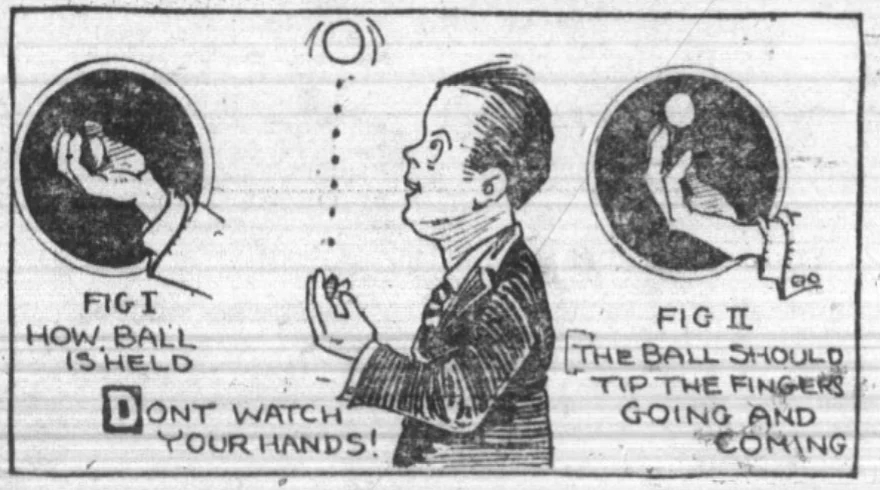
From a technical standpoint, Lesson One introduced the "single vertical throw," executed with a single prop. Rasso advised readers to source inexpensive hard rubber balls measuring roughly one and a half to two inches in diameter from local variety stores, noting that a modest investment of ten cents per ball would yield equipment comparable to professional standards.

The mechanics outlined in the 1922 column emphasize fluid ergonomics over rigid control:
- The Grip: The ball must be held loosely in the palm, secured gently by the fingers near the upper region of the palm.
- The Release: The throw is initiated with a smooth upward motion, allowing the ball to roll naturally over the fingertips, which act as a guide to ensure a true vertical trajectory.
- The Catch: Rasso explicitly warned against catching the object with a flat, rigid palm that produces an audible slap, as this increases the likelihood of rebounds and dropped props. Instead, the ball should first touch the fingertips and gracefully roll inward as the hand naturally encloses around it.
- Posture and Height: Beginners were instructed to limit tosses to a manageable height of approximately twelve inches (roughly thirty centimeters), maintaining a loose, free-swinging arm with relaxed elbows rather than keeping the arms stiffly pinned to the torso. Crucially, practitioners were directed to focus their gaze entirely on the ball rather than their own hands, training the eye to anticipate spatial trajectories.
Advancing to Lesson Two: The Double Vertical Throw
Published shortly prior in the Long Beach Telegram on November 29, 1921, the second installment elevated the practitioner’s skill ceiling by introducing simultaneous manipulation of two objects within a single hand. Rasso noted this milestone as a point of personal pride from his youth, acknowledging that mastering the dual-prop configuration required overcoming initial organizational challenges regarding hand geometry.
The mechanics of the "double vertical throw" rely on a precise division of labor within the hand:

- Dual Grip Configuration: The first ball is seated deep within the palm, secured by the ring and little fingers. The second ball is positioned forward, held in readiness by the thumb, index, and middle fingers.
- Execution Sequence: The ball held externally by the fingers is always initiated first, rolling over the fingertips upon release. As it departs, the palm-held ball transitions forward to occupy the vacated finger position.
- Trajectory and Pacing: Building directly upon the single vertical foundation, the practitioner tosses the first ball (Ball A) to a height of approximately two feet (sixty centimeters). Rather than a strictly flat vertical plane, Ball A is directed slightly off-axis so that its descent occurs roughly two inches to the right of its ascent. Just as Ball A reaches its apex and begins its downward path, the second ball (Ball B) is launched upward along the primary vertical channel. This staggered timing prevents mid-air collisions, creating a continuous, wheel-like rotational flow as Ball A is caught and immediately re-thrown.
- Alternative Variations: Rasso also documented a secondary variation wherein Ball A maintains an exact vertical course while the hand shifts laterally to establish an independent, parallel trajectory for Ball B, requiring rhythmic hand repositioning to catch and relaunch each object sequentially.
Implications and Historical Significance of Archival Recovery
The systematic documentation and re-publication of Rasso’s lessons carry significant value for contemporary prop manipulation historians, educators, and circus arts researchers. During an era when physical skills were predominantly transmitted via oral tradition, apprenticeship, or direct observation in theater backstage areas, the decision to codify juggling techniques in mass-circulation newspapers represented a democratization of performance arts.
By analyzing these instructional texts, modern researchers gain insight into the standardization of juggling nomenclature and pedagogy in the early twentieth century. The pedagogical progression—moving deliberately from a single object spatial awareness exercise to multi-object rhythmic cadence—mirrors modern sports science methodologies for developing hand-eye coordination and motor skill acquisition. Furthermore, recovering these texts rescues a vital piece of European-American variety history from obscurity, ensuring that the legacy of performers like Rasso extends beyond brief theatrical directory entries into the active historical record of physical culture.