
The preservation of early twentieth-century popular culture has taken a fascinating turn for the international juggling community, thanks to the ongoing archival research of performer and historian Esteban Vélez. In his latest installment exploring a rare 1921–1922 newspaper series titled Easy Juggling, Vélez brings to light lessons three and four written by the celebrated French-born performer known simply as Rasso. Originally published across various American newspapers—including the Long Beach Telegram—these historical tutorials provide an invaluable window into how technical proficiency, pedagogical methodologies, and foundational performance skills were transmitted to the general public during the roaring twenties.
This ongoing archival recovery project not only highlights the evolution of prop manipulation as both a performing art and a recreational pastime, but it also underscores the linguistic and technical shifts that have occurred in the juggling lexicon over the past century. As contemporary practitioners analyze these vintage columns, they are offered a rare glimpse into the pedagogical framework used by touring professionals of the vaudeville era to demystify complex physical disciplines for everyday readers, particularly aspiring youths.
Historical Context and the Legacy of the Rasso Family
To fully understand the significance of the Easy Juggling series, one must examine the backdrop of the entertainment industry during the early 1920s. Vaudeville was nearing its golden age peak in the United States, and touring European specialty acts were heavily sought after by major theater circuits. Among these traveling performers was the Rasso family. Rasso himself was born into a rich theatrical lineage in France; his father was an esteemed juggler and a prominent member of the renowned "Rasso Trio," while his mother enjoyed a successful career as an opera singer.
Immersed in this artistic environment from early childhood, Rasso naturally gravitated toward the mastery of object manipulation. His career eventually spanned multiple continents, with successful tours across the United States, Germany, France, and various other nations. By the time he penned his ten-part newspaper series in the winter of 1921, the modern mass media landscape was expanding rapidly. Newspapers frequently utilized syndicated instructional columns—ranging from domestic housekeeping tips to physical culture and sports tutorials—to engage readers and drive circulation. Rasso’s decision to publish a step-by-step guide to juggling represented a pioneering effort in popularizing a niche performance art for a mainstream, domestic audience.
Chronology of the Archival Discovery

The rediscovery of Rasso’s instructional columns is the culmination of meticulous historical research involving extensive database searches of 1920s United States newspaper archives. Vélez’s investigative undertaking required combing through brittle, digitized, and microfilmed regional publications to piece together the complete ten-part series.
The chronological rollout of the series in late 1921 marked a deliberate pedagogical progression. While the first two lessons introduced absolute beginners to the foundational concepts of holding and tossing single objects and basic vertical throws, lessons three and four—published on December 6 and December 13, 1921, respectively—escalated the physical demands placed on the reader. By transitioning from fundamental single-hand control to multi-prop coordination, Rasso structured his curriculum to mirror the natural learning curve of a professional protege, adapted safely for the average household reader.
Linguistic Evolution and Terminology Shifts
A critical element of Vélez’s commentary on the Rasso series involves the evolution of juggling terminology. Modern jugglers reading the 1921 texts will immediately notice a divergence between historical nomenclature and contemporary standard definitions.
In Lesson 3, Rasso introduces a multi-ball pattern that he explicitly terms the "triple wheel." In modern toss juggling, this exact mechanical pattern is universally recognized as the "shower." Conversely, the trick Rasso describes in Lesson 4 under the title of "shower" corresponds to what today’s practitioners define as the "cascade."
This semantic shift is of profound interest to historians of circus and variety arts. In the early decades of the twentieth century, standardized notation systems such as Siteswap—which revolutionized how juggling patterns are mathematically described today—did not exist. Instructors relied on descriptive metaphors, visual imagery, and mechanical comparisons (such as comparing a pattern to the rotating motion of a wheel or the falling movement of a shower) to communicate spatial dynamics. Understanding these historical translation discrepancies is essential for modern researchers attempting to reconstruct and interpret nineteenth- and twentieth-century instructional literature accurately.
Breaking Down Lesson 3: The Mechanics of the "Triple Wheel"

Published in the Long Beach Telegram on December 6, 1921, Lesson 3 focused on advancing the learner from basic two-hand coordination to the complex execution of three objects. Rasso opened the installment with characteristic enthusiasm, reflecting on the personal milestone of transitioning from a two-ball single-hand exercise to a three-ball pattern distributed across both hands.
According to Rasso’s instructional text, success in the "triple wheel" relied heavily on spatial accuracy during throws paired with rapid, disciplined hand mobility. The learning progression was meticulously broken down:
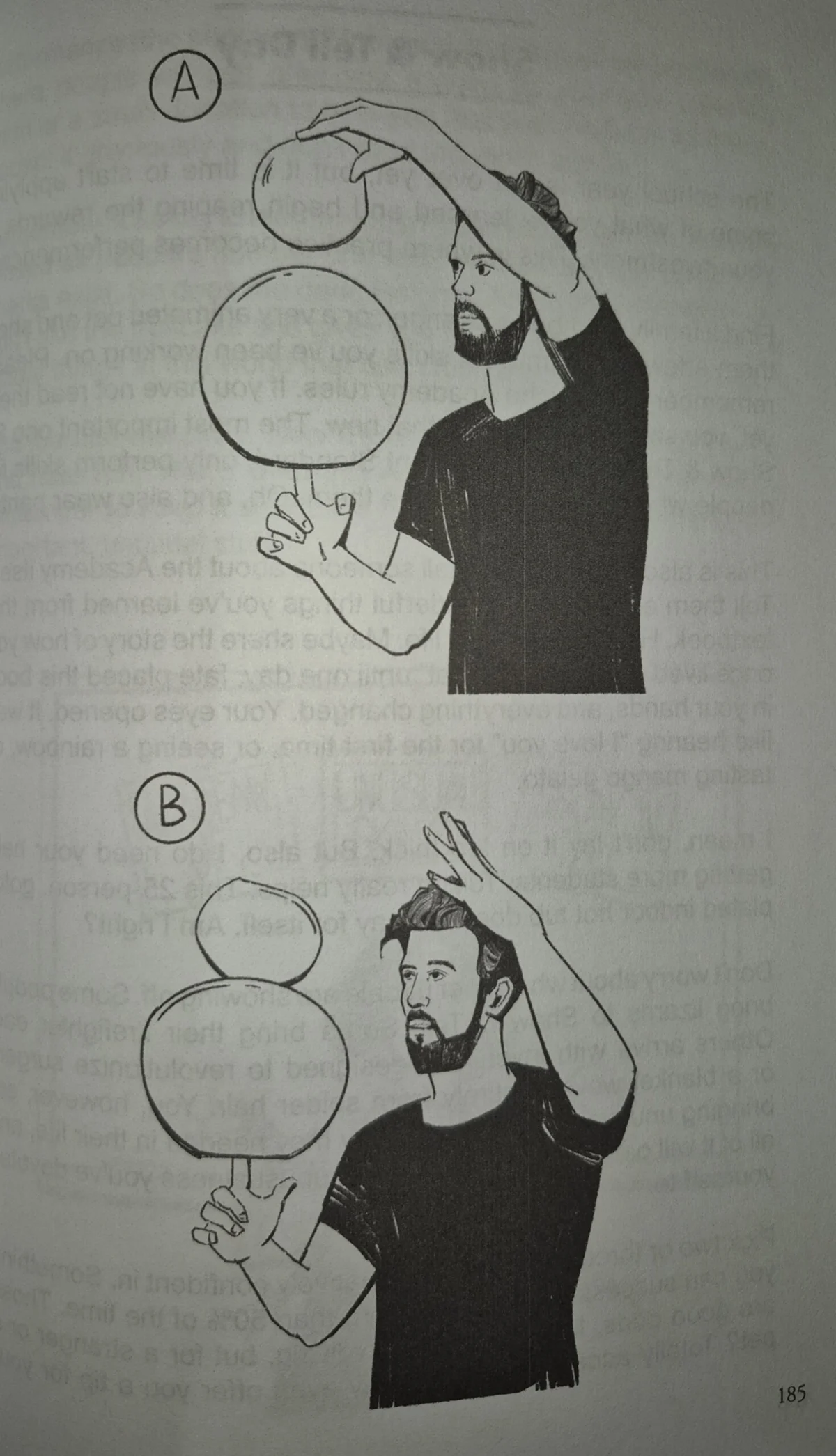
- Arc Pass: The student began by passing a single ball back and forth in an arc roughly one and a half feet high, maintaining relaxed arms to ensure natural freedom of movement.
- Horizontal Pass: The student practiced passing the ball directly across in a straight, horizontal pathway from one hand to the other.
- Single Wheel Combination: By merging the arc pass and the horizontal pass, the student formed a continuous circular motion (for a right-handed person, initiating the throw from the right hand).
- Introducing the Second and Third Props: Rasso systematically guided the reader to incorporate a second ball, timing the horizontal pass of the second object with the peak of the first ball’s arc. Finally, the introduction of the third ball required holding two objects in the dominant hand and one in the non-dominant hand, executing precise timing to clear space for incoming catches at an elevation of approximately three feet.
Despite the inherent difficulty, Rasso maintained an encouraging tone, assuring readers that the average boy or child could master the stunt with adequate dedication.
Breaking Down Lesson 4: Mastering the "Triple Shower"
The fourth lesson, appearing in the same publication just one week later on December 13, 1921, tackled what Rasso regarded as the most challenging stunt in his entire ten-part curriculum: the "triple shower" (the modern cascade).
Rasso acknowledged the psychological hurdle of learning the trick, explicitly warning readers that it represented the peak technical difficulty of the series, yet firmly encouraging perseverance. The pedagogical breakdown required a complete rethinking of hand-to-hand trajectory:
- Unlike the circular routing of the wheel pattern, the shower technique demanded that the initial ball be tossed in a curve that hovered directly over the receiving hand before beginning its descent.
- The instructor noted a common physiological hurdle: right-handed individuals naturally experienced a temporary lack of control when operating with the non-dominant left hand, a deficit that could only be corrected through deliberate, repetitive practice.
- As the second and third balls were integrated, the tempo of the exercise accelerated dramatically. To compensate for the required hand-shifting speed, Rasso advised students to elevate their throws to approximately three feet, granting the hands vital fractions of a second to reposition.
The lesson concluded with a look ahead toward the broader scope of the physical curriculum, promising that subsequent installments would shift away from ball manipulation to explore the manipulation of elongated objects such as sticks, bottles, and traditional Indian clubs.

Fact-Based Analysis of Implications and Pedagogical Value
The publication and subsequent modern analysis of Rasso’s lessons offer significant insights into the history of physical education and recreation. Historians note several key implications of these archival findings:
- Democratization of Elite Skills: By bringing circus-level prop manipulation into the daily newspaper format, performers like Rasso played a vital role in transforming juggling from an exclusive, insular trade secret passed down within theatrical families into an accessible recreational hobby.
- Standardization of Physical Literacy: The structured, incremental approach seen in Rasso’s columns laid early groundwork for modern sports coaching methodologies, emphasizing foundational muscle memory before attempting complex multi-object integration.
- Preservation of Intangible Cultural Heritage: Archival projects led by researchers like Vélez safeguard the ephemeral history of variety arts, ensuring that the methodologies of nineteenth- and twentieth-century masters are not lost to time.
Broader Impact on the Modern Juggling Community
Today, the global juggling community places immense value on historical preservation. Organizations such as the International Jugglers’ Association (IJA) and independent researchers actively support the digitization and study of vintage instructional materials.
The revival of Rasso’s work serves as a bridge between generations of performers. While modern learners benefit from high-definition video tutorials, motion-capture analysis, and standardized notation, examining texts from 1921 reminds the contemporary community of the universal challenges inherent in mastering physical coordination. Rasso’s emphasis on patience, relaxation, and systematic progression remains just as relevant in the digital age as it was in the era of printing presses and local metropolitan newspapers. Through the diligent efforts of historians unearthing these forgotten columns, the foundational legacy of early twentieth-century masters continues to inspire new generations of prop manipulation enthusiasts around the world.