
The history of professional variety performance is often defined by the names that dominated marquee lights, yet the art form’s true architecture was built by dedicated performers whose names have faded from public memory. Among these are Raymond Pike and his son, Raymond Charles Pike—known professionally as Bobby Winters. Though their careers spanned the most transformative eras of 20th-century entertainment, from the golden age of Vaudeville to the television era, they remained largely overlooked by modern historians until recent archival discoveries. By examining their trajectories, one gains a clearer understanding of the evolution of American stage craft, the rigors of the mid-century circus circuit, and the persistent influence of familial legacy in the arts.

The Formative Era: Raymond Pike and the Vaudeville Tradition
Raymond Henry Pike, born in 1893, emerged into a performance landscape characterized by rapid shifts in consumer taste. His career began in the early 1910s, a period when physical comedy and variety acts were the bedrock of American theater. For 42 years, Pike operated as a multi-disciplinary entertainer, transitioning from a foundation in acrobatics—where he spent his first 16 years—into the technical discipline of juggling.
Historical accounts, notably those documented by renowned collector Larry Weeks, provide a rare window into the structure of a classic 15-minute variety act during the 1920s and 30s. Pike’s performance was noted for its technical diversity: opening with a routine involving a tennis racket and two balls, he moved seamlessly into four-hoop manipulation and a sophisticated three-stick sequence. Perhaps his most enduring contribution to the era was his "drunken juggler" persona, a character-driven act that blended high-level coordination with the "cute business" and physical comedy necessary to maintain audience engagement in large, often raucous, theaters.

Pike’s professional dedication was punctuated by his commitment to his peers. Serving as the president of the Boston branch of the American Guild of Variety Artists (AGVA) just before the Second World War, he represented the interests of performers during a time of immense economic uncertainty. As global conflict intensified, Pike opted to transition his talents to the United Service Organizations (USO), performing for troops overseas. This shift from commercial theater to morale-boosting service was common among high-caliber performers of his generation, reflecting a sense of duty that frequently placed their artistic development secondary to national requirements. Pike’s death in 1948 at the age of 55 marked the end of a prolific career, but his influence was already being felt through the emergence of his son.
The Transition to Modernity: The Rise of Bobby Winters
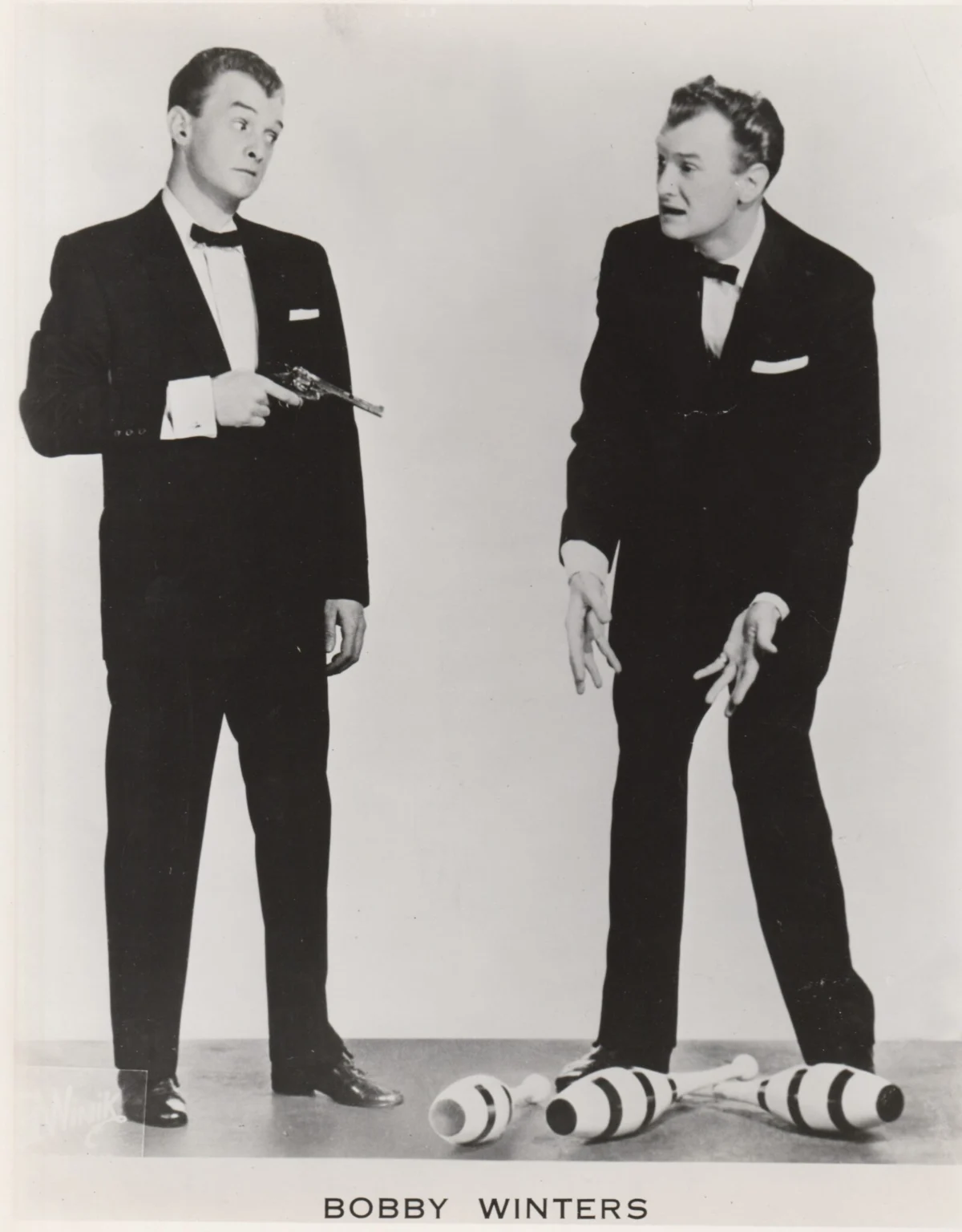
Raymond Charles Pike, who adopted the stage name Bobby Winters to distinguish his career from his father’s, represented the next generation of physical performers. By the time Winters began his professional journey in the 1940s, the entertainment industry was undergoing a massive paradigm shift. The decline of the traditional Vaudeville circuit necessitated a pivot toward nightclubs, traveling revues, and the nascent medium of television.

Winters cultivated a distinct comedic identity, characterized by what critics of the time described as "purposely clumsy, but brilliant." His act was a masterclass in misdirection. He famously integrated the "drum roll" gag, a piece of performance art that bridged the gap between the wings and the stage, requiring precise timing and interaction with stagehands. His "medals gag"—an escalating display of mock accolades hidden within his costume—served as a satirical commentary on the vanity of the performer.
The shift from the physical rigidity of his father’s era to the more fluid, character-based comedy of the mid-century was evident in Winters’ work. He prioritized rhythm and timing over the sheer technical density of earlier juggling routines. His tambourine work, which involved intricate grinds and body-contact manipulation, allowed him to stand out in a competitive market where variety acts were fighting for airtime on programs like "The Buick Circus Hour."

Chronology of an Artistic Lineage
The history of the Pike-Winters family can be mapped across the major cultural shifts of the 20th century:
- 1893: Birth of Raymond Henry Pike.
- 1910s–1920s: Pike establishes his reputation in acrobatics and transitions to solo juggling.
- 1930s: Pike reaches the peak of his career; serves as Boston AGVA president.
- 1940s: Raymond Charles Pike begins his career; adopts the name Bobby Winters to avoid professional confusion.
- 1948: Death of Raymond Henry Pike.
- 1950s–1960s: Bobby Winters gains national recognition through television appearances and club work.
- 1970: Winters concludes his professional performance career.
- 1999: Death of Bobby Winters on November 20 at age 77.
Data Analysis: The Mechanics of the Act
Historical footage preserved by researchers such as Tom Kellett and Bobby Jule reveals the specific technical evolution of the craft. Winters’ repertoire included the "kidney swing" (or ball-on-string gag) and the "ball on parasol," techniques that required an advanced understanding of trajectory and tension.

The analytical consensus among juggling historians, such as David Cain, is that these acts functioned as a bridge between the "pure" technical juggling of the late 19th century and the prop-based comedy that defines modern circus arts. Whereas early acts focused on endurance and volume, Winters and his contemporaries focused on "the bit." This shift is reflected in the diminishing duration of pure object-manipulation sequences in favor of character-driven sight gags. This evolution was not merely an aesthetic choice but a commercial necessity; as television screens shrunk the stage, performers had to find ways to make their craft legible and engaging to a home audience that could not see the finer details of high-speed object manipulation.
Broader Implications and Historical Context
The recovery of the Pike and Winters story underscores a critical issue in the study of performing arts: the fragility of physical media. Much of the information regarding these performers was lost for decades, residing only in the personal archives of collectors and the memories of aging industry insiders. It was only through the digitization of old film reels and the dedicated research of organizations like the Museum of Juggling History that these performers have been restored to the narrative.

The implications of this discovery are twofold. First, it highlights the importance of institutional archiving. Without the preservation of film by individuals like Bobby Jule, the nuances of Winters’ "medals gag" or his tambourine-grinding technique would have been lost to history. Second, it challenges the current perception of "the golden age of juggling." Often, the narrative is monopolized by a handful of legendary figures. However, the work of Pike and Winters demonstrates that the industry was supported by a massive infrastructure of mid-tier performers who were responsible for the daily maintenance of the art form’s popularity.
Conclusion: A Lasting Legacy
Bobby Winters’ final years, marked by health struggles and eventual hospitalization, reflect the often-precarious nature of a life spent on the road. Yet, his legacy is not found in the awards he may or may not have received, but in the influence he exerted on the variety performers who followed him. By successfully transitioning from the physical theater of his father to the comedic timing required for the television age, Winters ensured that his family’s contribution to the arts remained relevant for over half a century.

As historians continue to analyze the films left behind, the names Raymond Pike and Bobby Winters serve as essential case studies in the adaptability of the human performer. They remind us that the history of entertainment is not merely a collection of isolated stars, but a continuous chain of innovation, passed from one generation to the next, often in the quiet, rhythmic motion of a club or a tambourine held in the air. Their story, once nearly forgotten, is now firmly re-integrated into the broader tapestry of American variety performance, providing a vital link to a vanished era of stage craft.