
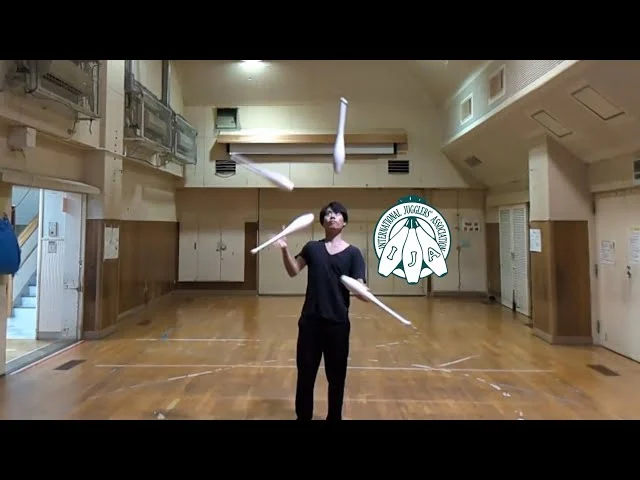
The International Jugglers’ Association (IJA) has officially spotlighted Japanese performer Motoki Date as the featured artist for the October 2026 edition of its "Tricks of the Month" series. This recurring digital initiative, hosted on the eJuggle platform, serves as a cornerstone for technical development within the global juggling community. Date, a practitioner who began his journey in 2014, has garnered international attention for his emphasis on aesthetic precision and geometric complexity, particularly in his mastery of club manipulation within the "wall plane."
The Evolution of the IJA Tricks of the Month Series
The IJA, founded in 1947, has consistently sought to standardize and elevate the art of juggling through pedagogical resources. The "Tricks of the Month" series was conceptualized to bridge the gap between traditional instruction and modern social media-driven performance art. By selecting contributors like Motoki Date, the IJA provides a platform for specialized techniques that might otherwise remain confined to niche regional circles.
Since its inception, the eJuggle resource has evolved from a simple repository of tutorials into a comprehensive multimedia archive. The series acts as a longitudinal record of juggling trends, documenting the shift from classic toss juggling to the contemporary focus on "flow arts" and "visually refined" patterns. Date’s inclusion marks a pivot back to technical excellence, emphasizing the trajectory and physical shape of the props over purely improvisational styles.
Chronology and Biographical Context
Motoki Date’s professional trajectory offers insight into the modern development of juggling as a disciplined performance art. Since he began his practice in 2014, Date has spent over a decade refining a style that prioritizes the "wall plane"—a two-dimensional spatial configuration where the juggler maintains patterns flat against an imaginary plane in front of their body.
In the 2026 October showcase, Date demonstrates a series of club patterns that defy conventional rhythm. His approach is notable for its deliberate pace and emphasis on the arc of the clubs. By focusing on the "shape and trajectory," Date aligns his work with the mathematical side of juggling, often referred to as siteswap theory, though he applies these concepts with a high degree of artistic sensibility. His work serves as a case study for practitioners aiming to transition from functional pattern maintenance to high-level aesthetic performance.
Technical Analysis of Wall Plane Manipulation
The "wall plane" is a fundamental yet challenging concept in club juggling. Unlike circular or sagittal plane patterns, which allow for more peripheral movement, the wall plane requires the juggler to maintain a strict vertical and horizontal alignment. Any deviation in the wrist flick or the release angle results in a visible error in the pattern’s geometry.
Data-driven analysis of club juggling suggests that the force required to maintain these patterns increases exponentially with the complexity of the "flips" and "spins" involved. Date’s performance highlights the efficiency of his movement, showing minimal wasted energy. By minimizing the "dead space" between catches, he creates a visual flow that appears continuous to the audience. This technical proficiency is the result of thousands of hours of repetition, a common theme among IJA featured artists who prioritize "refined" visuals.
Supporting Data: The Impact of IJA Educational Outreach
The IJA’s commitment to education is reflected in its membership-supported programs. The organization currently manages four primary pillars of outreach:
- The Annual IJA Festival: A weeklong gathering that historically attracts hundreds of professional and amateur jugglers globally.
- Long-Form Media: Includes the "Tricks of the Month," podcasts, and detailed masterclasses.
- YJA (Youth Juggling Association): A specialized program aimed at fostering skills in participants under the age of 18.
- IRC (IJA Regional Competitions): A competitive framework that provides a professional stage for regional talent to qualify for international honors.
The sustainability of these programs is entirely dependent on membership dues. As of late 2026, the IJA has reported a consistent growth in its digital subscriber base, citing a 12% increase in engagement with instructional content compared to the previous fiscal year. This uptick suggests that the demand for high-quality, peer-led instruction is at an all-time high, fueled in part by the global accessibility provided by the internet.
Official Responses and Community Reaction
While individual commentary from the IJA board remains focused on the overarching goal of community development, the response to Date’s feature has been marked by professional praise from within the industry. Analysts note that featuring international artists like Date is a strategic move for the IJA to maintain its relevance in a globalized juggling market where talent is no longer concentrated in North America or Europe.
"The inclusion of diverse, technically oriented performers is essential for the growth of our craft," noted an anonymous representative familiar with the IJA’s content curation process. "When we highlight the work of artists who focus on the ‘wall plane’ or other complex spatial configurations, we are essentially providing a blueprint for the next generation of performers to follow. It elevates the floor for what is considered ‘standard’ in contemporary juggling."
Broader Implications for the Juggling Arts
The rise of digital content platforms like eJuggle has fundamentally changed how juggling tricks are disseminated. In previous decades, a performer might spend years developing a specific, refined pattern that would only be seen by a handful of people at a physical convention. Today, through the "Tricks of the Month," that same performer can influence the global juggling vocabulary within days of a video’s release.
This rapid dissemination has several implications:
- Standardization of Technique: Complex patterns that were once considered "impossible" or "secret" are now subject to immediate peer review and imitation.
- Aesthetic Shift: There is a growing premium on the "look" of the juggling. As audiences become more accustomed to high-definition video, the visual aesthetics of the props, the costume of the juggler, and the symmetry of the pattern have become as important as the raw technical difficulty.
- Professionalization: The IJA’s focus on structured resources encourages hobbyists to approach the craft with the rigor of a professional athlete or musician.
Conclusion: The Future of the Craft
Motoki Date’s contribution to the October 2026 cycle is a testament to the enduring appeal of technical mastery in the digital age. By focusing on the nuance of club trajectory, he reminds the community that even after a decade of practice, there is always room to refine the fundamental mechanics of the art.
The IJA’s continued support of these artists through its membership-driven model ensures that this knowledge remains accessible to everyone, from the casual backyard enthusiast to the professional circus performer. As the organization looks toward the next calendar year, the emphasis on quality, precision, and global collaboration remains the primary driver of its mission. For those interested in the future of the field, the "Tricks of the Month" series continues to act as the primary barometer for where the art of juggling is heading. The union of technology, tradition, and personal expression, as exemplified by Date, remains the hallmark of the modern IJA.