
Laughter, a fundamental human expression, serves as a universal language, capable of transcending geographical borders and cultural divides. In environments marked by significant adversity, its power extends beyond mere amusement, acting as a crucial bridge for social connection and psychological resilience. This profound understanding underpins the mission of Clowns Without Borders (CWB), an organization dedicated to deploying the transformative potential of humor to unite people, particularly those grappling with challenging circumstances. A recent initiative in Egypt stands as a compelling testament to this mission, showcasing how laughter and creative engagement can catalyze both social cohesion within forcibly displaced communities and heightened environmental awareness among their youngest members.
The ambitious project, titled the Theatre for Climate Justice Project, unfolded through a robust collaboration between CWB-USA, Vassar College, and Dawar Arts Egypt. This groundbreaking partnership was conceived to address the intricate and often overlapping crises of climate change and forced displacement within Egypt, utilizing the innovative mediums of theatre and puppetry. The initiative was generously supported by The Andrew W. Mellon Foundation through its Consortium on Forced Migration, Displacement, and Education (CFMDE), underscoring the academic and humanitarian significance of its objectives.
Project Genesis and Collaborative Foundations

The journey commenced with the arrival of CWB Artist in Residence, Hannah Gaff, who spearheaded the creative direction of the project. Gaff, an experienced practitioner in the field of humanitarian clowning, worked closely with a highly talented and dedicated Egyptian team. This ensemble included Nelly Abd-El Maksoud, Saly Ahmed, Sami Gomaa, Tarek Ahmed, and Diaa Eldin Rayad, all operating under the meticulous guidance of Project Manager Ahmed Moussa. Their collective expertise in performance art, community engagement, and local cultural nuances was instrumental in tailoring the project to resonate deeply with the target communities.
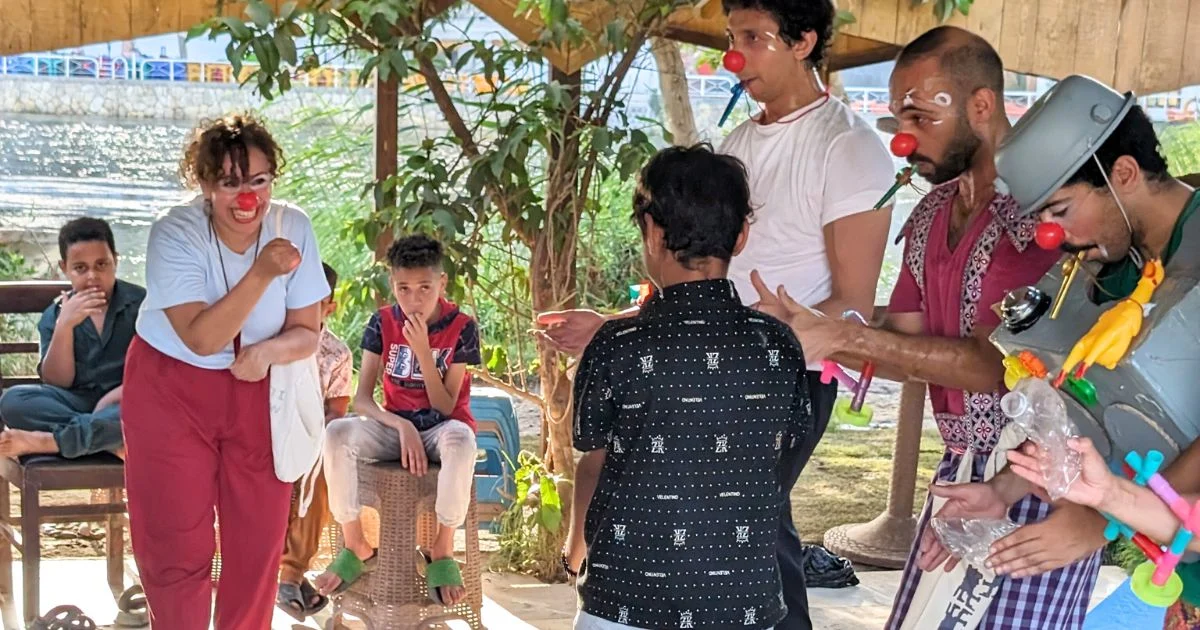
The Theatre for Climate Justice Project was meticulously designed to empower vulnerable communities, with a specific focus on refugees and asylum seekers, by intertwining artistic expression with critical environmental concerns. Through a series of interactive workshops and captivating theatrical performances, the team embarked on an exploration of the myriad challenges posed by climate change. These included, but were not limited to, the escalating threat of sea-level rise, pervasive environmental pollution, and the growing scarcity of vital resources—issues that disproportionately affect forcibly displaced populations, who often reside in overcrowded, precarious, and resource-deprived conditions. The project’s unique approach sought to leverage play and laughter not just as tools for entertainment, but as potent instruments for community building, fostering creativity, and tackling urgent global challenges.
The Context: Forced Displacement and Climate Vulnerability in Egypt
Egypt, strategically positioned at the crossroads of Africa and the Middle East, has long served as a host country for significant populations of refugees and asylum seekers. According to the United Nations High Commissioner for Refugees (UNHCR), Egypt currently hosts over 670,000 registered refugees and asylum seekers, representing 62 different nationalities. The primary countries of origin include Syria, Sudan, South Sudan, Eritrea, Ethiopia, Yemen, and Somalia, all regions plagued by conflict, political instability, and in many cases, the intensifying impacts of climate change.

These displaced populations in Egypt face a unique set of hardships. Many, particularly those in urban centers like Cairo, struggle with ambiguous legal statuses, often not qualifying for full UNHCR protection. This precarious standing frequently translates into severe socio-economic challenges, including alarmingly high rates of unemployment due to legal restrictions on their right to work. Furthermore, issues such as visa complications, reciprocity laws, licensing hurdles, and widespread discrimination exacerbate their vulnerability. Language barriers often compound their isolation, making access to essential services and integration into society exceedingly difficult. The psychological toll of displacement, coupled with these systemic barriers, often leads to significant trauma and stress, particularly among children.
The intersection of forced displacement and climate change in Egypt presents a particularly dire scenario. Egypt itself is highly vulnerable to the effects of climate change, with the Nile Delta—the country’s agricultural heartland and home to a large portion of its population—identified as one of the world’s most susceptible areas to sea-level rise. Projections suggest that even a modest increase in sea levels could displace millions, contaminate freshwater resources, and severely impact agricultural productivity. Moreover, the Nile River, the lifeblood of Egypt, faces increasing threats from pollution due to industrial waste, agricultural runoff, and inadequate waste management, further imperiling public health and ecological balance. For displaced communities, who often lack secure housing, clean water, and sanitation, these environmental threats are not abstract concepts but immediate dangers that exacerbate their already fragile existence. The Theatre for Climate Justice Project thus addressed not only the psychological well-being of these children but also equipped them with a deeper understanding of and agency over the environmental issues directly impacting their lives.
Defeating the Garbage Monster: A Theatrical Solution
At the heart of the project’s performance component was a captivating one-hour play meticulously crafted by the team, centered on the urgent issue of pollution in the Nile River. The narrative revolved around a formidable antagonist: the "Garbage Monster," a powerful symbol of the environmental challenges confronting Cairo and, by extension, Egypt’s vital waterways. This theatrical embodiment of pollution served as a tangible foe for the young audience.

Crucially, the play was designed to be highly interactive, inviting children from various refugee and asylum-seeker backgrounds—including those from Sudan, South Sudan, Syria, Somalia, Ethiopia, Eritrea, and Yemen—to actively participate in defeating the menacing Garbage Monster. This direct engagement transformed passive viewing into active problem-solving, empowering the children to confront the destructive force threatening their villages and, by extension, their collective future. The dramatic tension and eventual triumph over the monster provided a powerful metaphor for collective action and environmental stewardship.
Hannah Gaff, reflecting on the profound impact of these performances, shared, “Many brave kids would raise their hands and say the most beautiful ideas for reducing plastic waste, containing garbage, reducing pollution, and then one would suggest that we clean up all the pollution in the river right in front of us.” This direct and enthusiastic response from the children underscored the project’s success in fostering a sense of agency and inspiring concrete, actionable ideas for environmental improvement.
A particularly poignant moment was recounted by artist Diaa Eldin Rayad, illustrating the immediate behavioral change ignited by the play. He shared, "Interacting with children is one of the most enjoyable moments for me. One child told me, ‘I am not a garbage monster!’" Rayad continued, describing how, at the conclusion of the show, this same child spontaneously collected plastic bottles without any prompting. This anecdote powerfully demonstrates how the theatrical experience transcended entertainment, embedding a personal sense of responsibility and inspiring real-world environmental action. By presenting environmental challenges in an accessible, engaging, and empowering format, the project effectively encouraged a generation of children, often marginalized and disempowered, to become active agents of change. The triumphant defeat of the Garbage Monster, naturally, culminated in vibrant dance parties, allowing the children to celebrate their collective victory and reinforce the positive association with environmental stewardship.
Finding Voice and Agency Through Creative Play

Beyond the main performance, the Theatre for Climate Justice Project incorporated interactive workshops that invited children to transform everyday discarded items into vibrant puppets. Using materials like plastic bottles, bags, and other street-found garbage, children crafted an array of aquatic creatures, including fish, crocodiles, and cobras. This act of upcycling was not merely a craft activity; it was a powerful pedagogical tool that empowered children to become active participants in environmental conservation, demonstrating that waste could be reimagined and given new life. This creative approach ignited imaginations and instilled a tangible sense of responsibility for their environment.
The workshops fostered not only environmental awareness but also deep personal growth, particularly for children whose voices are too often silenced by adversity. One profoundly heartwarming story emerged from these sessions, illustrating the transformative power of play. A quiet six-year-old boy, known for his reticence, approached Sami Gomaa and asked him to name his newly created fish puppet "pet." This simple request deeply surprised his mother, who confided that her son was "silent all the time." Through the act of creation and imaginative play, this child found a unique way to express himself, a poignant reminder that arts-based interventions can unlock potential and provide avenues for self-expression that traditional methods might miss.
Tarek Ahmed recounted another instance of a child exercising agency and self-expression: "A girl decided to make the tail in her own way. After suggestions from me about how to make the tail, she told me, ‘Hmmmm…, I will draw it.’" This small act of defiance and creative independence highlighted the project’s success in nurturing individual creativity and empowering children to trust their own artistic instincts.
Nelly Abd-El Maksoud shared a particularly inspiring experience that underscored the reciprocal nature of creative engagement: "Today there was a little girl who made the crocodile puppet. And for the first time, I experienced the feeling that someone was fully aware that she was doing something beautiful. This is a new feeling for me. She kept putting in a lot of details of her own, and I kept cutting her pieces and doing anything she wanted. She was very passionate about the puppet and had a great interest in it. She made me feel it was possible to turn the simplest things into beautiful things." These reflections from the artists themselves affirm the profound impact of the workshops, demonstrating how the children’s passionate creativity inspired and enriched the experience for everyone involved. These events collectively highlight the transformative power of play in unlocking children’s potential and fostering their ability to express themselves freely and confidently.

Laughter Unleashed and Confidence Gained
Hannah Gaff observed firsthand the transformative power of play and the tangible increase in self-confidence among the children. She recalled, "In the beginning of the workshop, two kids said they didn’t think they could make the puppets (made of plastic and garbage found on the street) and by the end they were so proud of the puppets they made, showing them off to everyone." This shift from initial hesitation to profound pride illustrates the potent role of creative achievement in building self-esteem, particularly for children who may have experienced significant setbacks and trauma.
Gaff further noted, "After the kids made the puppets, they wanted to take them outside to play in the playground. They ran around the building with them, bringing them to life." This natural extension of the workshop into spontaneous, imaginative play underscored the lasting impact of the creative process. A newfound confidence was palpable as the children animated their puppets, their imaginations soaring freely in a safe and supportive environment.
Diaa Eldin Rayad, another member of the Egyptian team, also witnessed the magic unfold: "The children played with us while laughing. A 6-year-old-boy of Sudanese nationality told me, ‘We will make a snake from a bag of chips. This is difficult!’" This interaction not only highlighted the children’s engagement and joy but also their innate capacity for problem-solving and adaptation, even when faced with perceived difficulties. The workshop became a sanctuary where children could express themselves freely, forge new friendships, and develop a deeper understanding of one another, bridging the gaps created by diverse backgrounds and traumatic experiences. By providing opportunities for imaginative play and collaborative creation, the team empowered children to overcome challenges, build resilience, and envision a brighter, more sustainable future.

Broader Impact and Implications
The Theatre for Climate Justice Project achieved significant success beyond its immediate objectives. By bringing together children from diverse backgrounds—such as Sudan, South Sudan, Syria, Eritrea, and Yemen—it fostered a profound sense of belonging and mutual understanding. The shared experience of creating, performing, and laughing together helped to bridge cultural divides, dismantle stereotypes, and build a stronger, more cohesive community among young refugees and asylum seekers. In contexts where children often experience isolation and discrimination, these shared moments of joy and collaboration are invaluable for fostering social integration and psychological well-being.
The project also served as a powerful model for integrated humanitarian aid and environmental education. It demonstrated that complex and often daunting issues like climate change can be approached in accessible and empowering ways for children, particularly those in vulnerable situations. By combining the therapeutic power of laughter and play with practical lessons on environmental stewardship, CWB and its partners created a holistic program that addressed both the emotional and educational needs of the children. This approach not only alleviates immediate suffering but also equips future generations with the knowledge and motivation to address pressing global challenges.
The success of this initiative in Egypt underscores the critical importance of supporting arts-based interventions in humanitarian contexts. Laughter, often underestimated, proves to be a powerful tool that can bridge divides, spark creativity, inspire hope, and build resilience in the face of adversity. Organizations like Clowns Without Borders, through their innovative programs, demonstrate that human connection, joy, and a sense of agency are not luxuries but essential components of recovery and sustainable development in crisis-affected communities worldwide. The Theatre for Climate Justice Project exemplifies a powerful, replicable model for fostering empathy, promoting environmental consciousness, and empowering the most vulnerable members of society to become active participants in shaping a better future.