
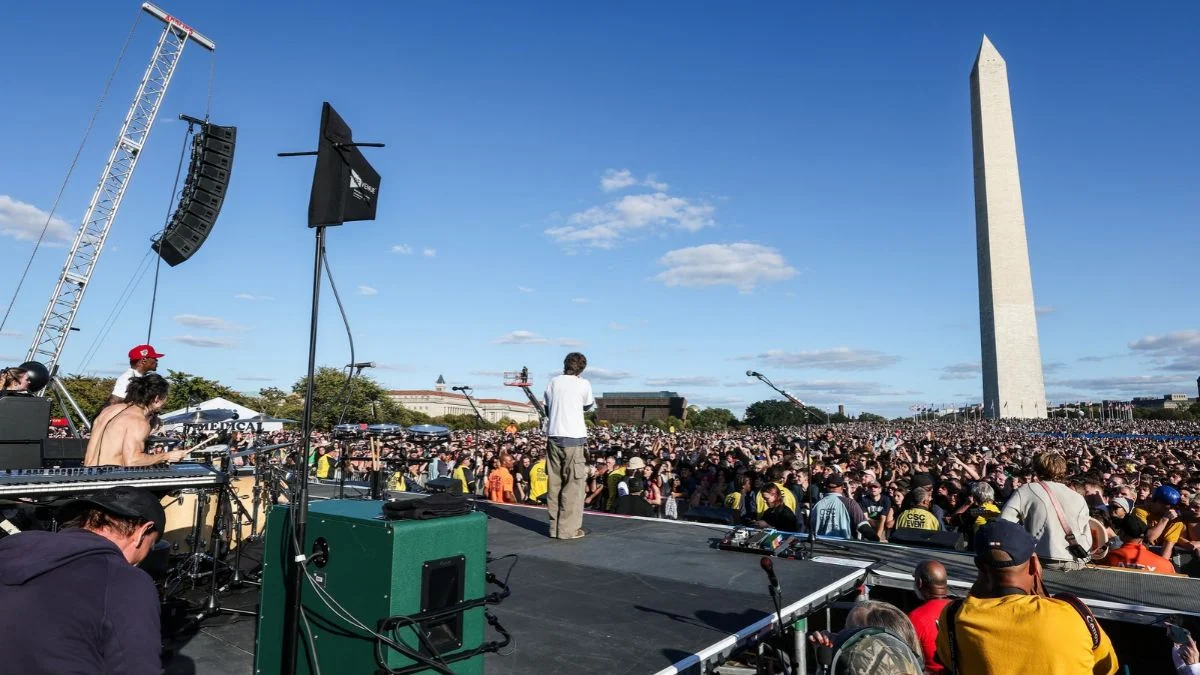
The intersection of modern hardcore punk and high-profile civic activism reached a monumental zenith on Saturday, October 24th, as Baltimore-based outfit Turnstile drew an estimated crowd of 60,000 fans to the National Mall for a historic free benefit concert. Staged against the backdrop of the Washington Monument, the massive gathering marked the dramatic conclusion of the latest North American leg of the band’s acclaimed “NEVER ENOUGH TOUR.” Beyond the sheer scale of the attendance, the event proved to be a resounding philanthropic success, shattering its initial financial objectives by raising more than $220,000 for international humanitarian relief efforts directed toward Palestine, Sudan, and Lebanon.
Organized in collaboration with Human Concern International, the open-air concert transformed the nation’s capital into a pulsating hub of solidarity and sonic intensity. When the band first announced the benefit earlier in the month, organizers and stakeholders established a modest and attainable fundraising target of $100,000. However, an overwhelming wave of public generosity, driven by direct donations, on-site contributions, and widespread digital mobilization, more than doubled that expectation by Sunday morning. The staggering financial turnout underscores not only the commercial and cultural pull of Turnstile at the height of their career, but also the increasing appetite among modern music fans for politically and socially engaged live events.
A Triumphant Homecoming Rooted in Regional Hardcore History
For frontman Brendan Yates, who spent his formative years growing up in nearby Burtonsville, Maryland, the massive gathering carried profound personal significance. Long before headlining arenas and gracing late-night television, Yates and his bandmates were nurtured by the rich, tight-knit DIY punk and hardcore underground of the Mid-Atlantic region. Speaking with The Washington Post ahead of the Saturday afternoon performance, Yates reflected on the deep ties binding the band to the local community. “This is a scene that raised us,” he remarked, acknowledging the invisible thread connecting their contemporary success to the grassroots venues of Maryland, Virginia, and Washington, D.C.
The weight of the location was not lost on the seasoned concertgoers in attendance, many of whom noted the striking historical echoes of the event. The National Mall and its surrounding monuments have occasionally served as unconventional stages for dissenting, independent music, most notably recalled through the legendary, unannounced free afternoon performances staged by the influential D.C. post-hardcore band Fugazi during the 1990s. By bringing a modern incarnation of aggressive, melodic hardcore music back to the shadow of the obelisk, Turnstile deliberately aligned themselves with a legacy of civic-minded musical performance that prioritizes accessibility, community engagement, and direct action over corporate exclusivity.
Despite a grueling touring schedule that has spanned the globe throughout the year, physical adversity failed to sideline the band’s energetic frontman. Reports from behind the scenes indicated that Yates spent the day prior to the Washington Monument concert icing a severely injured ankle—a direct result of high-octane stage performances over preceding weeks. Nevertheless, the physical setback was entirely imperceptible to the tens of thousands packed onto the lawn as Yates led the group through a punishing, 19-song setlist that lasted approximately 75 minutes.
Spanning tracks from their breakthrough releases as well as their Grammy-winning 2026 material, the performance opened with the explosive energy of “BIRDS” and immediately transitioned into fan-favorites like “REAL THING,” “ENDLESS,” and “MYSTERY.” As the afternoon sun beat down on the National Mall, the circle pits churned with relentless momentum through renditions of “CANNED HEAT,” “HOLIDAY,” and “BLACKOUT.” Mid-way through the performance, Yates paused briefly to address the immense crowd, expressing profound gratitude for their solidarity before lifting his microphone to lead the thousands-strong audience in a resounding, unified chant of “Free Palestine! Free Sudan! Free Lebanon!” The performance ultimately culminated in a climactic run of “NEVER ENOUGH” and “T.L.C. (Turnstile Love Connection),” leaving the audience breathless and cementing the date as a watershed moment in contemporary live music.
A Banner Year of Critical and Commercial Milestones
The successful execution of the Washington Monument benefit caps off what can only be described as a transformative, career-defining twelve months for Turnstile. Long celebrated as critical darlings within the underground music community, the band has successfully crossed over into mainstream cultural ubiquity without sacrificing the raw intensity that defined their early output.
The momentum began in earnest at the Grammy Awards earlier in 2026, where Turnstile captured their first two golden gramophones. Most notably, their critically acclaimed LP NEVER ENOUGH was awarded Best Rock Album, signaling a decisive shift in the Recording Academy’s recognition of contemporary heavy music. Rather than resting on their laurels, the band parlayed this validation into high-profile cross-promotional opportunities, culminating in a triumphant musical guest debut on Saturday Night Live earlier in October. The SNL appearance introduced their melodic, groove-laden hardcore sound to millions of living rooms nationwide, broadening their demographic base and laying the groundwork for the massive turnout witnessed on the National Mall just weeks later.
Following the conclusion of their current touring cycle, Turnstile shows no signs of slowing down. The group is slated to make a high-profile appearance at Tyler, the Creator’s Camp Flog Gnaw festival in Los Angeles this November, before pivoting toward an extensive international festival circuit planned throughout 2027.
Broader Implications and Philanthropic Impact in Live Music
The unprecedented success of the Washington Monument benefit concert offers valuable insight into the shifting paradigm of modern music curation. In an era where ticket prices for major pop and rock tours have skyrocketed—frequently pricing out working-class fans and drawing regulatory scrutiny—Turnstile’s decision to mount a free, all-ages public concert serves as a potent counter-model. By utilizing public space for public good, the band demonstrated that large-scale live music can remain fundamentally democratic and accessible while simultaneously generating substantial material support for populations suffering from active humanitarian crises.
Furthermore, the collaboration with Human Concern International highlights a growing trend among contemporary artists to leverage large-scale public platforms for targeted international aid. While the music industry has a long history of charity concerts—dating back to historic global efforts like Live Aid—the modern iteration driven by independent and alternative acts tends to focus on localized, highly transparent grassroots distribution networks. By channeling over $220,000 directly into relief initiatives for Palestine, Sudan, and Lebanon, the concert bridged the gap between domestic cultural expression and global empathy.
As political discourse increasingly permeates cultural spaces, Turnstile’s ability to draw 60,000 people without corporate ticketing monopolies, while simultaneously engaging them in global humanitarian advocacy, establishes a new benchmark for modern rock bands. It proves that artistic integrity, commercial viability, and social consciousness are not mutually exclusive, but can instead reinforce one another to create moments of collective catharsis that extend far beyond the final chord of a guitar.