The cinematic landscape often explores the boundaries of human endurance, testing protagonists against extreme environments, hostile wildlife, and internal psychological demons. However, 20th Century Studios’ upcoming feature film Whalefall, slated for a theatrical release on Friday, October 16, introduces a cinematic peril previously reserved for maritime mythologies and cautionary fables: the terrifying reality of being swallowed alive by a marine mammal. Based on Daniel Klaus’s acclaimed bestselling novel of the same name, the film translates an extraordinarily rare and claustrophobic premise into a feature-length exploration of survivalism, complicated paternal relationships, and the crushing weight of unresolved grief.
Driven by a haunting marketing campaign featuring the stark tagline, “The odds of being swallowed alive by a whale are not zero,” the film immediately establishes a tone that merges visceral body horror with deeply rooted emotional drama. While statistical probability dictates that such an event remains an astronomical anomaly, the narrative thrust of Whalefall forces its protagonist, played by Austin Abrams, into the harrowing epicenter of that very mathematical fraction.
Synopsis and Chronological Setup
The narrative framework of Whalefall is established through a carefully paced prelude that contrasts the cold, unyielding nature of the ocean with the fractured dynamics of a human family. The story opens by depicting the final, rugged moments of Mitt, portrayed by Josh Brolin. Mitt is characterized as a tough-as-nails, highly skilled commercial diver—a figure revered by his community and peers, yet deeply feared and resented by his son, Jay (Austin Abrams).
The primary timeline of the film resumes precisely one year after Mitt’s tragic death. Jay returns home from college to visit his mother and sisters, ostensibly to participate in the anniversary memorials honoring his late father. However, Jay’s true motivation for returning to the coast of Monterey, California, is far more private and desperate. Driven by an overwhelming need for closure and lingering guilt, Jay sneaks out in the early morning hours for a clandestine, unauthorized solo dive. His objective is to scour the ocean floor in hopes of locating some physical remnant or personal artifact of his father’s final dive.
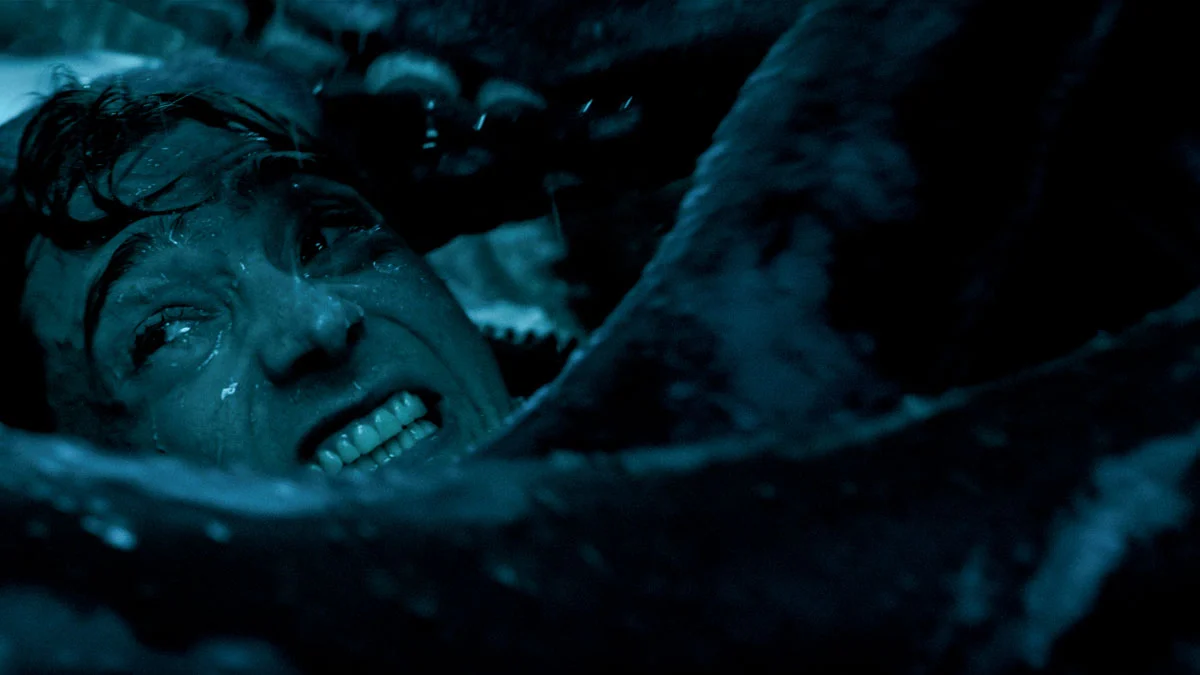
The structural tension of the film builds with inevitable dread. From the moment Jay enters the water, the audience is acutely aware of the impending catastrophe. That tension erupts into sheer terror when a massive sperm whale, actively hunting a giant squid in the abyssal depths, inadvertently sweeps Jay into its path. Caught in the violent thrashing of the squid’s tentacles, Jay is dragged directly into the cavernous, crushing dark of the whale’s mouth and subsequently forced down into its digestive tract.
Inside the Beast: Production Design and Body Horror
Once trapped within the interior of the sperm whale, Whalefall shifts into a masterclass of single-location survival cinema and visceral body horror. The production design team successfully transforms the biological interior of a marine mammal into a suffocating, tactile labyrinth. Covered in synthetic biological secretions, goo, and visceral textures, the sets constructed on the soundstage manage to evoke profound claustrophobia and raw terror.
Film critics have noted that the tactile realism of these sequences forces an intense physical reaction from viewers, effectively redefining cinematic body horror by utilizing an actual organic organism as the primary antagonist’s interior. Despite the obvious reliance on practical set construction and visual effects, the environment feels oppressively authentic, anchoring Jay’s struggle in a gritty, tactile reality.

Performances and Character Dynamics
At the core of the film’s emotional resonance is Austin Abrams’ performance as Jay. Abrams shoulders the immense burden of carrying a single-character survival narrative for a substantial portion of the runtime. Following a string of notable cinematic appearances—including a recent role in Zach Cregger’s Resident Evil adaptation—Abrams solidifies his capability to serve as the emotional focal point of high-concept thrillers. Even when Jay’s desperate circumstances lead him to make questionable tactical decisions under duress, Abrams maintains the audience’s sympathy through a grounded, emotionally raw portrayal.
Conversely, Josh Brolin’s presence is felt heavily through a series of flashbacks that punctuate Jay’s internal monologues and survival efforts. Rather than presenting a sanitized or universally beloved paternal figure, the flashbacks reveal a harsh, demanding reality. Mitt’s interactions with his son frequently cross the line into emotional abuse and psychological belittling, driven by impossible expectations and a rigid demand for perfection. These memories paint a complex portrait: Mitt was undeniably charismatic and respected by the outside world, but to his son, he was an insurmountable mountain of judgment.
Paradoxically, these painful psychological scars provide the very survival instincts Jay requires. Buried within the memories of his father’s harsh lessons are the technical diving procedures, mental fortitude, and sheer stubbornness needed to strategize an escape from the inside of a living creature.
Narrative Pacing and Thematic Shifts
Despite the undeniable novelty of its premise, Whalefall encounters structural hurdles common to single-location survival dramas. As the narrative progresses past the initial shock of the ingestion sequence, the middle act experiences pacing issues. Jay’s efforts to engineer an escape occasionally lose focus, leading to narrative lulls where the tension threatens to dissipate.
Furthermore, the film’s final act takes a notable stylistic departure. Transitioning away from the grounded, gritty realism of the first two acts, the conclusion introduces impressionistic and overtly sentimental elements. This tonal shift attempts to deeply link Jay’s physical fight for survival with his psychological need to process and forgive his father’s memory. While some of these emotional beats land with considerable impact, others risk feeling heavy-handed, creating a slight friction with the stark survivalist mechanics established earlier in the runtime.
Broader Implications and Cultural Impact
Whalefall arrives at a unique juncture in contemporary cinema, offering a fresh subgenre divergence from traditional monster features and creature features. By anchoring a fantastic, highly improbable scenario in genuine psychological trauma, the film transcends standard B-movie territory to deliver a deeply human exploration of grief.
While statistical reality dictates that audiences members will almost certainly never face the exact physiological dilemma experienced by Jay on screen, the thematic undercurrent of the film speaks to a universal human condition. Grief, much like the predatory forces of the deep ocean, possesses the capacity to swallow an individual whole. Through its harrowing depiction of physical endurance and emotional reconciliation, Whalefall provides a cathartic cinematic experience ahead of its nationwide theatrical release on October 16.