
Garsington Opera has recently captivated audiences with its vibrant and profoundly unconventional new production of Gerald Barry’s The Importance of Being Earnest, a work that continues to challenge traditional notions of operatic adaptation. Directed by Jack Furness, this staging, which premiered in July 2026, has garnered significant attention for its audacious interpretation, transforming Oscar Wilde’s classic comedic play into an "hilarious and anarchic race through" its narrative, as described by Garsington Opera’s Chair, Miranda Curtis. Rather than a straightforward translation of Wilde’s meticulously crafted dialogue into song, Barry’s opera, and particularly Furness’s vision, asserts its own distinct artistic identity, demanding to be appreciated on its own surreal and often startling terms.
The Enduring Legacy of Wilde’s Masterpiece
Oscar Wilde’s The Importance of Being Earnest, first performed in 1895, stands as a towering achievement in English comedic theatre. A "trivial comedy for serious people," as Wilde himself subtitled it, the play is a masterful satire of Victorian society, its rigid class structures, moral hypocrisy, and the absurdities of courtship and marriage among the upper echelons. Its enduring popularity stems from its brilliant wordplay, memorable characters, and a plot driven by mistaken identities and social masquerades. Characters like Lady Bracknell, with her iconic pronouncements such as "To lose one parent, Mr. Worthing, may be regarded as a misfortune; to lose both looks like carelessness," have become indelible figures in literary history, their lines woven into the fabric of popular culture.
The play’s perfection in its original form, however, presents a formidable challenge for any adapter. Its humour is intrinsically linked to the precise rhythm and delivery of Wilde’s dialogue, where every word, every pause, and every witty retort contributes to a tightly woven tapestry of comedic brilliance. To tamper with such a finely tuned mechanism risks undermining its very essence. This inherent challenge forms the backdrop against which Gerald Barry’s operatic reimagining must be understood.
Gerald Barry’s Radical Reinterpretation
Gerald Barry, the acclaimed Irish composer known for his avant-garde and often confrontational musical style, first unveiled his operatic take on The Importance of Being Earnest in a concert premiere in Los Angeles in 2011. It subsequently received its full staged debut by the Royal Opera in 2013 and was revived at the Barbican Theatre in London in 2016. From its inception, Barry’s work was designed not as a reverent adaptation but as a radical deconstruction. Barry famously cut approximately two-thirds of Wilde’s original text to form his libretto, a decision that inherently alters the comedic timing and narrative flow. This approach has led to varied critical responses over the years, with some lamenting the loss of Wilde’s full wit, while others have praised Barry for his bold and transformative vision.
Barry himself maintained that he preserved the entirety of Wilde’s plot and most of the famous lines, albeit in a drastically condensed and recontextualized manner. For instance, the reviewer notes that Lady Bracknell’s famous line about losing parents loses some of its punch when not preceded by its setup. This exemplifies Barry’s method: he extracts the essence, often amplifying it through musical means, but sacrificing the leisurely, intricate build-up of Wilde’s prose. This condensation, far from being a flaw, is central to appreciating Barry’s opera as an independent artistic statement. It functions as a high-speed, musically driven commentary on Wilde, rather than a faithful operatic translation.

The Garsington Production: A Whirlwind of Absurdity
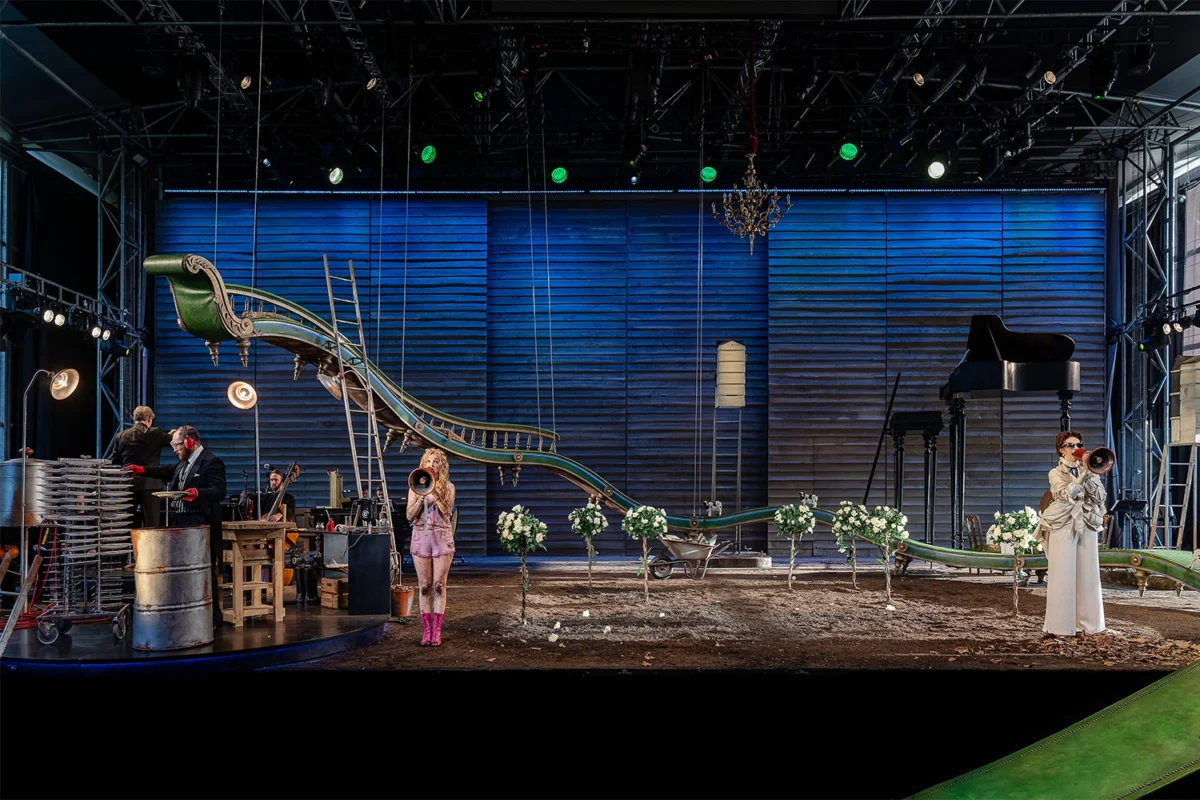
Jack Furness’s new production at Garsington Opera fully embraces this spirit of anarchic reinterpretation. The staging, designed by Francis O’Connor, immediately signals its departure from conventional theatrical aesthetics. A colossal chaise longue dominates the stage, snaking around like a surreal waterslide, down which characters frequently tumble, adding a physical comedy layer to the already frenetic pace. A grand piano, featuring elongated legs reminiscent of Salvador Dalí’s surrealist elephants, further underscores the dreamlike, distorted reality of the performance. This visual language primes the audience for an experience that prioritizes theatrical invention and musical expression over strict narrative fidelity.
Movement director Rebecca Meltzer’s choreographed routines inject bursts of unexpected physical activity, often intentionally dislocated from the emotional core of the scene. This deliberate dissonance enhances the opera’s surreal quality, making the characters’ actions seem both arbitrary and intensely focused, mirroring the disjointed yet powerful musical landscape.
Musical Innovation and Orchestral Theatrics
Under the baton of Douglas Boyd, the 20-strong Philharmonia Orchestra was not confined to an unseen pit but occupied a prominent corner of the stage, becoming an active participant in the drama. This innovative placement allowed the orchestra to engage directly with the theatrical action, with musicians occasionally chanting and stamping their feet, blurring the lines between performer and ensemble. The composition of the orchestra—a quintet of strings, "sinuous" wind instruments, and "discordant" brass—allowed for an astonishing range of effects, serving as both a narrative commentator and an emotional amplifier.
Barry’s score is a tapestry of ingenious musical allusions and percussive textures. The orchestra frequently mirrors and exaggerates the plot developments. For example, during Lady Bracknell’s impassioned denunciation of the French Revolution, the orchestra bursts into a revolutionary theme, strikingly similar to La Marseillaise, offering a sardonic musical counterpoint. Similarly, familiar tunes like Auld Lang Syne and Beethoven’s Ode to Joy appear sporadically, sometimes without surtitles, humorously attributed to the characters themselves, such as Lady Bracknell or Miss Prism offering "their own take on it."
The interrogation scene, where Lady Bracknell probes Jack’s dubious origins, is underscored by strings playing in a style reminiscent of minimalist composer Steve Reich, creating a sense of relentless, almost hypnotic questioning. The Act II confrontation between Gwendolen and Cecily, a scene charged with social tension and veiled hostility in Wilde’s original, is transformed into a highly theatrical spectacle. The characters deliver their lines through megaphones, their utterances punctuated by Merriman, the butler, dramatically smashing plates, a visceral sonic representation of their simmering conflict. This moment, in particular, highlights the precision of both Barry’s compositional genius and the flawless execution by the Garsington performers, creating an astounding fusion of sound and action.
Peter Lidbetter, in his dual roles as Merriman and Lane, exemplifies the multi-faceted demands of this production. He seamlessly transitions between being a bass singer, a percussionist (responsible for the dramatic plate smashing), and a deadpan entertainer, showcasing a remarkable versatility that is crucial to the opera’s success. Similarly, Susan Bickley’s portrayal of Miss Prism in Act III, with her singing delivered in fragmented, "broken lines," demonstrates both the complexity of Barry’s composition and Bickley’s exceptional vocal and dramatic skill.

Characters and Costumes: A Sinister Turn
The cast delivers Barry’s demanding score with impressive command and theatrical flair. Zahid Siddiqui shines as a splendid Jack, navigating the character’s dual identity with a blend of earnestness and comedic timing. Seán Boylan asserts his strong baritone as Algernon, capturing the character’s debonair charm and mischief. Holly Brown’s Gwendolen is beautifully voiced, while Jennifer France brings a suitably vivacious energy to Cecily, embodying the youthful infatuation and romantic ideals of the character.
In the non-singing role of Dr. Chasuble, Kevin Whately provides skillful physical humour, particularly as he grapples with a smoking beehive, a whimsical detail that fits perfectly within the production’s overall aesthetic of controlled chaos.
A traditional element of Barry’s Earnest stagings is the casting of Lady Bracknell, usually portrayed by a male singer in a suit rather than a stereotypical dame costume. Henry Waddington’s "nigh on perfect portrayal" of Lady Bracknell is further enhanced by Hannah Wolfe’s costume design. Lady Bracknell’s attire undergoes a particularly "sinister turn" in Act III, reflecting the character’s increasingly ominous presence as the revelations unfold, adding a layer of visual commentary to her formidable personality. This choice reinforces the character’s imposing authority, stripping away any potential campiness to reveal a truly formidable figure.
The Pinnacle of Nonsense: Symbolism and Dystopia
Furness’s production pushes the boundaries of theatrical absurdity, reaching its most successful moments when the nonsensicality reaches boiling point. Merriman’s frequent watering of trees with a hose, creating "suggestive projectiles," is one such recurring visual gag. The casual throwing of crockery and characters occasionally falling into the unoccupied orchestra pit contribute to the sense of a world just slightly out of control.
The setting for each scene is cleverly suggested by miniature models: terraced townhouses for the city and beehives for the country, providing an almost childlike, yet strikingly effective, shorthand for the shifting locations. The introduction of guns, with Lady Bracknell even shooting a model terraced house upon discovering Jack’s unfashionable address, injects a darkly comedic edge.
Perhaps the most memorable and bizarre element is the appearance of a kangaroo. Introduced via a single quip about Algernon being sent to Australia, the animal then inexplicably graces the stage for a considerable period. Its continued presence and fate in Act III invite multiple interpretations: does it represent Bunbury, Algernon’s invented invalid friend, and the resolution of that deception? Or does it simply underscore Algernon’s flippant association of death and Australia? This ambiguity, far from being confusing, enhances the opera’s dreamlike, absurdist quality.

Crucially, the production takes a particularly apocalyptic and dystopian turn after the interval. This shift reflects a deeper, more unsettling undercurrent within Barry’s opera itself, suggesting that beneath the surface of Wilde’s wit lies a commentary on societal decay and the fragility of appearances. Furness’s vision amplifies this, presenting a world spiraling into a glorious, chaotic disarray that is both shocking and exhilarating.
Implications for Contemporary Opera
Garsington Opera’s staging of Barry’s The Importance of Being Earnest holds significant implications for the landscape of contemporary opera. Garsington, renowned for its commitment to innovative and often challenging productions, reinforces its reputation by embracing such a radical work. By presenting an opera that deliberately deconstructs a literary classic, Garsington encourages its audience to approach new works with an open mind, challenging preconceived notions of what opera "should be."
This production serves as a powerful testament to the vitality of modern opera, demonstrating its capacity to engage with historical texts not through mere replication, but through transformative artistic dialogue. Barry’s opera, as realized by Furness, proves that even the most perfectly formed literary works can be re-imagined in ways that are both respectful of their essence and boldly innovative in their execution. It invites audiences to consider adaptation not as a hierarchical process of improvement or degradation, but as a parallel creative act, offering a new lens through which to appreciate both the original and the reinterpretation.
The success of this production also highlights the evolving role of the orchestra and the stage director in contemporary opera. The Philharmonia’s on-stage presence and active participation, coupled with Furness’s intensely theatrical and symbolic direction, underscore a trend towards more immersive and multi-disciplinary operatic experiences. This approach encourages a broader engagement with the art form, potentially attracting new audiences who seek dynamic and visually arresting theatrical events.
In conclusion, Garsington Opera’s production of Gerald Barry’s The Importance of Being Earnest is a triumph of daring artistic vision and meticulous execution. It is a work that thrives on its own terms, offering a whirlwind of musical invention and theatrical absurdity that pays homage to Wilde’s genius by fearlessly deconstructing it. For those willing to set aside expectations of a traditional adaptation, this "anarchic race through" Wilde’s classic offers a profoundly rewarding and utterly unforgettable operatic experience, solidifying its place as a significant event in the cultural calendar.