
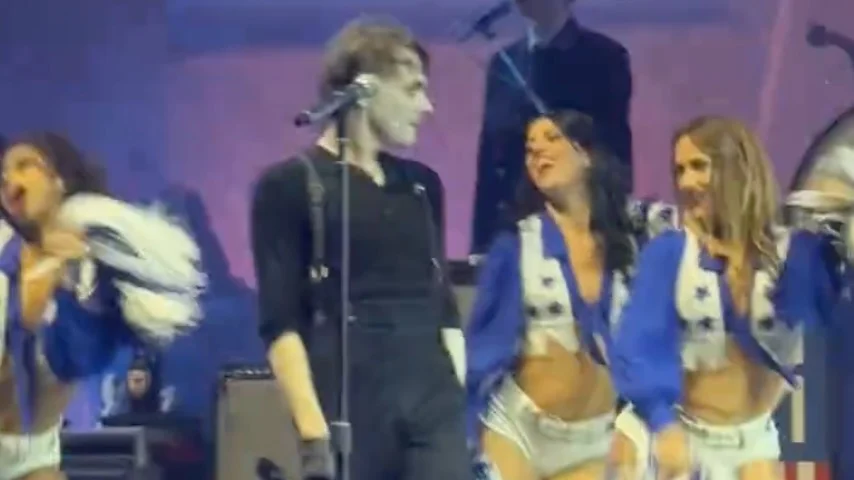
The intersection of high-concept rock music and fiercely protected corporate branding has landed in a federal courtroom following a dramatic opening night at one of Southern California’s most iconic historic venues. Pro Silver Star Ltd., the corporate entity that owns and aggressively manages the globally recognized Dallas Cowboys Cheerleaders (DCC) brand, has officially filed a lawsuit against legendary alternative rock band My Chemical Romance. The legal action stems from a theatrical and politically charged performance during the first installment of the band’s heavily anticipated, five-night sold-out residency at the Hollywood Bowl.
The lawsuit, which requests both a temporary restraining order and a preliminary injunction to halt the use of the disputed attire in subsequent performances, highlights the complex friction that arises when commercial trademark enforcement collides with protected artistic expression, theatrical satire, and sociopolitical commentary.
The Catalyst: A Theatrical Production at the Hollywood Bowl
The controversy erupted on October 21, 2026, as My Chemical Romance took the stage for the opening night of their residency celebrating their seminal, multi-platinum 2006 concept album, The Black Parade. The tour, structured as a grand rock opera set within a dystopian, fictional totalitarian regime, utilizes heavy pyrotechnics, stark lighting, and militaristic imagery to convey dark themes of mortality, war, and societal collapse.
During a performance of the band’s aggressive anti-establishment anthem "Teenagers," a troupe of backup dancers joined the band on stage. Clothed in costumes strikingly reminiscent of the world-famous Dallas Cowboys Cheerleaders uniform—complete with the distinct color scheme, star-spangled iconography, and tailored cut—the dancers initially engaged in choreographed routines before the tone of the performance shifted dramatically.
As the theatrical narrative of the song unfolded into simulated martial conflict, the dancers took up prop rifles. They participated in a staged firefight within the fictional dictatorship’s storyline, eventually being graphically depicted as shot and killed on stage.
While theatrical shock value has long been a hallmark of My Chemical Romance’s live performances—dating back to their emo-punk origins in the early 2000s through their subsequent stadium-filling iterations—the deployment of the recognizable Dallas Cowboys Cheerleaders aesthetic in a violent, militarized combat scenario crossed a legal boundary for the brand’s proprietors.
Legal Arguments and Filings by Pro Silver Star Ltd.
According to legal documents filed by Pro Silver Star Ltd. and reviewed by various media outlets, the core of the grievance rests not on the music, the politics, or the anti-war message of the production, but specifically upon trademark dilution, brand degradation, and consumer confusion.
The filing outlines the plaintiff’s primary arguments:
"On Oct. 21, 2026, Defendants staged ‘The Black Parade,’ a theatrical concert production set in a fictional dictatorship and featuring pyrotechnics and armed conflict," the lawsuit states. "As part of that production, female performers took to the stage in the DCC Uniform—and then armed themselves with rifles in a staged firefight, only to be depicted being shot."
Furthermore, the legal team representing Pro Silver Star Ltd. emphasized that the visual similarity was close enough to genuinely mislead portions of the audience and internet observers.
"Audience members and online commentators understandably believed that the performers were the real Dallas Cowboys Cheerleaders and said so in social media posts that continue to circulate," the filing added.
To demonstrate a measured approach and preempt arguments regarding First Amendment protections or artistic censorship, the plaintiffs explicitly carved out boundaries for what they are—and are not—seeking to change.
"Silver Star is not litigious, and it takes no issue with MCR’s music, its artistic ambitions, or any message Defendants seek to convey," the statement in the filing reads. "Silver Star does not ask Defendants to change their setlist, narrative, politics, choreography, or even their decision to put gun-toting performers on stage. Silver Star asks only that those performers not wear the DCC Uniform while doing it. The universe of alternative costume designs is effectively unlimited."
In addition to the emergency requests for restraining orders and temporary injunctions to prevent the continuation of the costume usage during the remainder of the Hollywood Bowl residency, Pro Silver Star Ltd. is pursuing unspecified monetary damages for trademark infringement and unfair competition.
Background Context of the Dallas Cowboys Cheerleaders Brand
To understand the intensity of the legal response, one must examine the meticulous corporate stewardship surrounding the Dallas Cowboys Cheerleaders, often dubbed "America’s Sweethearts." Over decades, the organization has transformed from a traditional NFL sideline squad into a global pop culture phenomenon, multimedia franchise, and tightly guarded intellectual property.
Managed under Pro Silver Star Ltd., the brand generates substantial revenue through merchandise, global appearances, reality television series (such as CMT and Netflix’s documentary series Dallas Cowboys Cheerleaders: Making the Team and America’s Sweethearts: Dallas Cowboys Cheerleaders), and corporate sponsorships. The iconic uniform—featuring white vest tops with blue stars, white shorts, fringe, and white go-go boots—is registered as a trademarked asset.
Because the organization relies heavily on maintaining a pristine, wholesome, and family-friendly image to sustain its massive commercial valuation, the association with a violent, bloody, anti-war rock concert narrative featuring armed conflict and simulated executions represents a direct threat to the brand guidelines established by ownership.
The Response from My Chemical Romance and Legal Standing
As of the initial filings, representatives for My Chemical Romance—including their management, legal counsel, and the band members themselves (frontman Gerard Way, guitarist Ray Toro, guitarist Frank Iero, and bassist Mikey Way)—have not issued a formal public statement regarding the lawsuit.
Legal experts specializing in entertainment and intellectual property law note that this case sits at the intersection of trademark law, parody, and the First Amendment’s protection of artistic expression. While artists enjoy significant latitude when utilizing satire, parody, or political commentary in their work, trademark law heavily penalizes unauthorized commercial use that is likely to cause consumer confusion or dilute the distinctiveness of a famous mark.
My Chemical Romance’s defense could potentially invoke the doctrine of nominative fair use, artistic expression, or parody, arguing that the inclusion of the uniforms was a transformative artistic statement meant to critique American militarism, pop culture consumerism, and institutionalized performance. However, because the costumes closely mirrored the real uniforms without explicit alterations characteristic of traditional satire (such as exaggeration or overt caricature), legal analysts suggest that Pro Silver Star Ltd. holds a strong initial position regarding the likelihood of consumer confusion.
Broader Impact and Industry Implications
The lawsuit arrives at a critical juncture for My Chemical Romance, who are currently enjoying a massive resurgence in popularity following their reunion, subsequent global tours, and high-profile festival headlining slots. The Black Parade remains a touchstone album of 21st-century rock music, and staging a full-album anniversary residency at a venue as prestigious as the Hollywood Bowl is viewed as a monumental career milestone.
Beyond the immediate legal fallout for the remaining nights of the residency, this case could establish an important precedent regarding the limits of incorporating recognizable corporate, athletic, or institutional uniforms into live theatrical rock productions. In an era where modern music tours rely heavily on immersive, cinematic world-building, high-concept visual storytelling, and pop-culture pastiche, artists and production designers are increasingly vulnerable to intellectual property claims if their satirical elements tread too close to registered trademarks.
As the litigation proceeds through the federal court system, all eyes remain fixed on whether My Chemical Romance will alter the costume designs for the concluding nights of their historic residency, or if the band will mount a robust First Amendment defense against one of the most fiercely guarded corporate brands in professional sports and entertainment.