
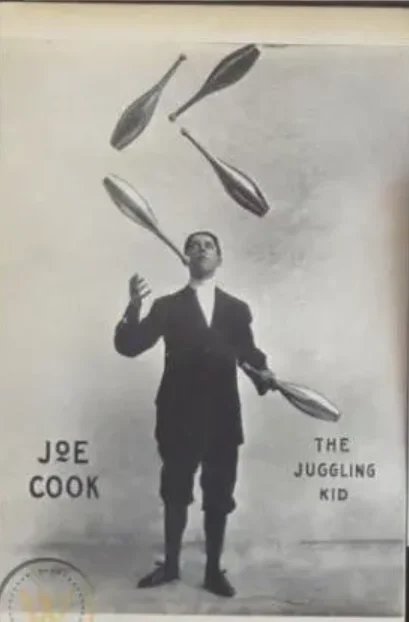
Joe Cook, a name that resonates with the golden age of American vaudeville, stands as a testament to unparalleled versatility and unwavering dedication. His illustrious career, spanning the late 19th and early 20th centuries, saw him command stages alongside luminaries like W.C. Fields and Fred Allen. Cook’s adage, “we must love our work so much that the time we have to be away from it hurts,” perfectly encapsulates the ethos of an artist whose passion drove him to master an astounding array of skills, most notably the formidable challenge of juggling five Indian clubs. This article delves into the life and enduring legacy of Joe Cook, exploring his extraordinary talents, his journey from adversity to stardom, and the legendary perseverance that made him a true icon of entertainment.
A Prodigy Forged in Adversity: Early Life and the Birth of a Performer
Born Joseph López on March 29, 1890, in Evansville, Indiana, Cook’s early life was marked by profound tragedy. His father, Joseph López, a Spanish actor who had emigrated to the United States, tragically drowned when Joe was just three years old. A mere few months later, his mother also passed away, leaving young Joe and his brother orphaned. This immense loss, however, paved the way for a new chapter when the boys were adopted by the Cook family, close friends of the Lópezes.
The Cook household, particularly a sprawling barn on their property, became an unconventional training ground for young Joe. Within its rustic confines, he immersed himself in a diverse curriculum of physical arts: acrobatics, gymnastics, juggling, and various balancing acts. This informal yet rigorous training environment allowed his natural talents to flourish without the constraints of formal instruction. By the age of fourteen, Joe, alongside his brother, was already performing intricate trapeze acts at home, a testament to their burgeoning skills. Together, they soon formed a juggling act, aptly named "The Juggling Kids," which provided their initial foray into public performance.

Joe Cook’s solo debut arrived in July 1907 at F. F. Proctor’s 125th Street Theater. Proctor’s venues were renowned across the vaudeville circuit for showcasing top-tier talent, and securing a spot there was a significant milestone for any aspiring performer. This debut marked the official commencement of a career that would redefine the boundaries of stage entertainment.
The Quintessential Vaudeville Star: A Master of All Trades
Joe Cook was not merely a performer; he was a living embodiment of the "master of all trades" adage, a true polymath of the stage. His repertoire was astonishingly broad, encompassing virtually every facet of popular entertainment in his era. He could sing with charm, dance with agility, and act with comedic timing. His manual dexterity was legendary, allowing him to effortlessly juggle balls and clubs, perform breathtaking acrobatics, and even execute "antipodism" – the art of manipulating objects with one’s feet while lying on one’s back, often involving humans. Beyond these physical feats, Cook captivated audiences with daring tightrope walks, intricate unicycle tricks, and musical performances on both the violin and ukulele. Capping off his diverse skill set was his sharp wit, delivered through engaging stand-up comedy routines.
An advertisement from 1909 vividly captured the essence of Cook’s extraordinary abilities, proclaiming him a "Master of all trades. Presenting in a 15-minute act: juggling, unicycles, magic, hand balancing, ragtime piano and violin, dancing, balloon rolling, tightrope walking, talking, and caricaturing. Something original in every line: something entertaining." This advertisement underscores not only the breadth of his talents but also the innovation he brought to each discipline, ensuring that every moment of his performance was captivating and fresh.
During the height of vaudeville’s popularity, Cook solidified his reputation as one of its most celebrated stars. He wasn’t just a novelty act; he was a headliner, capable of holding an audience spellbound with his seamless transitions between different art forms. His ability to weave together such disparate skills into a cohesive and endlessly entertaining show was a hallmark of his genius and placed him in an elite class of performers.

From Stage to Screen: Cook’s Cinematic Ventures
As the 1920s drew to a close and the 1930s began, the entertainment landscape was evolving, with cinema and nascent television gaining traction. Joe Cook, ever the adaptable performer, successfully transitioned his immense talents from the live vaudeville stage to the burgeoning world of film and television. He quickly became one of the most famous stars of musical theater, leveraging his stage presence and multifaceted skills for a new medium.
His filmography includes notable works such as Rain or Shine (1928), Fine and Dandy (1930), and Hold Your Horses (1933). These films provided a wider audience with access to Cook’s unique brand of entertainment, capturing his dynamic performances for posterity.
One particularly significant cinematic artifact is his appearance in Rain or Shine. The film offers a rare visual record of Cook’s circus techniques, showcasing his mastery of diverse disciplines. From the 50-minute mark of the film, viewers can witness Cook performing a dazzling routine that includes "balloon walking" (likely a form of prop manipulation while walking), intricate five-club juggling, the highly unusual art of antipodism with human subjects, and impressive acrobatics. This footage is not just entertainment; it serves as an invaluable historical document, offering a glimpse into the physical demands and artistry of a bygone era of performance.
The Unwavering Pursuit: Mastering the Five Indian Clubs

While Joe Cook was celebrated for his diverse talents, his relentless pursuit and eventual mastery of juggling five Indian clubs stand out as a testament to his extraordinary dedication. This particular feat, considered highly challenging even by today’s standards, became a hallmark of his act and a symbol of his unwavering commitment to his craft. The depth of this commitment was vividly captured in an interview conducted by Mary B. Mullett, editor and writer for American Magazine, in January 1924. Through Mullett’s recounting, three poignant anecdotes reveal the arduous journey Cook undertook to conquer the five clubs.
Over 100 Broken Indian Clubs: A Lesson in Persistence
Cook’s own words, shared with Mullett, paint a picture of an artist driven by an almost obsessive desire for perfection:
“…And a city apartment, let me tell you, is no place for a kid to practice the stunt I was trying to master at the time: juggling five Indian clubs. I used to try it on my bed. But the clubs would hit the ceiling or crash to the floor; so I went over to Thirty-Seventh Street across from the firehouse and practiced there. Later, I found a gym where I could stand on a mat. That saved me from breaking a lot of clubs. But in the four years I worked to achieve that stunt, I broke over a hundred. But I never lost interest. I hated going to bed at night because I wanted to keep practicing. I would wake up at five in the morning and wait impatiently for dawn so I could start again. Later, when we moved closer to another, He practiced at the gym from eight in the morning until noon. After a fifteen-minute break for lunch at a café, he practiced until dinnertime.”
This narrative highlights the sheer, unyielding effort Cook invested. His progression from a cramped apartment to the street, and finally to a gym, illustrates his resourceful adaptation to find suitable practice environments. The statistic of "over a hundred" broken clubs over four years is staggering, not just in terms of material cost, but in the sheer number of failed attempts it represents. More importantly, it underscores his profound love for his work, a passion so intense that sleep felt like an unwelcome interruption, and the dawn a long-awaited signal to return to his craft. This level of dedication, characterized by hours of daily practice, reveals the depth of his commitment to artistic mastery.

Juggling in Front of the Fire Station: The Cost of Ambition
Mullett’s article also provided a more intimate glimpse into Cook’s street-level practice sessions, capturing a vivid scene from his youth:
“The men in front of the fire station laughed sympathetically. Across the street, a nearly grown boy, with two Indian clubs in each hand, stared at the fragments scattered on the pavement at his feet. A moment before, he had been juggling five clubs in the air. Every day, right there in the street, he practiced this stunt. And almost every day, the performance was cut short by that ominous ‘CRACK!’ For the Indian clubs jugglers use are hollow and break easily. When the boy turned around, one of the firemen called after him: ‘Hey, kid! How many are broken?’ The boy looked up and grinned: Thirty-nine! ‘How much are they?’ ‘Two dollars each.’ ‘Wow! You must have a gold mine.’ ‘I wish I did!’ That boy had fourteen years old…”
This anecdote, set against the backdrop of a bustling street and the watchful eyes of the firemen, humanizes Cook’s struggle. It emphasizes the fragile nature of the early Indian clubs, which were typically hollow and prone to breakage. The casual exchange with the fireman reveals the financial burden of his pursuit – 39 broken clubs at two dollars each represented a significant sum in the early 1900s, especially for a fourteen-year-old. This interaction paints a picture of a determined young man, undeterred by repeated failures and financial strain, driven solely by the desire to master his craft. The YouTube video titled "1920s LEARN HOW TO JUGGLE Circus School with Joe Cook" further illustrates the techniques and the era, and notably, it stands as the oldest known video recording of someone juggling five Indian clubs, providing crucial visual evidence of this historical feat.
Joe Cook’s First Time with 5 Indian Clubs in an Act: Triumph Born from Failure

The path to on-stage mastery was not without its public humiliations, as Mullett recounted:
“For example, his trick with the five Indian clubs. He’s the only person who can juggle that many clubs, at least in public. But he practiced for four years straight before he mastered it. During that time, he broke over a hundred clubs, at two dollars each. Finally, he felt so confident that he tried to do it as part of his act at the theater, and he failed! He tried it again and again. At first, the audience thought he was fooling them. But he wasn’t! He had to give up. That was on a Monday night. When he came offstage, the manager said to him, ‘Stop it, Joe! You can’t do that trick.’ ‘Nobody can.’ ‘But I can!’ Cook said. ‘Well, don’t try it again here. I pay you to perform, not to practice during the show.’ So, he didn’t try it again that week. But the following week, at another theater, he boldly told the audience that he would juggle five Indian clubs and he did! If he had set out to accomplish that feat, or any other, he would have practiced for forty years, if necessary.”
This story perfectly encapsulates the essence of Cook’s resilience. Despite years of solitary practice and achieving proficiency, the pressure of a live performance initially proved too much. His repeated failures on stage, leading to the audience’s confusion and the manager’s stern warning, could have easily deterred a lesser individual. Yet, Cook’s unwavering self-belief, articulated in his firm declaration, "But I can!", speaks volumes about his conviction. His eventual triumph at another theater, achieved just a week later, was not merely a successful juggling act; it was a profound demonstration of mental fortitude and an unshakeable belief in his own capabilities. Mullett’s concluding remark, that he would have practiced for "forty years, if necessary," underscores the depth of his commitment to any goal he set for himself.
Indian Clubs: A Historical Context
To fully appreciate Cook’s achievement, it is important to understand the context of Indian clubs. These clubs, distinct from modern juggling clubs, derive their name and form from ancient Persian "meels" and Indian exercise implements. They were traditionally used for physical training, developing strength, flexibility, and coordination through swinging exercises. By the late 19th and early 20th centuries, they had found their way into circus and vaudeville acts, where jugglers began to adapt them for complex aerial patterns.

Juggling five objects of any kind is inherently difficult, requiring immense hand-eye coordination, precise timing, and consistent practice. With Indian clubs, the challenge is amplified by their unique shape, weight distribution, and the need for accurate spins and catches. The hollow construction of early clubs, as noted in Mullett’s article, also made them fragile, adding a financial and practical barrier to extensive practice. In an era before advanced juggling techniques were widely documented or shared, mastering such a feat required pioneering effort and self-devised methods, making Cook’s accomplishment all the more remarkable.
A Legacy Beyond the Limelight: Later Life and Enduring Impact
Joe Cook’s remarkable career, unfortunately, faced a tragic decline due to health issues. In 1941, he was diagnosed with Parkinson’s disease, a progressive neurological disorder that gradually stripped him of the physical dexterity that had defined his life and career. As his health deteriorated, Cook made the difficult decision to sell his beloved home in Lake Hopatcong, which he had famously named "Sleepless Hollow." This estate was renowned for the lavish parties he hosted and the array of celebrities he entertained, a testament to his social standing and the friendships he cultivated throughout his career. After selling "Sleepless Hollow," he moved to New York City. Joe Cook passed away on May 16, 1959, in Staatsburg, New York, leaving behind an indelible mark on the world of entertainment.
Historical Significance and the "First Juggler" Debate
While Mary Mullett’s 1924 interview claimed Joe Cook was the "only person who can juggle that many clubs, at least in public," historical research offers a more nuanced perspective on the "first" five-club juggler. According to Mullett’s anecdote, Cook was 14 when he juggled five clubs, placing this achievement around 1904.

However, circus researcher Charlie Holland, in his article "Who was the first five club juggler?", indicates that other jugglers may have performed this feat even earlier. Holland suggests that Will Hanvarr likely holds the distinction of being the first, with records mentioning his performances with five Indian clubs between 1901 and 1903. Additionally, Holland identifies other early 20th-century jugglers such as Claude Bartram and Tom Breen, who were also noted for their five-club juggling skills.
Therefore, while Joe Cook may not have been the absolute first five-club juggler to perform before an audience, he is undeniably among the earliest masters of this complex discipline. His inclusion in the pantheon of pioneering five-club jugglers is secure. Furthermore, the video recording of Joe Cook performing with five Indian clubs remains the oldest known visual record of this specific feat, making it an invaluable piece of juggling history. This footage not only demonstrates his incredible skill but also provides a tangible link to the early development of complex juggling patterns.
Joe Cook’s legacy is multifaceted. He was a vaudeville sensation, a cinematic presence, and a master of an extraordinary range of performance arts. Yet, it is his legendary perseverance in mastering the five Indian clubs, detailed through the anecdotes from Mary B. Mullett, that perhaps best illustrates his character and enduring influence. His unwavering dedication, resilience in the face of failure, and profound love for his work continue to inspire, reminding us that true mastery is often the result of relentless, passionate effort, much like the sentiment he himself expressed: "we must love our work so much that the time we have to be away from it hurts." His story remains a powerful narrative of ambition, skill, and the indomitable spirit of a true entertainer.


![Iron Maiden Legend Nicko McBrain Turned Down Trump Golf Invite: [He] Should Be Put in Jail](https://worldbusk.org/wp-content/uploads/2026/10/iron-maiden-legend-nicko-mcbrain-turned-down-trump-golf-invite-he-should-be-put-in-jail.webp)