The cinematic adaptation landscape has long been littered with the wreckage of failed video game translations, a historical trend that has frequently treated interactive source material with either dismissive contempt or misguided reinvention. Among the most notorious examples of this phenomenon are the 1994 live-action adaptation of Street Fighter starring Jean-Claude Van Damme and Raul Julia, and the subsequent 2009 release Street Fighter: The Legend of Chun-Li. Both films earned universally poor reviews, consistently ranking near the bottom of critical aggregators and embedding themselves into pop culture lore as cautionary tales of Hollywood’s inability to successfully bridge the medium gap.
Consequently, the bar for the 2026 iteration of the property was exceptionally low. By default, the martial arts comedy-adventure needed only to avoid absolute catastrophe to secure the dubious honor of being the finest film adaptation the franchise has ever produced. Arriving in theaters on Friday, October 16, 2026, the new Paramount release clears that low bar, delivering an energetic, chaotic, and visually faithful cinematic experience that nevertheless stumbles in critical structural areas, ultimately missing a definitive knockout blow.
Plot Architecture and Narrative Progression
The narrative foundation of the 2026 film centers on martial artists and longtime friends Ryu, portrayed by Andrew Koji, and Ken, played by Noah Centineo. The story establishes that in 1987, the duo’s camaraderie fractures permanently following the inaugural World Warrior competition, an event won by Ryu, and the subsequent death of their mentor, Gouken, played by Don Lee.
Six years later, the characters’ trajectories have diverged sharply. Ken has achieved mainstream, MTV-style fame, though he is widely regarded as a joke within the traditional martial arts community. Ryu, meanwhile, has chosen a path of seclusion and hiding. Their paths are inevitably forced back together when the primary antagonist, the sinister M. Bison—portrayed by David Dastmalchian—announces a second World Warrior tournament.
Recruited by Bison’s operative Chun-Li, played by Callina Liang, the world’s leading fighters converge on Metrolao City to participate. Every competitor harbors distinct ulterior motives, whether tied to personal vendettas, participation in Bison’s expansive criminal network, or a combination of both. This massive ensemble brings together characters drawn directly from across the franchise’s history, ranging from headline figures to obscure deep cuts like Joe, a fighter originating exclusively from the 1987 original game, here brought to life by UFC Featherweight Champion Alexander Volkanovski.

Casting Dynamics and Action Choreography
The film’s casting strategy heavily favors physical authenticity and cross-industry star power, leaning heavily on professional wrestlers and martial artists who are accustomed to physical performance. Cody Rhodes appears as Guile, sporting a prominent flat-top hairstyle that became a viral marketing fixture, including serving as the inspiration for a theatrical popcorn bucket. Rhodes, transitioning from the squared circle of professional wrestling, brings an inherent lack of subtlety that suits the larger-than-life nature of the character.
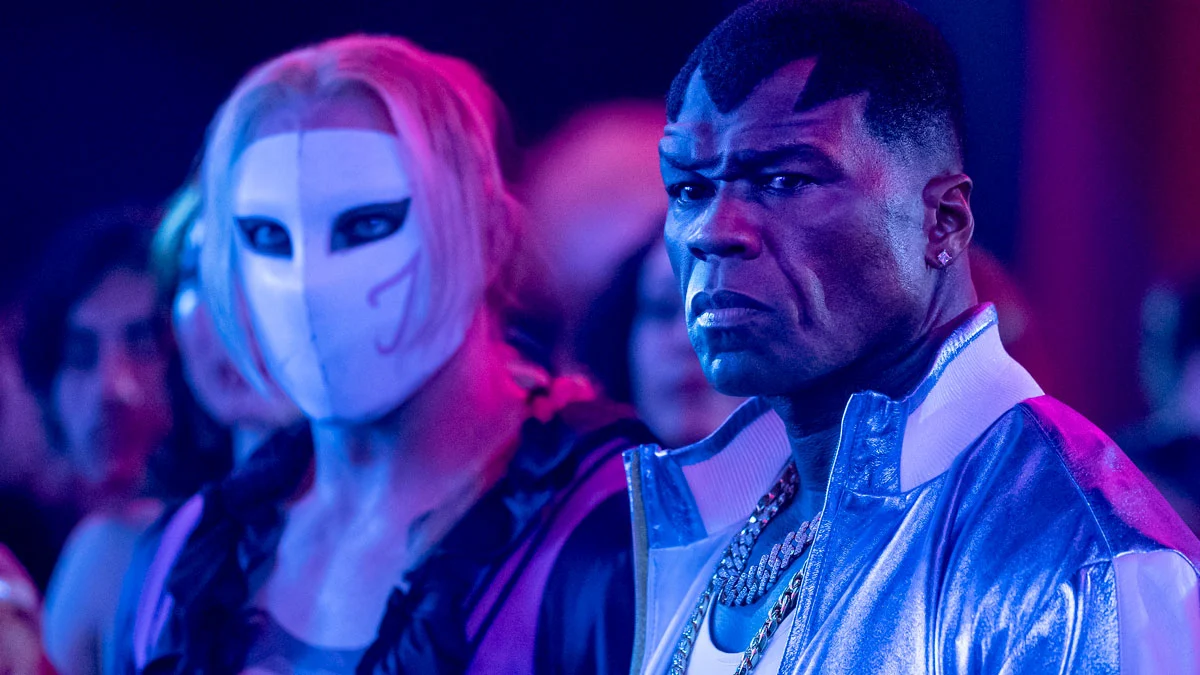
Rhodes is joined by fellow professional wrestling figures Joe "Roman Reigns" Anoaʻi, who portrays the villainous Akuma, and Hirooki Goto, who steps into the role of sumo staple E. Honda. Curtis "50 Cent" Jackson rounds out portions of the cast as Balrog, delivering gruff performances and physical presence, while musician Orville Peck makes his feature film acting debut as Vega. Peck’s performance is somewhat constrained by the character’s signature hard plastic mask, highlighting the challenges of translating stylized game aesthetics directly to the screen without losing emotional range.
On the villainous and comedic fronts, David Dastmalchian embraces the eccentricities of M. Bison, incorporating a subtle homage to Raul Julia’s legendary 1987 portrayal. Eric André enters the dynamic as ring announcer Don Sauvage, a casting choice that aligns naturally with his career of playing live-action cartoon personas, directed here by Kitao Sakurai, a frequent collaborator.
The ensemble also benefits from grounded performances where possible, such as Bollywood star Vidyut Jammwal’s take on Dhalsim, which successfully navigates potential cultural stereotypes. Andrew Koji anchors the emotional core as Ryu, contrasting effectively with Noah Centineo’s comedic take on Ken. Despite narrative shortcuts in establishing their historical bond, the fight sequences featuring Koji and Centineo stand out as the film’s strongest action set pieces.
Aesthetic Choices and Stylistic Ambiguity
Aesthetic presentation remains one of the film’s most defining characteristics. The production utilizes a dual approach to visual storytelling, integrating ’90s-style anime flashback sequences produced by Titmouse Animation alongside live-action segments designed with a deliberate, Looney Tunes-esque cartoonishness. Characters frequently deploy video game catchphrases and operate with heightened physics.
However, this commitment to cartoon chaos introduces continuity and detail oversights. Notably, the soundtrack prominently features 4 Non Blondes’ 1992 hit single "What’s Up," which is featured during flashback sequences explicitly set in 1987 or earlier. While minor temporal discrepancies of this nature are common in action comedies featuring energy-projecting fighters and CGI-rendered characters like Jason Momoa’s Blanka, they contribute to a broader sense of editorial incoherence.

The Tournament Structure Flaw
Despite capturing the kinetic energy and visual flair of the source material, the film suffers from a structural flaw regarding its central premise: the fighting tournament. Historically, both the 1994 and 2009 adaptations faced severe criticism for omitting the tournament concept entirely, failing to leverage the fundamental narrative engine of the franchise.
The 2026 film initially rectifies this by establishing an explicit eight-man bracket competition, prominently displayed on the arena wall. However, the execution falls short of audience expectations. Only two actual tournament matches are fully depicted on screen, with others subjected to sudden cuts or arbitrary forfeits. While the film compensates with numerous external action sequences, the underutilization of the bracket structure leaves the narrative feeling incomplete, especially when compared to contemporary martial arts adaptations like the summer release Mortal Kombat II, which successfully centered its plot around a structured competition.
Commercial Implications and Future Outlook
Financially and critically, the 2026 Street Fighter occupies a unique space in video game adaptation history. By delivering an uninhibited, fast-paced live-action cartoon experience backed by a soundtrack of nostalgic hits and a dedicated cast, the film satisfies a specific niche of fan expectations while sidestepping the catastrophic failures of its predecessors.
The concluding moments of the film signal clear intentions from the filmmakers to develop a franchise sequel. Whether the box office returns and audience reception for this initial entry will justify subsequent installments remains to be seen. For now, the production establishes a new, albeit flawed, baseline for what a cinematic Street Fighter universe can achieve.