
The vibrant tapestry of American street music, often chronicled in works like Cary Baker’s "Down on the Corner; Adventures in Busking & Street Music," celebrates a diverse cast of performers, from celebrated figures like Billy Bragg and Grandpa Elliott to unsung local heroes. Among these luminaries stands George Coleman, universally known as Bongo Joe, a San Antonio icon whose unique artistry transcended conventional musical boundaries. His performances, characterized by powerful vocals, rhythmic banter, and the thunderous percussion of a 55-gallon oil drum, established him as an "American Primitive" – a self-taught genius whose raw talent and idiosyncratic style captivated audiences and etched his legacy into the cultural fabric of Texas and beyond. This exploration delves into the life, times, and lasting impact of a man who turned everyday objects into instruments and street corners into stages, defining a singular chapter in the history of American folk and street performance.
Early Life and the Genesis of a Street Musician
Born George Coleman on November 28, 1923, in Haines City, Florida, Bongo Joe’s early life was marked by adversity. Orphaned at a young age, he found a new home and formative experiences in Detroit, a city known for its rich musical heritage. It was here that he first engaged with music, even reportedly performing alongside the legendary Sammy Davis Jr., a testament to his innate talent and early immersion in the performing arts. However, the path to conventional musical success proved elusive. By the 1940s, Coleman had relocated to Houston, where he honed his percussive skills in local ensembles. Yet, a turning point arrived when he faced the common musician’s dilemma: the inability to afford his own instruments. As he recounted in an interview with San Antonio musicologist Larry Skoog for the Arhoolie Foundation, his journey into unique instrumentation began in the early 1950s: "I was just trying to get a job as a drummer, and I couldn’t get the job unless I had my own drums. I tried to make a loan from several sources to buy drums… my first job, and couldn’t get the money so I got some cans and fixed them up like drums and started playing on street corners in Houston." This pragmatic improvisation laid the groundwork for his signature style, transforming industrial discards into powerful musical tools.
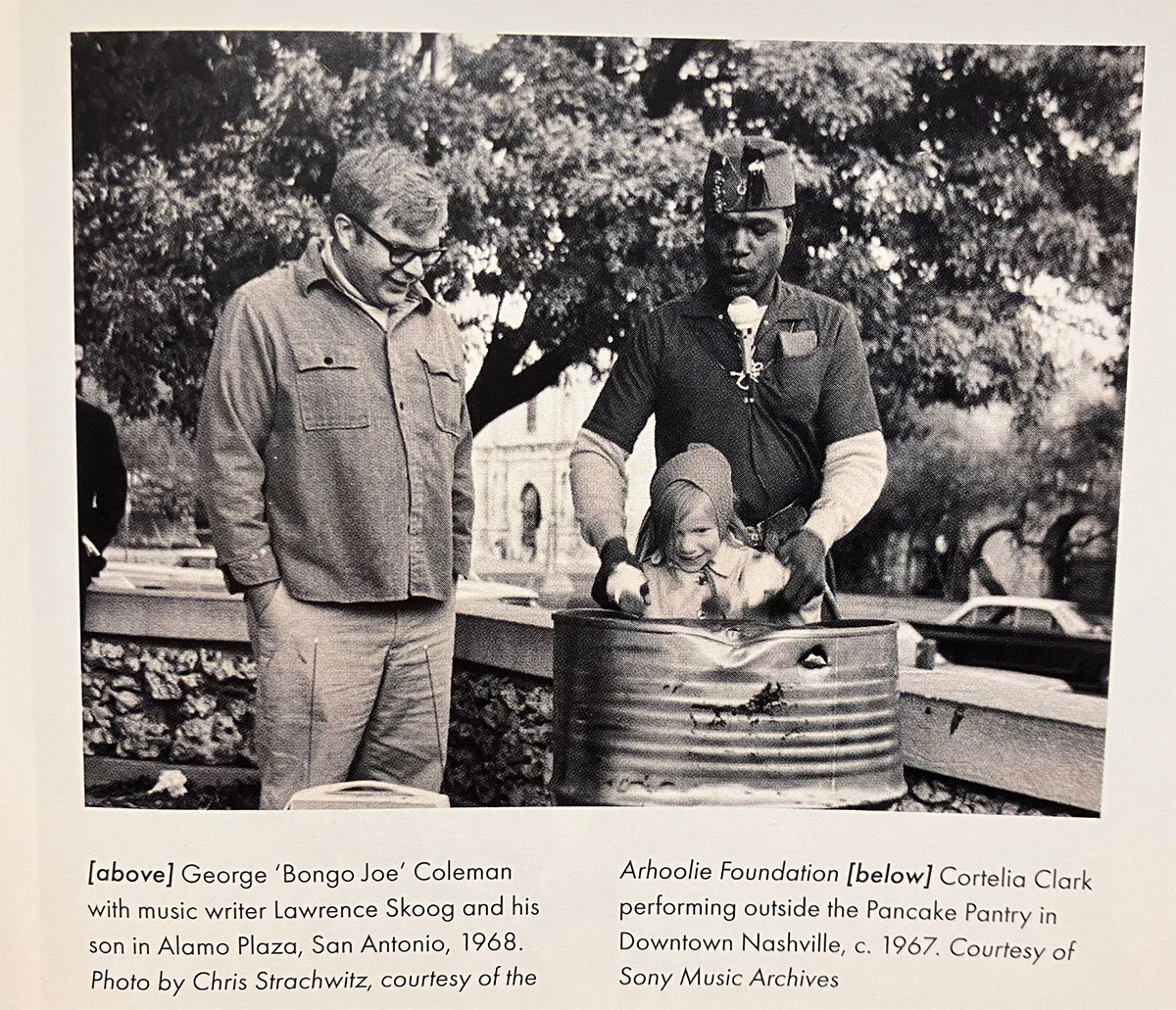
Coleman’s itinerant spirit led him through the streets of Houston, Galveston, and eventually to San Antonio, where he truly found his calling and cultivated a devoted following. It was in San Antonio that he became a fixture, performing on the bustling RiverWalk, near the entrance of HemisFair ’68, and outside the now-defunct Joske’s department store. His performances were a spectacle: a captivating blend of singing, spoken word, whistling, and witty, often bawdy, banter, all underscored by the resonant clang of his oil drum. He amplified his voice through a pickup microphone connected to a small amplifier, powered ingeniously by car batteries, creating a mobile, self-contained sound system that was as unconventional as his music. This ingenious setup was a testament to his resourcefulness and dedication to his craft, ensuring his unique voice and rhythms cut through the urban din.
The San Antonio Icon: An "American Primitive" Unveiled
Bongo Joe’s presence in San Antonio was indelible, a vibrant thread in the city’s cultural tapestry. Jim Beal Jr., who served for nearly a quarter-century as the esteemed music reporter for the San Antonio Express-News, vividly recalls encountering Bongo Joe as a teenager. "He was outrageous, loud and sometimes reminded me of the classic rodeo clown with mismatched kind of clothing," Beal stated, painting a picture of a performer who was as much a visual spectacle as an auditory one. "He was a statement of something. He was a showman — and he was pretty darn good percussionist." Beal further highlighted a subtle musical sophistication beneath the surface of Bongo Joe’s seemingly primitive style: "One day, a guy who I was playing in a garage band with the time, said to me: ‘You know, Bongo Joe always whistles in a minor key.’ I hadn’t thought of that!" This observation speaks to the underlying melodic sensibility that informed his performances, elevating them beyond mere noise.
Coleman’s daily commute to his performance spots was as distinctive as his music. From his modest tourist court residence off Broadway, he would traverse the ten to fourteen blocks to downtown San Antonio not by car, but on a jerry-rigged moped. Beal described it: "He had all that stuff on a small motorcycle, almost like a moped. It wasn’t a Harley Davidson and it wasn’t a bicycle; it was somewhere between. And somehow he jerry-rigged his moped to carry his oil drums." This image of Bongo Joe, laden with his unconventional instruments, navigating the city streets, further cemented his legend as a true original.
His performances were not designed for sustained, dedicated listening, but rather as spontaneous, immersive encounters. Beal noted, "But it wasn’t the kind of thing where you would go and hang around and listen to Bongo Joe play all night. You would encounter him on the way to a river block bar or tourists walking around, back and forth from the Alamo to their hotels, and that part of town was a big tourist attraction. So you would see him. He was just there." He became an organic part of the tourist experience, akin to other regional street attractions like the parrot handlers on Fisherman’s Wharf or the "gutter punks" with boa constrictors in New Orleans. His music, often described as a precursor to rapping, blended witty and frequently bawdy turns of phrase with intricate rhythms, forming a direct, engaging dialogue with passersby.
Jazz Roots and the Arhoolie Legacy
Despite his image as an "outsider artist," Bongo Joe’s musical influences were sophisticated and deeply rooted in jazz. In his interview with Larry Skoog, he rattled off a list of jazz titans as his heroes: "Dave Brubeck, Stan Kenton, Erroll Garner, Fat Wallace, Chick Webb, Gene Krupa, Stan Kenton, Duke Ellington, Johnny Hodges, Flip Phillips, Dizzy Gillespie, and this Mexican guy…I can’t think of his name right now." This pantheon of jazz greats reveals a profound understanding of complex musical structures and improvisation, contextualizing his seemingly raw street performances within a rich artistic tradition. His ability to distill these influences into a unique, accessible form for the street was a mark of his genius.
His talent did not go unnoticed by the wider music world. In 1968, Chris Strachwitz, the visionary founder of Arhoolie Records, a legendary label dedicated to blues, folk, and roots music, traveled to San Antonio specifically to record Bongo Joe. The resulting LP, simply titled "George Coleman: Bongo Joe," would be his only official studio recording, capturing the raw energy and distinctiveness of his street performances. AllMusic, in its review, described the album as both "hilarious" and "edgy," highlighting its unconventional charm. One particular track, "Innocent Little Doggie," resonated deeply, becoming an underground radio classic not only in Texas but also across the Atlantic in the United Kingdom. Strachwitz, reflecting on his discovery in a 2022 feature for the San Antonio Current, remarked, "Nobody took him seriously. He was just a street entertainer. But he was absolutely brilliant." Jim Beal Jr. corroborated the album’s authenticity, stating, "The melody line was his vocals. And he was just banging on the drums, and whistling and then some singing. What you heard on that here on that record is exactly what he did. He was what you might have called an American primitive." The Arhoolie recording served as a crucial historical document, preserving the ephemeral art of Bongo Joe for generations to come and introducing his unique sound to a broader audience.
National Exposure and Unforgettable Incidents
The intrigue surrounding his Arhoolie album, combined with his undeniable stage presence, occasionally drew Bongo Joe beyond the confines of San Antonio. Notably, he performed for nine years at the prestigious New Orleans Jazz & Heritage Festival, a significant testament to his recognized talent. In one extraordinary instance, he even accompanied jazz legend Dizzy Gillespie – astonishingly, as a pianist, showcasing a versatility that few might have expected from the oil drum percussionist. Jim Beal Jr. recounted his surprise: "What the heck, I travel all the way from San Antonio to New Orleans. And there’s Bongo Joe playing at New Orleans JazzFest!" His unexpected appearance at such a renowned festival underscored his unique place in the broader musical landscape. Furthermore, in 1976, Bongo Joe’s distinctive persona garnered national attention when he performed at several stops along Gerald Ford’s presidential campaign, demonstrating his crossover appeal and the widespread recognition of his engaging showmanship.
Beyond his musical exploits, Bongo Joe was also a figure of spontaneous action, often finding himself at the center of unusual events. In 1978, he became an unlikely hero when he assisted local authorities in capturing an alleged shoplifter. A detailed account by Josh Baugh in a 2017 San Antonio Express-News article, referencing an earlier 1978 piece, describes the incident: "Bongo Joe apprehends suspect in strange way," explains that Bongo Joe helped in the arrest of an alleged shoplifter. According to the story, the suspect stole some jewelry and sunglasses and then threatened a store worker with a knife. As the suspect fled, he ran past Bongo Joe, who pulled up on his moped next to a patrol car and asked the officer why that man had run past him. The cops told Bongo Joe the man was a suspect in a robbery. ‘With that information, Joe moved up alongside the breathless suspect and asked if he could give him a ride. The breathless person nodded ‘yes’ and he, too, climbed on the bike,’ the story said. ‘Joe said he told the man he looked like he needed a cup of coffee and would buy him one.’ The story continues, saying that patrol officers pulled up next to the bike and inquired if everything was OK. Joe apparently gave the officers a wink. ‘Finally, at Fourth Street and Broadway, Joe ploughed to a halt and got off the sagging moped,’ the story said. ‘The trailing officers immediately closed in and apprehended the suspect as he tried to get away.’ Later that night, Bongo Joe was back at his spot near Alamo and Commerce streets, banging on his drums." This incident perfectly encapsulated his quick wit and willingness to engage with the world around him, showcasing his role as an active participant in the urban environment rather than a mere observer.
However, Bongo Joe’s life was not without its darker moments. In 1987, he was involved in a self-defense shooting incident. After a heckler brandished a knife, Coleman, in defense, shot the individual in the shoulder with a .44-caliber handgun. Beal drew parallels to a similar incident involving Texas Outlaw country singer Billy Joe Shaver. The San Antonio Express-News elaborated: "In the mid-1980s, Bongo Joe found himself on the wrong side of the law after he shot a heckler at point-blank range with a .44-caliber handgun. In April 1983, Bongo Joe was playing to a crowd of about 30 people, including the heckler. According to a police sergeant quoted in a newspaper article about the incident, the heckler ‘made a threatening motion which Joe interpreted as an attack,’ the story said. The victim apparently walked to the nearby McDonald’s after he was shot and was then transferred to Medical Center Hospital and was treated for a bullet wound to the chest, the story said. Bongo Joe was jailed overnight on a third-degree felony charge and then was released on his own recognizance, according to one newspaper article. Another report said someone posted a $5,000 bond for him… Ultimately, Bongo Joe received five years’ probation to the incident." This event, while serious, underscored the raw and sometimes dangerous reality of street performance, where artists often navigate unpredictable public interactions.
Community Support and Philosophical Reflections
Bongo Joe’s significance to San Antonio was further demonstrated when his home along the San Antonio River was threatened with demolition. Faced with the prospect of leaving the city for his former home of Corpus Christi, a strong wave of community support emerged. A group of devoted San Antonio residents rallied, recognizing his cultural value, and successfully found him new living quarters within the city, ensuring his continued presence. This collective effort highlighted his status not just as a performer, but as a cherished local institution.
His philosophical outlook on life and art was captured in George Nelson’s 1972 20-minute documentary film, "Bongo Joe." In the film, Coleman shared his profound belief in constant evolution: "If a thing is not elevating or progressing, it ain’t alive," he declared. "You ain’t living if you ain’t doing… and if you ain’t progressing, you ain’t living. And, of course, if you ain’t doing, you’re dead. You’d be surprised at the walking dead we stumble across daily." These words offer a powerful insight into his relentless drive to create, perform, and connect, embodying a philosophy of continuous self-renewal that defined his extraordinary career.
Legacy and the Future of Busking in San Antonio
Bongo Joe’s remarkable career eventually drew to a close in the early 1990s following a diagnosis of diabetes and kidney disease. He passed away in 1999 at the age of 76, leaving behind an unparalleled legacy. His impact reverberated through the Texas music scene, notably earning a shout-out from Texas country singer Gary P. Nunn in his popular 2008 song "What I Like About Texas," cementing his place in the state’s cultural narrative.
His influence extended beyond music to the very legality of street performance in San Antonio. Jim Beal Jr. notes, "After Bongo Joe, a couple of local singer-songwriters were trying to get busking legalizing and they did it." This direct link suggests that Bongo Joe’s high profile and unique appeal played a role in paving the way for more permissive busking laws. Today, busking is permitted in many public pedestrian spaces in downtown San Antonio, including sidewalks in public rights-of-way and city-owned parks. However, specific exceptions exist for iconic locations such as the River Walk, Alamo Plaza (bounded by Alamo Street from Commerce to Houston, and east to Crockett and Blum, including sidewalks and the plaza itself), Main Plaza, and other outdoor spaces controlled by the City of San Antonio. The city maintains the right to "adopt further regulations and restrictions to protect the free flow of vehicular and pedestrian traffic and to preserve the historic and aesthetic ambiance of City of San Antonio resources."
While Beal relishes the legalization, feeling it has "enlivened the city’s public spaces," he offers a pragmatic caution: "This ain’t Royal Street in New Orleans where you can make a living, you know." This statement underscores the economic realities faced by most street performers, highlighting the distinction between a vibrant cultural activity and a sustainable profession. Nevertheless, Bongo Joe’s enduring spirit continues to inspire, reminding both musicians and the public of the power of raw talent, ingenuity, and an unwavering commitment to one’s unique artistic vision. His life story, an odyssey from orphaned youth to street legend, remains a compelling testament to the transformative potential of music and the indelible mark one individual can leave on a city’s soul.