
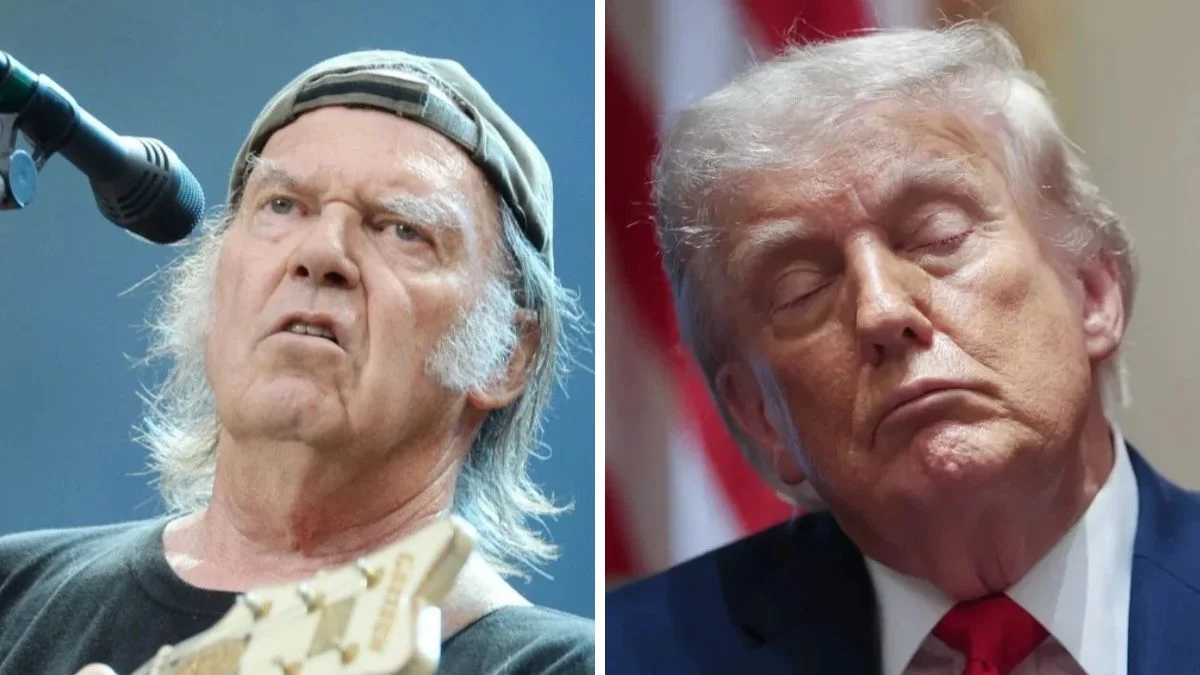
Legendary singer-songwriter Neil Young has escalated his long-running intellectual property dispute with Donald Trump, filing a sweeping $10 million copyright infringement lawsuit against the Trump 47 Committee. The legal action, lodged in the United States District Court for the Eastern District of Virginia, stems from the alleged unauthorized use of Young’s 1989 protest anthem, "Rockin’ in the Free World," during a political campaign event in Youngstown, Ohio.
This latest courtroom battle represents a dramatic escalation in a conflict that has spanned more than a decade. It touches upon complex questions regarding intellectual property rights, public performance licenses at political rallies, and the increasing friction between major recording artists and political campaigns that utilize popular music without explicit consent.
The Core Allegations and Legal Demands
According to the filed complaint, the Trump 47 Committee played "Rockin’ in the Free World" without a proper license or Young’s authorization immediately prior to Donald Trump taking the stage at a midterm campaign rally on October 12. Young’s legal team argues that this playback was not only a direct violation of federal copyright law but also a blatant breach of a previous agreement made between the artist and Trump’s political apparatus.
The lawsuit seeks $10 million in statutory and actual damages, citing willful copyright infringement. Furthermore, Young’s legal representation is asking the federal court to issue a permanent injunction barring the Trump 47 Committee, its organizers, and affiliated entities from utilizing Young’s musical catalog at any future public appearances, rallies, or promotional materials.
Under the guidelines of the federal court system, the defendants are required to respond to the complaint or file a formal motion to dismiss within 21 days of being officially served. As of press time, no official hearing date has been scheduled by the presiding judge, and representatives for the Trump campaign have not yet issued a formal public statement addressing the specific financial claims in the lawsuit.
A Decade-Long Battle Over Musical Rights
The friction between Neil Young and Donald Trump is nearly as old as Trump’s ambitions for the American presidency. The saga formally began on June 16, 2015, when Trump descended the escalator at Trump Tower in New York City to officially announce his first run for the White House. As he took the podium, the booming opening chords of "Rockin’ in the Free World" echoed through the atrium.
The unauthorized usage immediately triggered a public rebuke from Young, a Canadian-American citizen who has long been vocal about his political and social views. At the time, Young’s management team issued a statement clarifying that the campaign had not secured permission to use the track. While Trump’s campaign asserted that they had legally acquired a routine blanket performance license through organizations like ASCAP and BMI—which allow venues to host music—artists and legal scholars have long debated whether blanket venue licenses cover the specific ideological endorsements implied by playing songs at high-profile political campaign rallies.
The tension resurfaced aggressively during Trump’s 2020 reelection campaign. Young discovered that his songs—specifically "Rockin’ in the Free World" and "Devil’s Sidewalk"—were routinely being blasted at campaign stops, including the high-profile indoor rally in Tulsa, Oklahoma. Exasperated by the repeated infractions, Young filed a federal copyright infringement lawsuit in the summer of 2020.
That specific lawsuit was eventually resolved out of court after the Trump 2020 campaign entered into a settlement agreement, promising to refrain from using Young’s musical compositions at future political events without explicit, written authorization. Young’s current complaint argues that the Trump 47 Committee’s recent actions in Ohio constitute a direct violation of that historical understanding and the spirit of prior legal resolutions.
The Artistic Irony and Ideological Clash
Beyond the strictly legal arguments surrounding copyright and licensing, Young’s recent complaint delves into the stark thematic mismatch between his music and the political platform of Donald Trump. The lawsuit explicitly points out the profound irony of utilizing "Rockin’ in the Free World" at a conservative political rally.
Released in 1989 on Young’s twentieth studio album, Freedom, the track is widely recognized as one of the most prominent protest anthems of the late 20th century. While its chorus is undeniably anthemic and driving, the verses tell a deeply cynical and compassionate story about the underbelly of American society. The lyrics explicitly address themes of poverty, drug addiction, homelessness, urban decay, and the struggles of working-class families under the administration of George H.W. Bush.
The complaint outlines this ideological chasm directly, stating that the song’s core message is fundamentally "the opposite of everything Donald J. Trump stands for." Young has frequently maintained that while his music is meant to provoke thought and highlight societal failures, it should not be weaponized to endorse specific political candidates or ideologies that run counter to his worldview.
Political Activism on Both Sides
While Neil Young fiercely guards his artistic output from being associated with the Trump campaign, the artist has hardly removed "Rockin’ in the Free World" from political discourse altogether. Young continues to use the song on his own terms to voice his personal political convictions.
In September, during a co-billed performance alongside legendary outlaw country musician Willie Nelson, Young closed his live set by performing the iconic track while leading the crowd in passionate chants of "Take America Back!" Furthermore, the song was given an all-star revival in October at the annual Power to the People Festival, where a powerhouse collective of socially conscious rock musicians—including Bruce Springsteen, Foo Fighters frontman Dave Grohl, and Rage Against the Machine guitarist Tom Morello—teamed up to perform the track live.
The contrast highlights the core issue at the heart of modern campaign music disputes: it is not necessarily the presence of political music that artists object to, but rather the lack of consent and the specific political alignment implied by a campaign’s appropriation of their art.
Broader Industry Trends and Celebrity Endorsements
Neil Young is far from the only high-profile artist to lock horns with political campaigns over unauthorized song usage. Over the past decade, a growing roster of iconic musicians—including the Rolling Stones, Queen, Adele, Rihanna, Pharrell Williams, and the estate of Tom Petty—have issued public cease-and-desist letters or filed legal challenges against Donald Trump and other politicians for using their work without permission.
These recurring conflicts have highlighted a persistent gray area in United States copyright and performance rights law. While public venues typically hold blanket licenses with performance rights organizations (PROs) like ASCAP and BMI that allow them to play copyrighted music, legal experts note that political campaigns often stretch these licenses beyond their intended scope. Plaintiffs frequently argue that using a song as an introductory walk-on theme creates a false implication of endorsement, violating federal trademark and right-of-publicity laws in addition to copyright infringement.
At the same time, the intersection of music, celebrity culture, and political campaigning continues to evolve in unpredictable ways. On the same weekend that Young’s legal team filed their multi-million-dollar lawsuit, the political landscape demonstrated the complex ties between mainstream entertainment figures and the Trump campaign. Pop superstar Nicki Minaj made a surprise appearance alongside Trump at a high-profile campaign rally in Michigan. During the event, Trump publicly praised the rapper, creating a stark media contrast to the legal battles being fought over soundboards and licensing agreements just miles away.
Implications of the Lawsuit Moving Forward
As the case makes its way through the United States District Court for the Eastern District of Virginia, legal analysts will be watching closely to see how the judiciary handles the interplay between blanket venue licenses and the targeted use of music at political events.
If the lawsuit proceeds toward trial or results in a substantial settlement, it could establish a critical legal precedent for how political campaigns source their rally soundtracks. For artists who have spent decades crafting socially conscious anthems, the case represents a vital defense of artistic integrity and control. For Neil Young, the $10 million lawsuit is the latest chapter in a lifelong commitment to ensuring his music speaks for the causes he chooses—and strictly remains off limits to those he opposes.