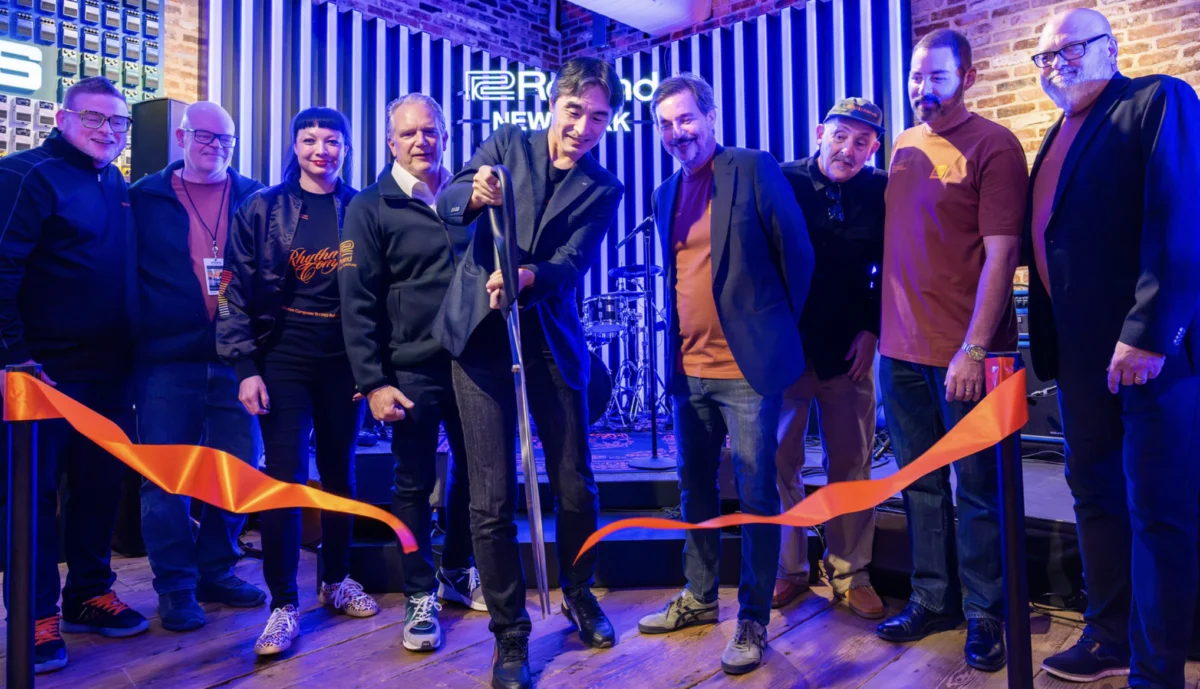
The landscape of professional music retail and community engagement in the United States underwent a significant transformation this week as Roland Corporation, the Japanese multinational manufacturer of electronic musical instruments, officially inaugurated its first standalone retail location in the United States. Situated at 414 West 14th Street in the heart of New York City’s vibrant Meatpacking District, the 9,000-square-foot facility represents a strategic shift in the company’s approach to customer experience, moving away from traditional wholesale models toward a direct-to-consumer, service-oriented retail strategy.

The grand opening event was an invitation-only gathering that brought together a cross-section of the music industry, including prominent artists, media representatives, and key stakeholders. The ceremony, presided over by Roland Corporation CEO and Representative Director Masahiro Minowa and Roland Americas CEO Manuele Barbini, served as both a ribbon-cutting and a high-profile showcase of the brand’s current technological trajectory. By integrating Roland, BOSS, and the recently acquired Drum Workshop (DW) under one roof, the company aims to create a singular, immersive hub for musicians of all disciplines.
A Strategic Pivot: From Manufacturing to Community Hub
The decision to establish a flagship location in New York City is rooted in a long-term assessment of regional market dynamics. While Roland has maintained a significant presence in the United States since 1978, its primary operational footprint has historically been tied to its West Coast headquarters. According to Masahiro Minowa, the East Coast represents a distinct cultural and musical ecosystem that requires a specialized approach to community building.

"Roland was founded in 1972, and as we look toward our 55th anniversary next year, we have analyzed how to best serve our global audience," Minowa noted during the event. "The East Coast and West Coast operate almost as two different countries in terms of their cultural influence and musical requirements. After seeing the success of our flagship locations in London and Tokyo, we identified a clear need to establish a dedicated communication hub for the East Coast music community."
This expansion reflects a broader industry trend where legacy hardware manufacturers are reclaiming control over the retail environment. By managing the showroom experience directly, Roland can bypass the constraints of traditional third-party retail, ensuring that customers receive consistent, high-level product education, personalized demonstrations, and a more curated interaction with their latest innovations.

Chronology of Innovation: The 10-Year Milestone
The store’s opening coincides with the 10th anniversary of two of the most influential product lines in the company’s history: the Roland Aerophone and the BOSS Katana amplifier series. Both lines were introduced during the 2016 "The Future. Redefined." global campaign, which sought to modernize the brand’s digital instrument offerings.
The evolution of these products over the last decade serves as a microcosm for the company’s broader innovation strategy. The Aerophone, for instance, bridged the gap between traditional wind instrumentation and digital sound synthesis, while the Katana series redefined expectations for affordable, high-fidelity modeling amplifiers. To commemorate this decade of development, the New York flagship is offering exclusive, limited-edition versions of these products. The Katana anniversary collection, which features a distinct high-gloss blue flame maple finish, is available for purchase exclusively at Roland’s flagship stores in New York, London, and Tokyo, underscoring the exclusivity of the new retail strategy.

Immersive Design and Technological Integration
The 9,000-square-foot space is architecturally designed to facilitate "spontaneous musical encounters." The store is divided into specialized zones, each catering to a specific demographic of the music-making community. These include:
- The Piano Show Loft: A dedicated space for Roland’s premium digital piano collection, featuring the debut of the new FP-40 Digital Piano equipped with built-in Wi-Fi, a significant step forward in connected instrument technology.
- The BOSS Cavern: An immersive environment specifically engineered for guitarists to explore the nuances of BOSS pedals and sound design.
- The Drum Workshop (DW) Suite: The only dedicated, comprehensive showroom for DW gear in the United States, providing drummers with an opportunity to interact with high-end acoustic and electronic percussion.
- The 808 Exhibit: A rotating historical exhibit that celebrates legacy products, beginning with the iconic TR-808 Rhythm Composer, a machine that fundamentally altered the course of global hip-hop and electronic music production.
Beyond the hardware, the facility emphasizes service. The store offers free 30-minute workshops, one-to-one product training, and "Vintage One-to-One" sessions. These services are designed to lower the barrier to entry for beginners while providing deep-dive technical support for professional producers and touring musicians.

Industry Impact and Artist Reception
The inaugural evening featured a series of performances that highlighted the versatility of the equipment. From the electronic precision of Detroit producer and DJ Recloose to the psych-rock stylings of Mdou Moctar and the jazz-inflected performance of saxophonist Hailey Niswanger, the store proved its ability to host a diverse array of musical styles.
Prince Paul, a legendary hip-hop producer and recipient of the 2026 Roland Lifetime Achievement Award, remarked on the importance of the space for the creative community. "Walking into the Roland New York City store reminds me of the nostalgic feeling and excitement of being in music shops back in the day," he stated. "It’s a rush for any musician or aspiring musician. This is going to be my new home for gear."

The sentiment was echoed by beatmaker Dibia$e, who emphasized the value of the space for the producer community. "It’s very important having spaces like this for the community, whether it’s for workshops or beat events like 404 Day," he said. The presence of such influential figures at the opening signals a clear intent: to position the store not just as a retail point, but as a central node in the city’s musical infrastructure.
Implications for the Future of Music Retail
The establishment of this flagship store has significant implications for the broader music technology sector. As the industry faces the dual pressure of digital globalization and the diminishing number of physical music stores, Roland’s move suggests that the physical "touch and feel" of an instrument remains an irreplaceable component of the artistic process.

"Musical instruments need that human touch," Minowa explained. "Because you are your own musician, your personality is reflected in the music you create. We want this store to be a place where you can develop your own experience with our products. We want to put as much of our technology as possible in front of as many musicians as possible."
By offering a direct line to the consumer, Roland is also gathering invaluable real-time data on how musicians interact with their products. This feedback loop is essential for a company that prides itself on iteration—much like the story of the TR-808, which was not initially considered a success but was later repurposed by the hip-hop community to define an entire genre. By fostering a space where musicians can experiment with unconventional setups—such as bass players utilizing guitar pedals or keyboardists exploring electronic percussion—the company is actively encouraging the next evolution of sound.

Looking Ahead
As the Roland Store New York City transitions from its grand opening to regular daily operations, the focus will shift to maintaining its role as a creative hub. With operating hours set from 11 A.M. to 7 P.M. daily, the location is poised to become a fixture in the Meatpacking District.
For the bass community, the company’s message is one of inclusion and expansion. By launching products like the GX-1 and GX-1B simultaneously, Roland is signaling that it is not treating the bass market as an afterthought. Instead, it is inviting bassists to challenge the traditional boundaries of their instrument through the use of technology that was previously seen as "guitar-only."

Ultimately, the opening of this flagship store represents a long-term investment in the concept of community-driven innovation. By providing a physical space for connection, education, and inspiration, Roland is attempting to future-proof its brand in an increasingly digital world, reinforcing the idea that while music may be produced on screens, it is fundamentally brought to life through physical engagement and human collaboration. As the store settles into its role within the New York music scene, the industry will be watching closely to see if this "communication hub" model can be successfully replicated in other global music capitals.